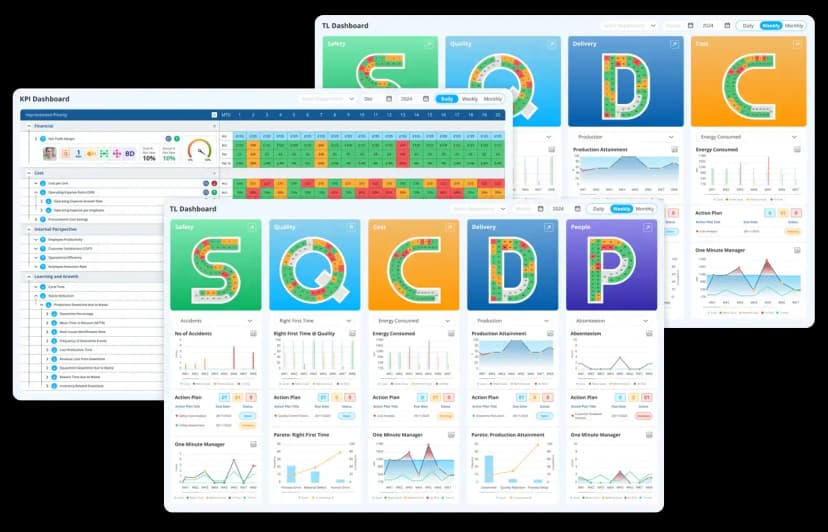
What Is a Gemba Meeting in Manufacturing and How to Run It Digitally?

Last updated on : January 30, 2026
A Gemba meeting is a short, time-boxed shop floor huddle where teams review SQDCP performance, surface abnormalities, assign owners and due dates, and escalate unresolved issues through Tier 1, Tier 2, and Tier 3 meetings. The most successful Gemba meetings follow a standard Gemba meeting agenda, use a Gemba board (often a Gemba huddle board or digital board) to make problems visible, and close actions within 24–72 hours.
Key takeaways
- Gemba meetings connect operators, managers, and leaders to align daily action with business goals (shop floor → strategy).
- Digital boards turn meetings into fact-driven decisions with real-time metrics and accountable actions.
- A tiered meeting system creates fast escalation and resolves issues without firefighting.
- Successful meetings are standardised, short, and driven by “normal vs abnormal” signals, not long discussions.
- SQDCP improves when actions are visible, owned, and verified - every day.
Why Gemba meetings matter in the digital era?
Manufacturing leaders are under pressure to improve shop floor management, reduce downtime, and keep teams aligned. A Gemba meeting, rooted in the principle Gemba walk which is the going to the “real place” where value is created - makes performance visible and accelerates problem solving.
But modern factories can’t rely only on whiteboards and paper charts. With digital tools like a Gemba board, Gemba huddle board, and shop floor dashboards, teams can shift from opinion-based updates to real-time, data-backed decisions - especially across shifts and sites.
What is a Gemba meeting?
A Gemba meeting is a short, structured daily discussion held on the shop floor where leaders and operators review KPIs, identify abnormalities, assign countermeasures, and ensure closure. It’s often run as a Gemba huddle meeting or shop floor daily meeting using visual boards.
In practice, a good Gemba meeting answers five questions:
- What changed since the last review?
- What’s abnormal (vs target/standard)?
- Why is it happening (likely causes)?
- What will we do before the next review (action plan)?
- Did our previous actions work (verification)?
Gemba meeting vs Gemba walk
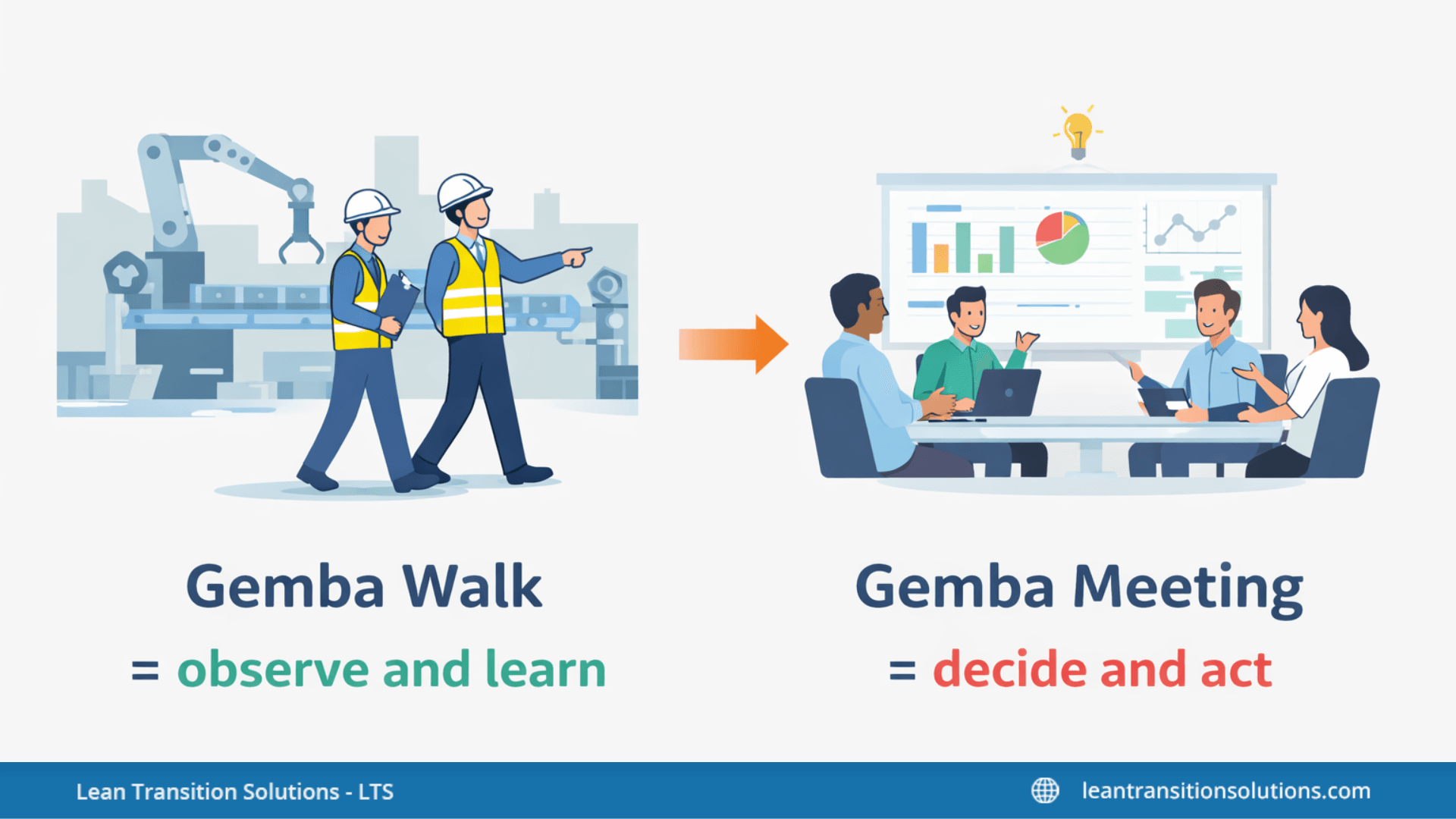
A Gemba walk is the act of going to the real place to observe work, ask questions, and learn.
A Gemba meeting is the structured daily cadence where the team reviews performance, agrees actions, and escalates issues using a board.
A simple rule:
- Gemba walk = observe and learn
- Gemba meeting = decide and act
Benefits: Why perform Gemba meetings
Gemba meetings create a daily operating rhythm that improves outcomes, not just reporting.
Benefits of a Gemba meeting
- Improve shop floor visibility and alignment to daily targets
- Identify bottlenecks early and prevent issues from escalating
- Build trust between shop floor teams and leadership through shared truth
- Reduce errors and improve quality using standardised work and visual signals
- Strengthen ownership, engagement, and accountability
- Improve Safety, Quality, Delivery, Cost, People performance via SQDCP meeting / SQDCP huddle structure
- Create faster escalation and resolution using an escalation board / tier board
How to prepare for Gemba meetings?
Preparation is what makes the meeting short. Without prep, the meeting becomes storytelling.
Before the daily Gemba meeting, ensure:
- A clear Gemba meeting agenda is visible to everyone
- The Gemba board (or Gemba huddle board) is updated before the meeting
- KPI definitions and targets are visible (what “normal” means)
- Roles are assigned (facilitator, timekeeper, note taker, escalation owner)
- Open actions from the previous meeting are ready for review
Read How to boost Gemba Walk efficiency to accelerate your Gemba meeting outputs from the beginning itself.
Gemba meeting template for 15-minute agenda
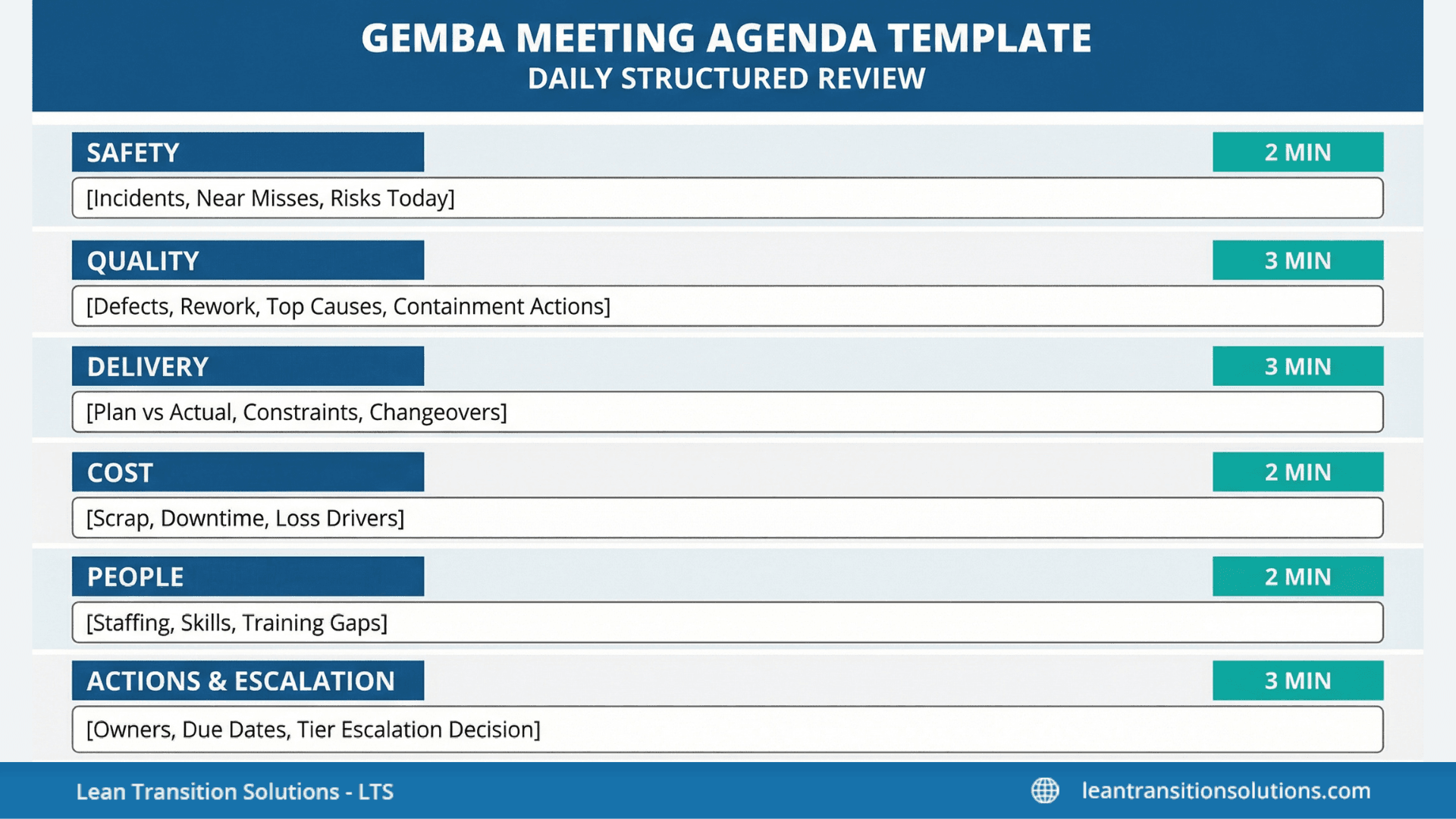
Use this Gemba meeting agenda to keep meetings short and consistent. This is also your reusable Gemba meeting template.
15-minute Gemba meeting agenda (template)
- Safety (2 min): incidents, near misses, risks today
- Quality (3 min): defects, rework, top causes, containment actions
- Delivery (3 min): plan vs actual, constraints, changeovers
- Cost (2 min): scrap, downtime, loss drivers
- People (2 min): staffing, skills, training gaps
- Actions & escalation (3 min): owners, due dates, tier escalation decision
This agenda format works whether you run a shop floor daily meeting, a Gemba huddle meeting, or a broader daily management meeting (lean) cadence.
How to conduct Gemba meetings: user guide (step-by-step)
Here’s how to run effective Gemba meetings consistently.
Start with previous action review (2–3 minutes)
- What was committed last time?
- What’s done?
- What is blocked and why?
This is essential for running a Gemba meeting that drives accountability instead of repeating the same problems.
Review “normal vs abnormal” performance (5–7 minutes)
Use the Gemba board to compare:
- Target vs actual
- Trend vs yesterday
- Standard vs current condition
Discuss top abnormalities only (3–5 minutes)
Pick the top issues that affect today’s plan.
- What happened?
- What is the likely cause?
- What’s the containment action for today?
Assign actions with owners and deadlines (2–3 minutes)
Each abnormality must produce:
- one owner
- one due date
- a clear verification method
Escalate unresolved issues (1–2 minutes)
If the team cannot close it within the defined time window, escalate it through the tiered meeting system (tier 1 tier 2 tier 3) using an escalation board / tier board.
Closing the loop: How Gemba meetings strengthen Tier 1, 2, 3 meetings
A Gemba meeting is typically the Tier 1 meeting in a tiered meeting system. It happens at the shop floor, often immediately after or during a Gemba walk, where teams review performance, identify abnormalities, and decide immediate actions.
When issues cannot be resolved at the Gemba meeting, they are escalated—not discussed again—into Tier 2 and Tier 3 meetings. Tier 2 focuses on cross-team coordination and root cause analysis, while Tier 3 addresses strategic or resource-intensive problems.
Here closing the loop means:
problems are seen at Gemba, acted on at Tier 1, escalated only when needed, and resolved at the right level—without repeating the same discussions.
Tier 1: Team huddle meetings (day-to-day actions)
Tier 1 is the frontline Gemba huddle meeting or SQDCP huddle or other metrics like SQDCM, SQDIP, SQDC etc. where teams:
- surface issues immediately
- track them on the Gemba huddle board
- assign actions that can be closed within a shift or 24 hours
Tier 2: Department manager meetings (escalation and coordination)
Tier 2 reviews consolidated issues that:
- need crossline coordination
- require resources (maintenance, engineering, QA)
- show repeated trends
Tier 2 should feel like problem-solving, not reporting. This is where the escalation board / tier board becomes the control system that prevents drift.
Tier 3: Executive leadership meetings (strategic alignment)
Tier 3 focuses on:
- recurring issues that require strategic decisions
- resource allocation
- cross-site standardisation
- policy or capability improvements
This is how a tiered meeting system (tier 1 tier 2 tier 3) closes the loop from shop floor reality to leadership decision-making. The Gemba meetings act as the base of all these.
How the Gemba tiers meetings connect the process flow
The strength of the tiered Gemba system is in the closed loop it creates:
- Tier 1: resolve within shift / 24 hours
- Tier 2: resolve within 48–72 hours
- Tier 3: strategic projects over weeks/months (with milestones)
This prevents “status meetings” and strengthens effective Gemba meetings.
Digital Gemba boards for meetings: why they work (and what to show)
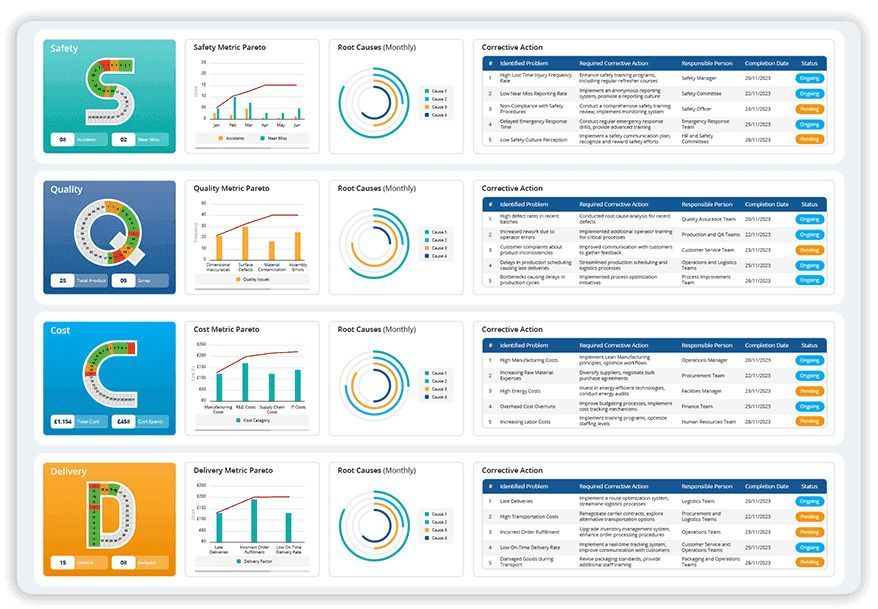
Traditional whiteboards can be inconsistent, hard to audit, and invisible across shifts or sites. Digital boards reduce these gaps by improving visibility, standardisation, and action tracking.
What to show on a digital Gemba board
Your Gemba board (or Gemba huddle board) should clearly show:
- SQDCP metrics or other shopfloor metrics like PQVC or PQDCM with targets and trends (SQDCP meeting / SQDCP huddle)
- Open actions with owner + due date + status
- Top abnormalities (today’s key constraints)
- Escalation path (Tier 1 → Tier 2 → Tier 3)
- Evidence where needed (photos/notes) to reduce debate
This keeps the daily Gemba meeting focused on decisions, not recollection.
Best practices for smarter Gemba meetings
These are the habits that separate “daily updates” from effective Gemba meetings:
- Keep it short: time-box to 10–15 minutes
- Use the same Gemba meeting agenda every day
- Standardise the board layout across shifts/lines
- Review only abnormalities (don’t read every metric)
- Always close actions visibly (owner + due date + verify)
- Use the tiered meeting system (tier 1 tier 2 tier 3) to escalate fast
- Make the shop floor daily meeting predictables - ame place, same time, same format
Common mistakes that make Gemba meetings fail and fixes
1. Reading metrics without decisions
Fix: review only abnormal metrics and require actions.
2. No definition of “normal”
Fix: show targets, standards, and thresholds on the Gemba board.
3. No owner or due date
Fix: every issue must create an action with accountability.
4. No escalation rules
Fix: use an escalation board / tier board and clear Tier SLAs.
5. Meetings run too long
Fix: follow a standard Gemba meeting agenda and time-box each section.
6. Same issues repeat daily
Fix: add verification steps and confirm countermeasures worked.
Gemba meeting checklist
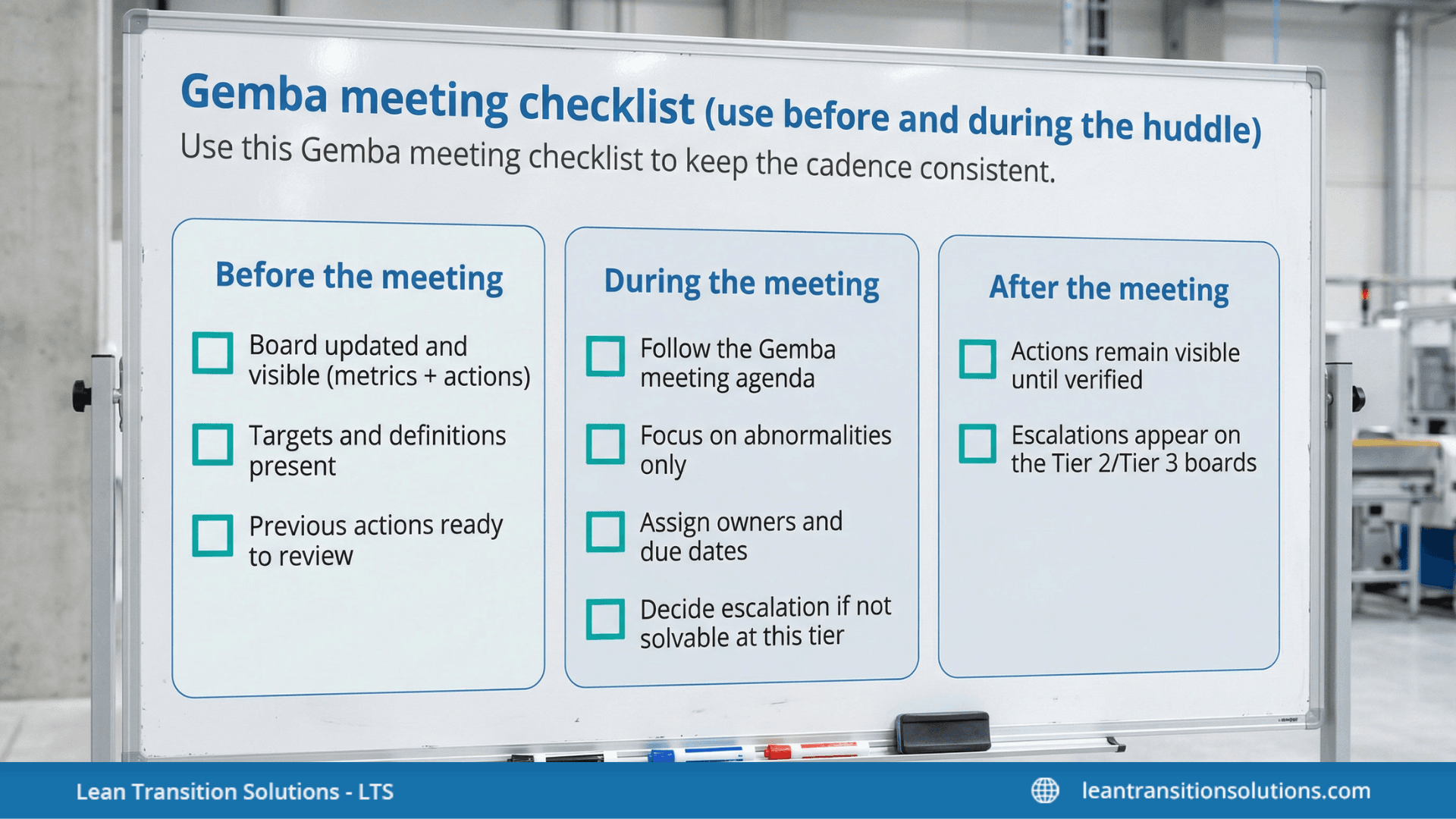
Use this Gemba meeting checklist to keep the cadence consistent.
Before the meeting:
- Board updated and visible (metrics + actions)
- Targets and definitions present
- Previous actions ready to review
During the meeting:
- Follow the Gemba meeting agenda
- Focus on abnormalities only
- Assign owners and due dates
- Decide escalation if not solvable at this tier
After the meeting:
- Actions remain visible until verified
- Escalations appear on the Tier 2/Tier 3 boards
This checklist improves running a gamba meeting across teams without “style drift.” While this can be used in the Gemba meeting, it is recommended to carry out an efficient Gemba walk before. For that, use the Gemba walk checklist before you moving to Gemba meetings.
LTS Data Point Meeting Gemba meeting tool with digital boards
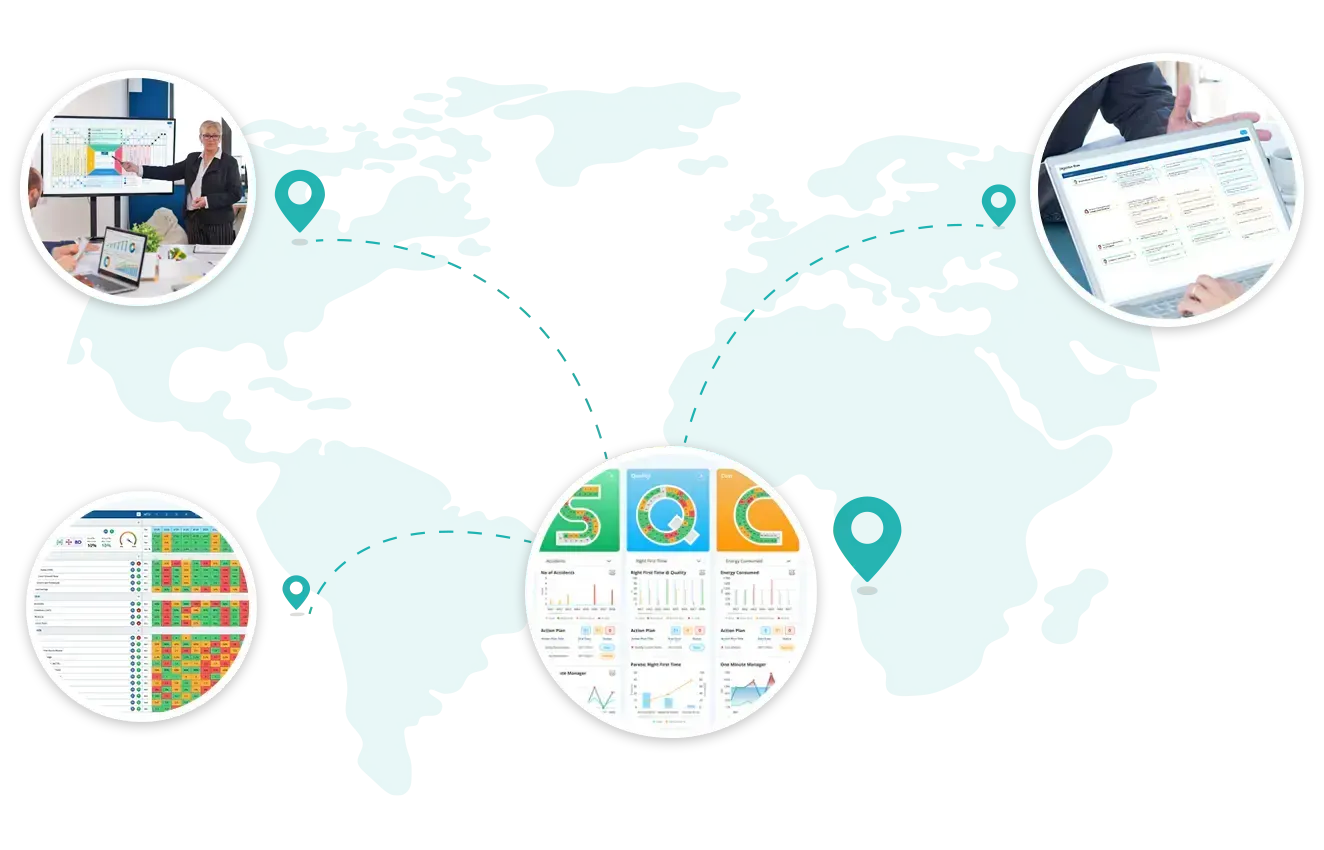
Data Point is a digital Gemba meeting and KPI board software designed to run a consistent daily Gemba meeting rhythm with SQDCP meeting / SQDCP huddle visibility and structured escalation through Tier 1, Tier 2, and Tier 3 meetings.
It’s typically used when teams need:
- standardised Gemba boards across shifts or sites
- real-time KPI visibility (not outdated updates)
- accountable action tracking with escalation
- consistent daily routines without manual rollups
In summary
A Gemba meeting works when it’s short, standardised, and action driven. Use a consistent Gemba meeting agenda, make “normal vs abnormal” visible on a Gemba board or Gemba huddle board, and close actions quickly through a tiered meeting system (tier 1 tier 2 tier 3). If you want effective Gemba meetings, focus on decisions, ownership, and verification, not reporting.
FAQs
1. What should we discuss in a Gemba meeting?
Focus on abnormalities in Safety, Quality, Delivery, Cost, and People (SQDCP), plus open actions. A Gemba meeting should produce owners, due dates, and escalation decisions—not long updates.
2. How long should a Gemba meeting be?
Most effective Gemba meetings are 10–15 minutes. Use a fixed Gemba meeting agenda and keep discussion limited to top abnormalities.
3. What is the difference between a Gemba walk and a Gemba meeting?
A Gemba walk is observing work at the real place. A Gemba meeting is the daily cadence where the team reviews performance, assigns actions, and escalates issues using a Gemba board.
4. What is a Tier 1 meeting in manufacturing?
Tier 1 is the frontline Gemba huddle meeting (often a SQDCP meeting / SQDCP huddle) where teams review daily performance, assign actions, and escalate issues they can’t solve quickly.
5. What is a Gemba board?
A Gemba board is a visual board used during Gemba meetings to show targets, actual performance, abnormalities, and actions. A Gemba huddle board is the version used for daily huddles and Tier 1 reviews.
6. How do I standardise Gemba meetings across shifts?
Use the same Gemba meeting template (agenda + board layout + action rules), define targets and escalation triggers, and keep actions visible until verified.