When Kaizen Isn't Enough: Why Manufacturers Choose Kaikaku
Last updated on : April 28, 2026
Continuous improvement is non-negotiable in modern manufacturing. But what happens when step-by-step gains stop moving the needle?
Kaikaku – the Japanese concept of radical, fundamental change – offers a different answer. Where Kaizen refines, Kaikaku rebuilds. For operations leaders facing a performance ceiling, a market disruption, or an ageing system no longer fixed by tweaks, Kaikaku is a deliberate strategic choice.
See how LTS Data Point gives your Kaikaku initiative the real-time performance visibility it needs to succeed – from planning through to sustained results
Kaikaku explained: What it is and why it exists
Kaikaku is a radical change – not a faster version of continuous improvement. The word translates from Japanese as “reform” or “radical change.”
In Lean manufacturing, it describes a large-scale, time-bound transformation that is willing to discard the current process entirely rather than refine it. A Kaikaku transformation might redesign an entire production line, replace a legacy workflow from the ground up, or overhaul how a plant manages quality, throughput, and scheduling simultaneously.
Kaikaku does not replace the continuous improvement process – it resets the baseline that continuous improvement then sustains. Most manufacturers understand Kaizen well. It is the engine of daily improvement – bottom-up, gradual, low-risk, and continuous. Compared to Kaizen, Kaikaku is different in every meaningful way:
- Kaizen improves the existing system by up to 20%, driven by teams, sustained daily
- Kaikaku replaces or redesigns the system, targeting 30-50% breakthrough gains, leading top-down within a defined project window
- Without Kaizen culture, Kaikaku gains erode. Without Kaikaku, Kaizen plateaus at the ceiling of a broken system
These two are partners, not rivals. For any leader, the question is knowing when one has reached its limit and the other must begin.
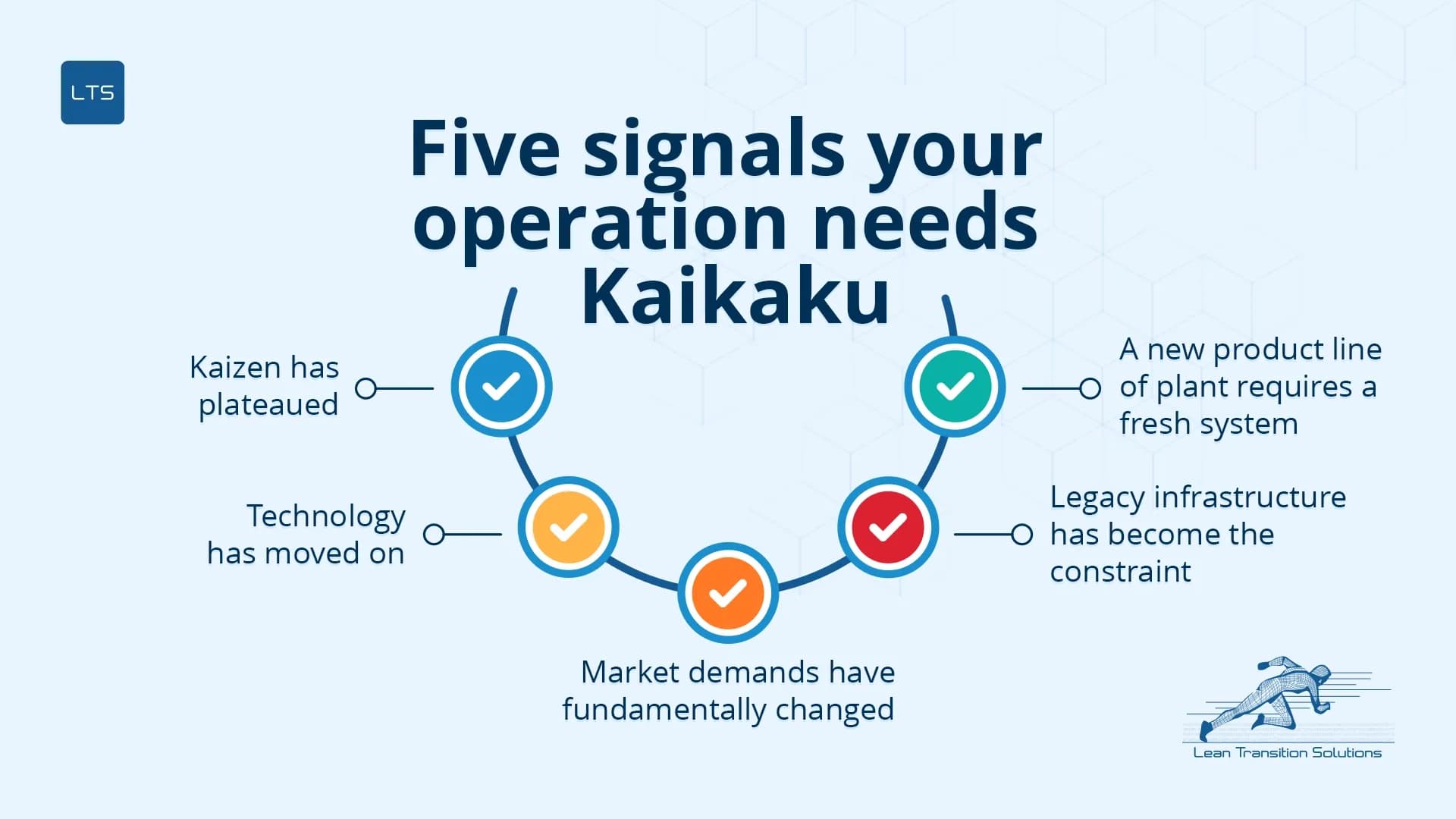
Five signals your operation needs Kaikaku
Most manufacturers wait too long to make the call. By the time performance has visibly stalled, the window for a managed transformation has already narrowed. Knowing when to move beyond manufacturing process improvement – and into a full system redesign – is one of the most consequential judgements an operations leader makes.
A Kaikaku manufacturing intervention is the right call when:
- Kaizen has plateaued: Improvement activity continues, but strategic metrics no longer move. The system’s limit has reached – refining it further will not close the gap.
- Technology has moved on: Automation, real-time data capture, or digital integration creates capability shifts that gradual adoption cannot realise. Competitors are scaling faster.
- Market demands have fundamentally changed: Customer requirements, regulatory standards, or supply chain realities have shifted to a degree the current operation was never designed to meet.
- Legacy infrastructure has become the constraint: Ageing equipment, spreadsheet-based planning, or manual workflows have accumulated to a point where patching costs more than rebuilding.
- A new product line of plant requires a fresh system: Adapting legacy operations to entirely new demands almost always underdeliver. Building from scratch is the smarter choice.
Most operations managers will already apply a range of process improvement techniques before a Kaikaku decision becomes necessary – Kaikaku is what comes next when those techniques have reached their limit.
Before making any decision, ask yourselves –
Are we improving the right system – or are we still making candles in a light bulb market?
What triggers a Kaikaku event
A Kaikaku event is a choice, not a crisis response. It is a structured, cross-functional improvement project with a defined scope and a compressed timeline – typically 60 to 180 days. What distinguishes it from reactive firefighting is simple – it is chosen deliberately, with a defined target, before the pressure forces the decision.
The five most common triggers in manufacturing are:
- Competitive pressure: A rival makes a transformative operational leap. Gradual catch-up is no longer enough.
- Digital transformation: Adopting Industry 4.0 tools, automated data capture, or real-time production dashboards requires radical process redesign to unlock their value. Technology without process change delivers little.
- Regulatory change: New compliance requirements demand process changes that gradual improvement cannot achieve within the required timeframe.
- Operational crisis: A supply chain failure, financial shock, or major equipment overhaul forces a fundamental redesign of how the operation functions.
- Strategic realignment: A leadership change, acquisition, or new industrial direction makes the current operation structurally misaligned with where the business is heading.
The trigger defines the scope. The target defines success. Both must be set before a single process is changed.
How to implement Kaikaku without losing control
Radical process redesign does not mean uncontrolled change.
The most successful Kaikaku implementations are disciplined, sequenced, and measured throughout. Lean expert Hiroyuki Hirano’s Kaikaku principles share a common thread – reject inherited assumptions, act on what works without waiting for a perfect plan and accept 50% implementation now over 100% later.
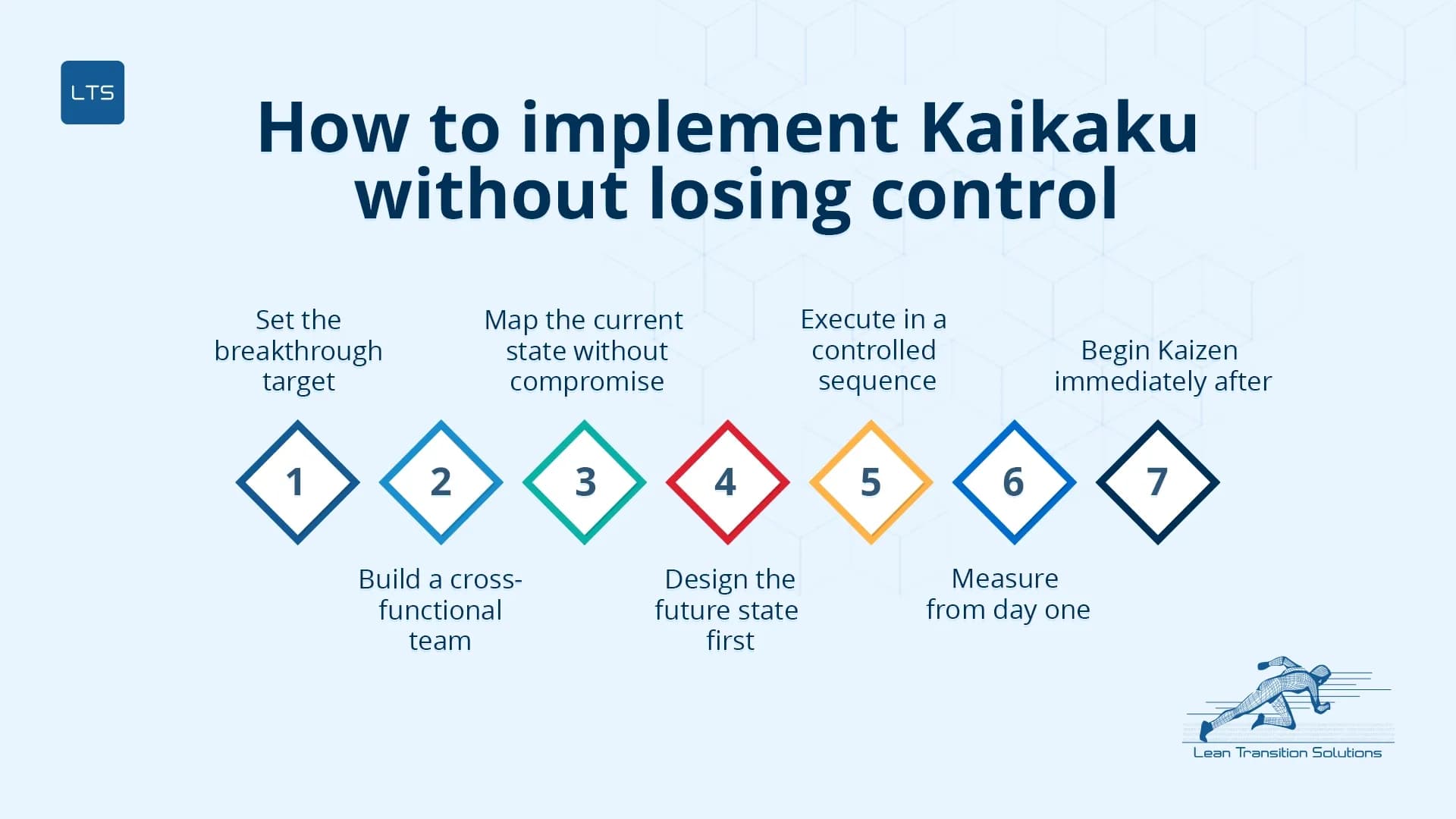
In practice, a structured Kaikaku implementation follows seven steps:
Set the breakthrough target
- Define a specific, measurable outcome – not a direction.
- Reduce lead time by 40% within 90 days.
- Cut OEE losses by half within a quarter.
Build a cross-functional team
- Include operations, engineering, IT, finance, and frontline staff.
- Top-down design without floor-level input fails consistently.
Map the current state without compromise
- Use value stream mapping to identify what will be replaced – not patched.
Design the future state first
- Build the new system on paper before anything changes on the floor.
Execute in a controlled sequence
- Phase the rollout where possible.
- Maintain production continuity while the new system comes online.
Measure from day one
- Track cycle time, takt time, first pass yield, and OEE in real time throughout – not just at project close.
- Each step mirrors the logic of PDCA – plan the new system, execute in a controlled window, check performance in real time, and act to sustain.
Begin Kaizen immediately after
- The moment Kaikaku delivers its target state, lean daily management must activate around the new baseline.
- Transition from kaikaku (radical shift) to kaizen (continuous, incremental improvement) helps to refine the gains.
Why most Kaikaku efforts fail – and how to avoid it
70% of large-scale transformations fail to achieve their goals. That figure is consistent across manufacturing research. For large-scale lean improvement initiatives specifically, the failure delivers are overwhelmingly human and structural – not technical.
The most common failure modes in Kaikaku manufacturing projects are:
- Employee resistance: Workers fear job insecurity and disruption to familiar routines. Without genuine floor-level engagement, teams resist the very change they are being asked to deliver.
- Leadership that launches but does not sustain: Executives sponsor the start and step away before the difficult middle phase. Kaikaku success factors depend on consistent leadership visibility – not just at the announcement stage.
- Boardroom design, shopfloor reality: Transformation conceived without frontline input misses the operational constraints that matter most. The people closest to the process must shape it.
- No mechanism to sustain gains: The project closes. The team scatters. Within six months, performance has drifted back toward old patterns. Without a daily management system tracking the new targets, regression is a near-certainty.
- Technology-first thinking: Implementing new software or equipment without addressing the behavioural and cultural shift required produces surface-level results at best. Kaikaku transformation is not an IT project – it is an operational and cultural shift.
When leadership steps back after the launch, the floor does not hold the new standard – it returns to the one it knows. The organisations that avoid this embed leader standard work into the daily routine from day one, making floor walks, performance reviews, and escalation disciplines a leadership habit rather than a project activity.
How LTS Data Point supports Kaikaku – Before, during, and after
Visibility is the infrastructure that Kaikaku runs on. Without real-time data before, during, and after the transformation, leaders were navigating blind.
LTS Data Point provides the performance management layer that gives Kaikaku initiatives the evidence, accountability, and sustaining structure they need at every stage.
Before the Kaikaku event
The case for radical change must be built on data – not instinct.
LTS Data Point manufacturing KPI dashboards surface exactly what leadership needs:
- Performance ceilings that Kaizen can no longer move
- Bottlenecks that are costing throughput across shifts and lines
- The measurable gap between current state and strategic targets
For senior leaders evaluating whether the scale of disruption is justified, this is where the data-led decision begins.
During implementation of Kaikaku event
Real-time KPI tracking in manufacturing keeps the transformation accountable.
Cycle time, takt time, OEE, and first pass yield update live – giving the project team an immediate signal on whether the new system is performing as designed.
LTS Data Point lean daily management tools maintain operational clarity across shifts and plants during what is inherently a volatile transition period. This includes:
- Huddle boards that structure daily team reviews around the metrics that matter
- Plan-vs-actual dashboards that make deviations visible the moment they occur
- Escalation workflows that ensure no issue falls between shifts unaddressed
After the Kaikaku event
LTS Data Point becomes the sustaining layer.
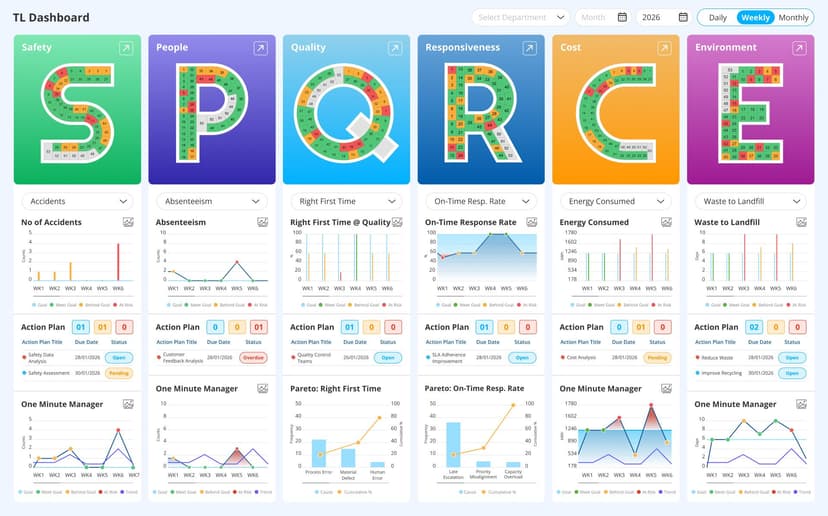
Tiered reviews, digital huddle boards, and SQDCP frameworks make performance visible every day – turning the new baseline into the new normal, not a temporary result that fades within a quarter.
Selecting the right continuous improvement metrics to track after a Kaikaku event is critical – the new baseline must be monitored against targets that reflect the transformed system, not the legacy one.
For teams managing task flow and work order visibility across the shopfloor, a digital TCard system integrates naturally into this daily management structure. It provides live tracking of task ownership, queue priority, and process adherence by line and shift.
A well-planned and properly sustained Kaikaku can deliver 30-50% performance gains. Without digital lean manufacturing infrastructure to track and hold those gains, most of that improvement will not survive the first year.
Kaikaku is not for every situation – but for manufacturers facing a performance ceiling, a strategic inflection point, or a system that Kaizen can no longer fix, it is the right tool. The decision to pursue radical lean transformation is a leadership choice – and the hardest part is admitting that what you have built cannot be saved by improving it. LTS Data Point gives that choice the data foundation it deserves – from the evidence that justifies the change, to the visibility that sustains it.
Your Kaikaku transformation needs real-time visibility from day one – talk to an LTS Data Point expert today
FAQs
1. Is Kaikaku the same as a Kaizen blitz?
No. A Kaizen blitz is a short, intensive improvement event – typically five days – targeting step-by-step gains within an existing system. Kaikaku redesigns or replaces the system itself, targeting 30-50% breakthrough improvements over a 60–180-day project window.
2. How long does a typical Kaikaku project take?
Most Kaikaku implementations run between 60 and 180 days depending on scope. The planning phase is often as long as the execution phase – rushing either stage is a leading cause of failure.
3. Can a manufacturer run Kaikaku and Kaizen simultaneously?
Yes, and they often should. Kaizen continues in areas not directly affected by the Kaikaku event. Once the transformation is complete, Kaizen becomes the primary mechanism for sustaining and building on what Kaikaku delivered.
4. What is the biggest risk of Kaikaku?
Failing to sustain the gains. Many transformations deliver their targets during the project window but regress within months once the team disperses and daily management reverts to old patterns. A lean daily management system built around the new baseline is essential from day one of the sustaining phase.
5. Do you need external consultants to run Kaikaku?
Not necessarily. Internal cross-functional teams can lead effective Kaikaku events when they have clear executive sponsorship, a structured methodology, and the right digital tools to track progress. External support is most valuable for organisations running their first major transformation.
6. How do you measure Kaikaku success?
Success is measured against the specific breakthrough target set at the outset – a 40% reduction in lead time, a 30% improvement in OEE. Short-term results should be confirmed by sustained performance tracking over 6-12 months, which is where a real-time KPI dashboard proves its long-term value.

Geandra Queiroz, Operations Management Consultant
Geandra is an Operations Management Consultant at Lean Transition Solutions, specialising in Lean philosophy, Lean Six Sigma, and strategic planning across manufacturing and healthcare. She is currently completing her PhD in Industrial Engineering at the Federal University of São Carlos, researching the integration of Operations Strategy, Lean, and Green Manufacturing.