Manufacturing Process Improvement: How Daily Execution Gaps Undermine Performance – and How to Close Them Systematically

Last updated on : January 29, 2026
Manufacturing process improvement often focuses on redesigning workflows, introducing new tools, or running improvement workshops. Yet performance still slips on the shopfloor – not because the process is flawed, but because daily execution doesn’t follow the intended design. Small deviations across shifts, teams, and decisions quietly erode throughput, quality, and delivery reliability. These execution gaps are rarely visible in traditional reports, making them difficult to address systematically.
What you’ll learn in this blog
- Why manufacturing process improvement often breaks down during daily execution
- Where real-world operations diverge from the designed manufacturing process
- How execution gaps accumulate across shifts and impact performance
- Why process improvement initiatives lose control after implementation
- How continuous improvement ideas for manufacturing can be sustained through daily execution
- How DMAIC and Lean Six Sigma can be applied to diagnose execution gaps
- Why visibility, cadence, and accountability are essential for consistent execution
- How planning, scheduling, and capacity gaps undermine improvement efforts
- How manufacturing process improvement can be scaled using operational visibility platforms like LTS Data Point
See how LTS Data Point supports manufacturing process improvement through daily execution visibility
Why manufacturing process improvement breaks down in daily execution
Even well-designed manufacturing process flows often fail in daily operations. On paper, process improvement initiatives look solid, but live production introduces variability that shows up in production metrics such as output, cycle time, and quality. Over time, this creates gaps between planned and actual operations, limiting the impact of factory process improvement efforts. Value stream mapping software is often used to visualise exactly where these gaps first appear, connecting the designed process flow to what is actually happening on the shop floor.
Where execution deviates from the designed manufacturing process
Small divergences from standard processes are common. In manufacturing process improvement examples, these deviations reduce consistency and efficiency.
- Operators adjust task sequences to maintain workflow.
- Supervisors reprioritise output over following the defined manufacturing process.
- Material or equipment constraints force local workarounds.
- Peak demand periods often lead to bypassing standard work.
- Informal adaptations go unrecorded, widening the gap between design and execution.
How Small Execution Deviations Compound Across Shifts
Minor deviations may seem harmless individually, but their cumulative effect across teams and shifts is significant.
- Changes on one shift can disrupt subsequent shifts.
- Workarounds can become informal “standards” if repeated.
- Delays or miscommunications during handovers reduce efficiency.
- Manufacturing process improvement examples show recurring errors often trace back to these small deviations
Why process improvement efforts lose control after handover
Many process improvement initiatives lose momentum once responsibility returns to daily operations. Execution discipline erodes when ownership is unclear.
- Improvements are inconsistently applied across shifts or teams.
- Temporary fixes gradually replace intended processes.
- Lack of accountability reduces adherence to factory process improvement standards.
- Performance issues are addressed reactively, not systematically.
Talk to an expert about closing execution gaps in manufacturing process improvement
From continuous improvement ideas to repeatable daily behaviour
Many continuous improvement ideas for manufacturing never translate into consistent daily action. Operators, supervisors, and teams may understand the concept, but without structured habits, improvement stops at intention. Bridging this gap is key for sustainable manufacturing improvement ideas.
Why continuous improvement ideas stall without daily ownership
Even strong concepts fail if no one is accountable for daily execution.
- Teams may treat improvement activities as optional or “extra” work.
- Improvements are often designed for ideal conditions, not live production variability.
- Continuous improvement methodologies like lean or Six Sigma are applied inconsistently.
- Lack of visibility reduces motivation to follow new procedures.
- Supervisors may prioritise output over enforcing adherence to lean process standards.
The gap between manufacturing improvement ideas and operator action
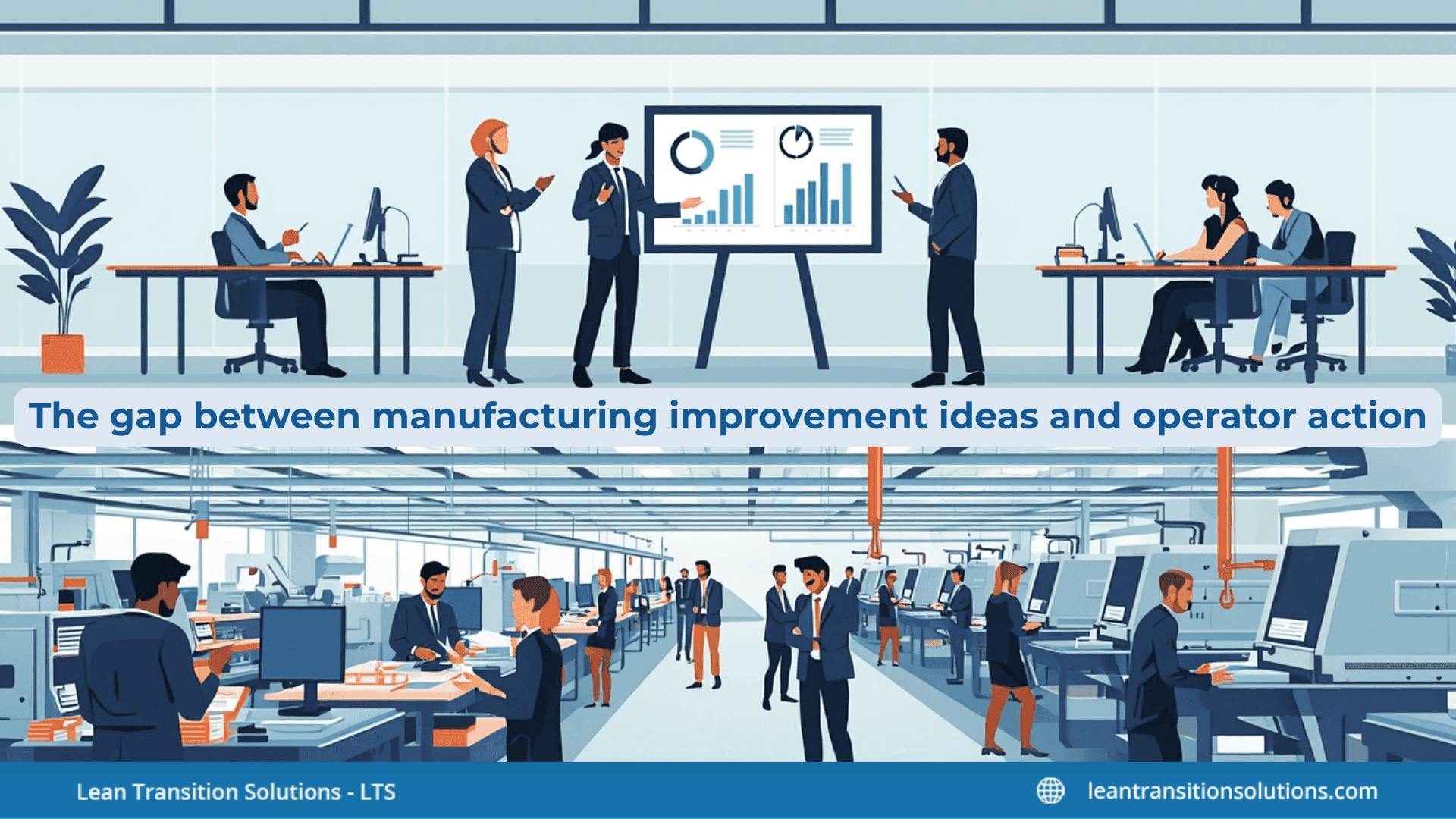
Practical application is where improvement success is determined.
- Operators adapt processes to handle immediate production pressures.
- New ideas may conflict with existing lean production routines.
- Training alone rarely ensures behaviour change.
- Improvement rules may be applied differently across teams or shifts.
- Execution data is often unavailable, making gaps invisible.
When lean process thinking becomes a one-time event
Occasional focus on improvement creates temporary gains that fade quickly.
- Lean initiatives often lose attention after workshops or pilot projects.
- Short-term results are celebrated, but daily reinforcement is missing.
- Teams revert to old habits without structured follow-up.
- Sustainable improvement requires linking manufacturing process changes to daily operational metrics.
Using manufacturing process improvement and DMAIC to diagnose execution gaps
Even strong manufacturing process improvement initiatives fail when execution variability is neglected. Methodologies like DMAIC can help pinpoint where processes break down and why improvements do not deliver expected outcomes.
Reframing DMAIC for execution variability in manufacturing process improvement
Applying DMAIC methodology in Six Sigma is often centred on defects, but in real-time operations, it can be adapted to address execution gaps.
- Define the real operational problem, not just the process defect.
- Calculate daily deviations from the intended manufacturing process.
- Assess patterns to spot systemic problems affecting throughput.
- Upgrade processes with practical steps for operators and supervisors.
- Control by embedding checks into daily routines to sustain improvements.
DMAIC examples in manufacturing process improvement
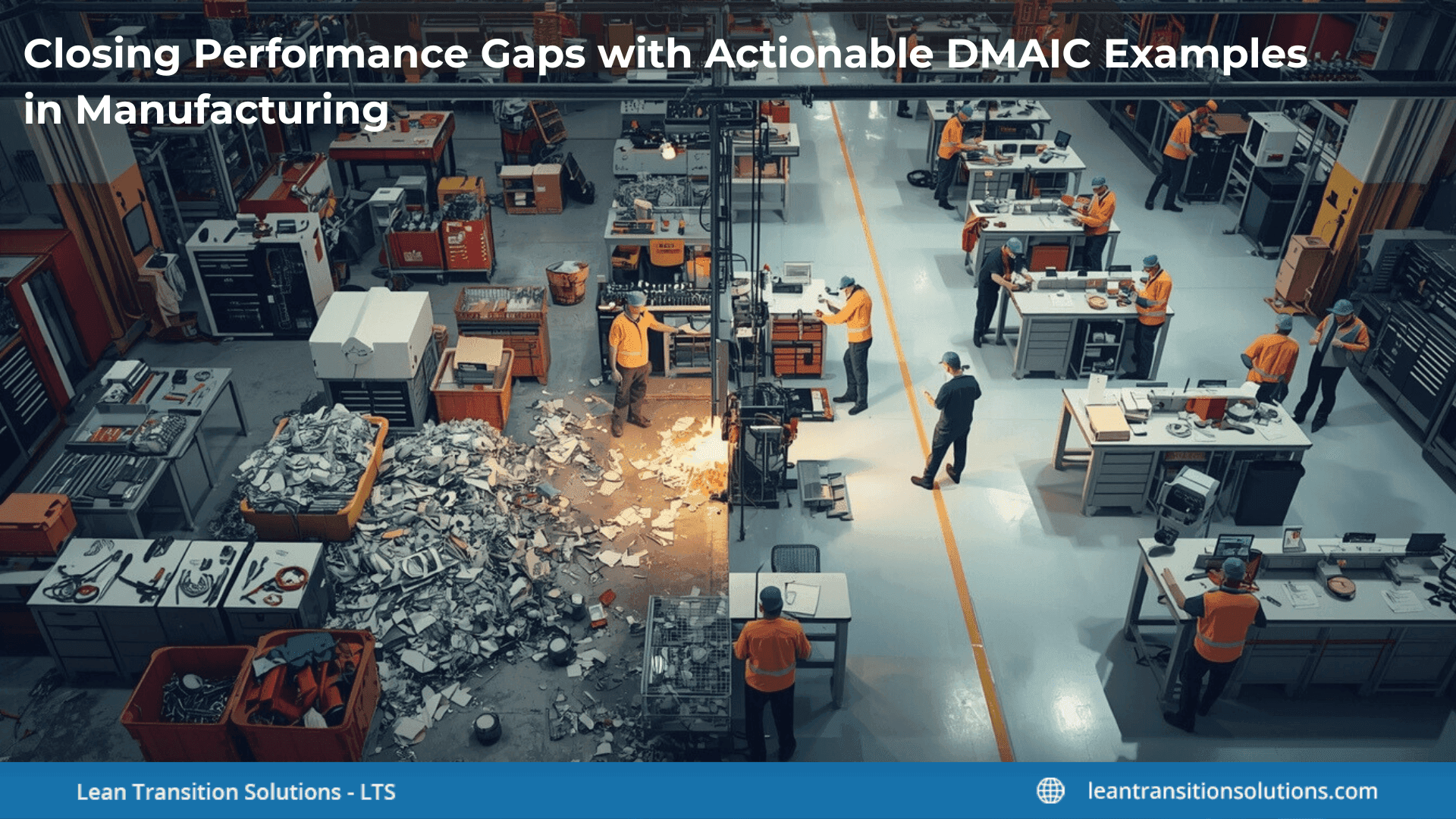
Actionable DMAIC examples in manufacturing show how execution-focused improvements close performance gaps.
- Minor deviations in takt time were measured and corrected across shifts.
- Operator decision delays were mapped and reduced using DMAIC in lean Six Sigma principles.
- Process adjustments were validated before full-scale rollout.
- Continuous feedback loops ensured manufacturing process improvement persisted after implementation.
- Key performance indicators (KPIs) were tracked in real time to prevent regression.
Why DMAIC in Lean Six Sigma fails without execution visibility
- Improvements are applied only theoretically, ignoring shopfloor realities.
- Lack of live monitoring hides deviations from the intended manufacturing process.
- Teams may misinterpret or selectively follow steps, weakening process improvement impact.
- Without daily accountability, small gaps compound into computable performance loss.
See how LTS Data Point brings visibility and accountability to manufacturing operations
Visibility, cadence, and accountability in manufacturing process improvement
The best manufacturing process improvement plans can fail if teams cannot see performance clearly, maintain execution rhythm, or are not accountable for results. Operational gaps often arise because visibility is limited, cadence is inconsistent, and ownership is unclear.
- Manufacturing process improvement demands live visibility into shopfloor activities.
- Without consistent operational cadence, improvements fade between shifts or teams.
- Accountability must be defined at the operator, supervisor, and team levels.
- Metrics that are tracked weekly or monthly fail to capture daily execution gaps.
- Lack of integrated manufacturing execution system reduces insight into deviations.
- Regular review meetings and clear escalation paths secure adherence to improved processes.
- Lean process thinking is ineffective without structured daily checks.
- Continuous feedback loops strengthen expected behaviours and prevent drift.
By focusing on visibility, cadence, and accountability, industries ensure that manufacturing process improvement is applied consistently and sustained across shifts, operators, and plants.
Explore how LTS Data Point connects process improvement to real shopfloor execution
Planning gaps that undermine manufacturing process improvement
Execution issues often stem from misaligned planning rather than poor process design. Manufacturing process improvement initiatives can stall when schedules, capacity, and resources are not coordinated with daily operational realities.
- Manufacturing planning assumptions frequently differ from actual production constraints.
- Misalignment between planned schedules and shopfloor realities creates delays.
- Lack of integration with manufacturing planning software or manufacturing scheduling software reduces responsiveness.
- Production planners may not have live visibility of deviations, impacting throughput.
- Capacity planning gaps affect both short-term output and long-term strategic goals.
- Inconsistent handoffs between teams and shifts amplify planning errors.
- Failure to update manufacturing planning systems with current execution data erodes improvements.
- Delays in decision-making reduce the impact of previously implemented manufacturing process improvement measures.
Addressing planning gaps makes sure that improvements are not just designed but executed consistently, reinforcing daily operational discipline and process adherence.
Manufacturing process improvement at scale with LTS Data Point
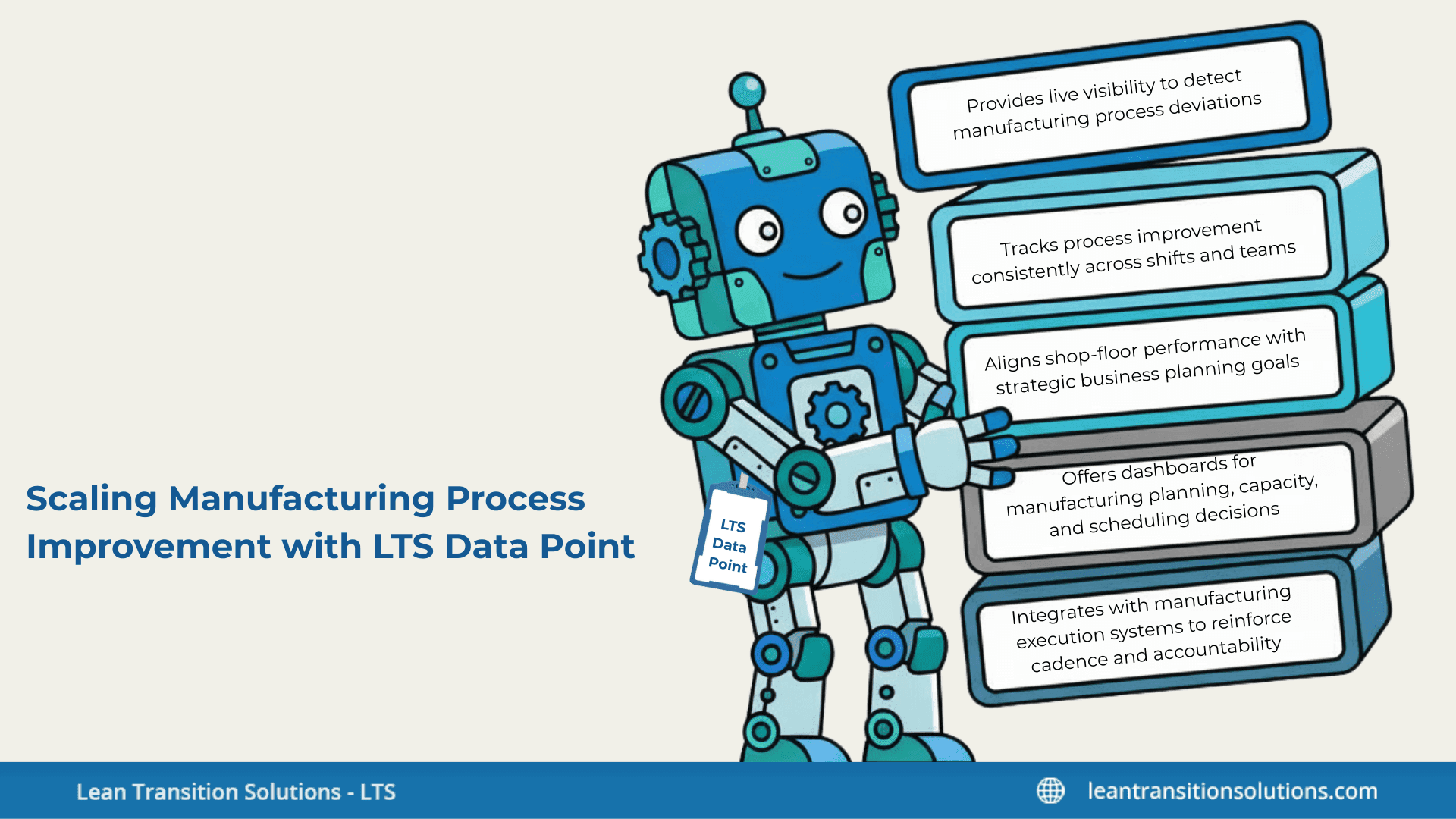
Scaling manufacturing process improvement across plants and shifts requires visibility, alignment, and live insights. LTS Data Point provides a practical way to bridge the gap between designed processes and daily execution.
- Offers live operational visibility to detect deviations in the manufacturing process.
- Allows consistent process improvement tracking across shifts and teams.
- Supports integration with manufacturing execution systems, developing cadence and accountability.
- Gives practical dashboards to support manufacturing planning, capacity planning, and scheduling decisions.
- Helps maintain alignment with strategic business planning by linking shopfloor performance to enterprise goals.
By embedding operational insights directly into daily workflows, LTS Data Point ensures that improvement initiatives are not only designed but executed reliably, allowing quantifiable and sustained performance gains.
For more clarification on which KPI tool to use to improve your manufacturing process, check out our latest blog: Which Manufacturing KPI Tool Is Best? Full Comparison Inside
Closing the gap between design and execution is critical for successful manufacturing process improvement. Execution variability, small daily deviations, planning misalignments, and lack of visibility can all undermine even the best initiatives. By focusing on structured execution, real-time monitoring, accountability, and data-driven planning, manufacturers can translate continuous improvement ideas for manufacturing into tangible results. Leveraging platforms like LTS Data Point ensures that improvements are sustained, measurable, and connected to broader business strategy planning, production capacity planning, and operational goals.
Get guidance on aligning manufacturing planning and execution using operational data
FAQs
1. What is manufacturing process improvement in daily operations?
Manufacturing process improvement focuses on reducing inefficiencies and execution gaps in daily production, not just redesigning workflows or processes.
2. Why do manufacturing process improvement initiatives fail after implementation?
Most initiatives fail due to lack of execution visibility, inconsistent adherence across shifts, and unclear ownership once improvements move into live operations.
3. How are execution gaps different from process defects in manufacturing?
Execution gaps occur when the designed process is not followed consistently, while process defects relate to flaws in the process design itself.
4. Can continuous improvement ideas work without lean or Six Sigma tools?
Yes. Continuous improvement ideas can succeed without formal tools if execution discipline, visibility, and accountability are maintained daily.
5. How does DMAIC help in manufacturing process improvement?
DMAIC helps diagnose where execution breaks down by defining problems, measuring deviations, analysing patterns, improving workflows, and controlling outcomes.
6. What role do shift handovers play in manufacturing performance?
Poor shift handovers often cause loss of context, delayed decisions, and inconsistent execution, leading to cumulative performance issues.
7. Why is planning alignment critical for manufacturing process improvement?
Misalignment between manufacturing planning and actual production conditions undermines scheduling accuracy and execution consistency.
8. How does visibility impact factory process improvement efforts?
Without real-time visibility, execution deviations go unnoticed, making it difficult to sustain factory process improvement initiatives.
9. What tools support sustained manufacturing process improvement at scale?
Operational visibility and performance platforms help monitor execution, reinforce accountability, and align daily operations with improvement goals.

Abel Jiménez, Lean Consultant
Abel is a Lean Consultant with over 30 years of expertise in operational analysis, process improvement, and organisational change across Mexican industries. Currently serving as Director of Insurance Promotions at CESCEMEX, he helps organisations leverage technology and lean practices to improve efficiency and manage change with continuity.