3C vs 4C: Which Problem-Solving Format Actually Fits Your Shopfloor Escalation?
Last updated on : August 18, 2026
The mistake most people do is choose one problem-solving technique for their entire industry to solve their entire problem. But is that enough?
Every problem in an organisation requires that specific problem-solving technique, be it Six Sigma, 8D, or any other. The difficulty is in deciding which fits where, when and how. Most organisations never reach this place. Why? They don't choose a problem-solving format; they inherit whatever the last consultant left behind.
Same is the case of workflows. 3C vs 4C: is one better than the other? Not really. It depends on what problem should be solved.
See how LTS Data Point handles 3C and 4C on the same board.
What problem are 3C and 4C actually trying to solve?
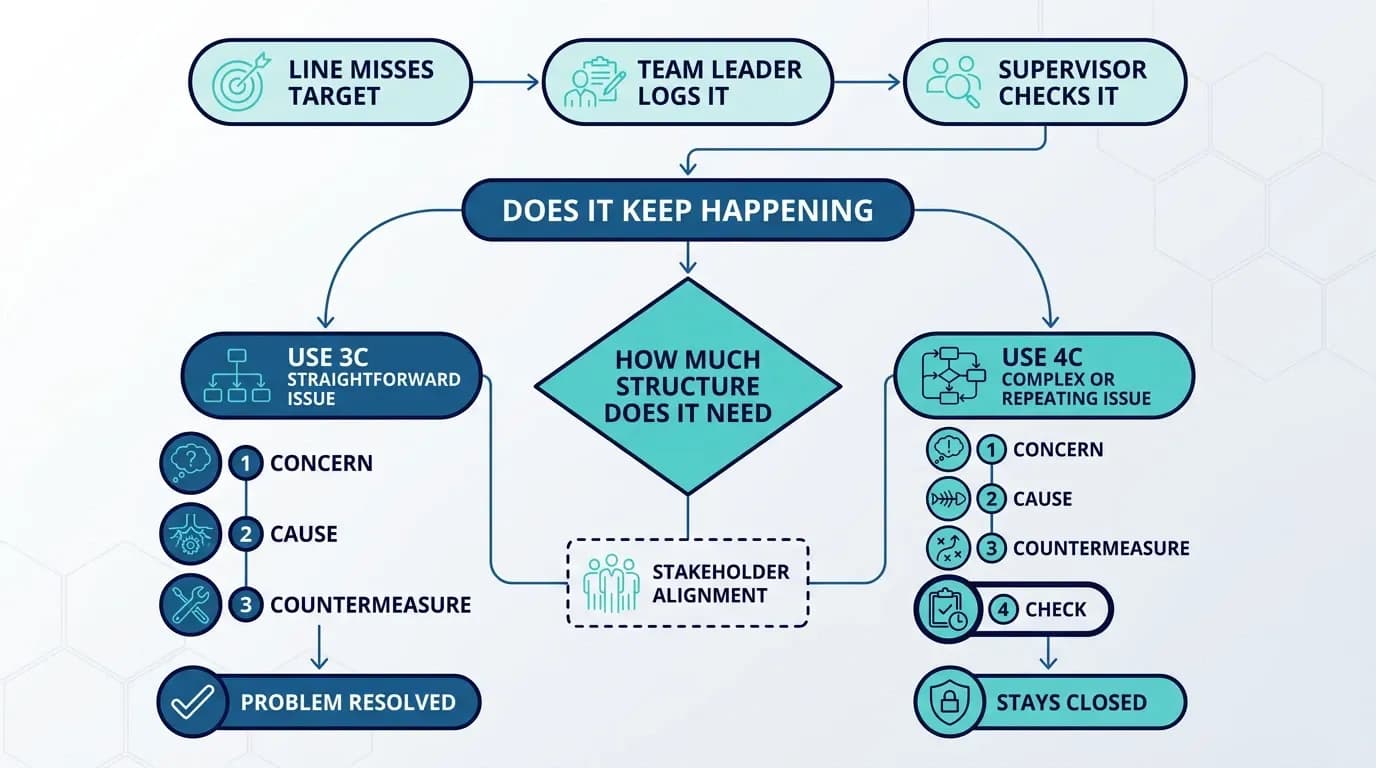
A fix without a format is a guess dressed up as a decision. On the shopfloor, the trigger is rarely subtle, a line falls short of its hourly target, the team leader logs the miss, and the supervisor checks it before the hour is out. No one drafts a report. But the moment repeats itself enough times, and a team reaches for structure instead of improvising their way through it again.
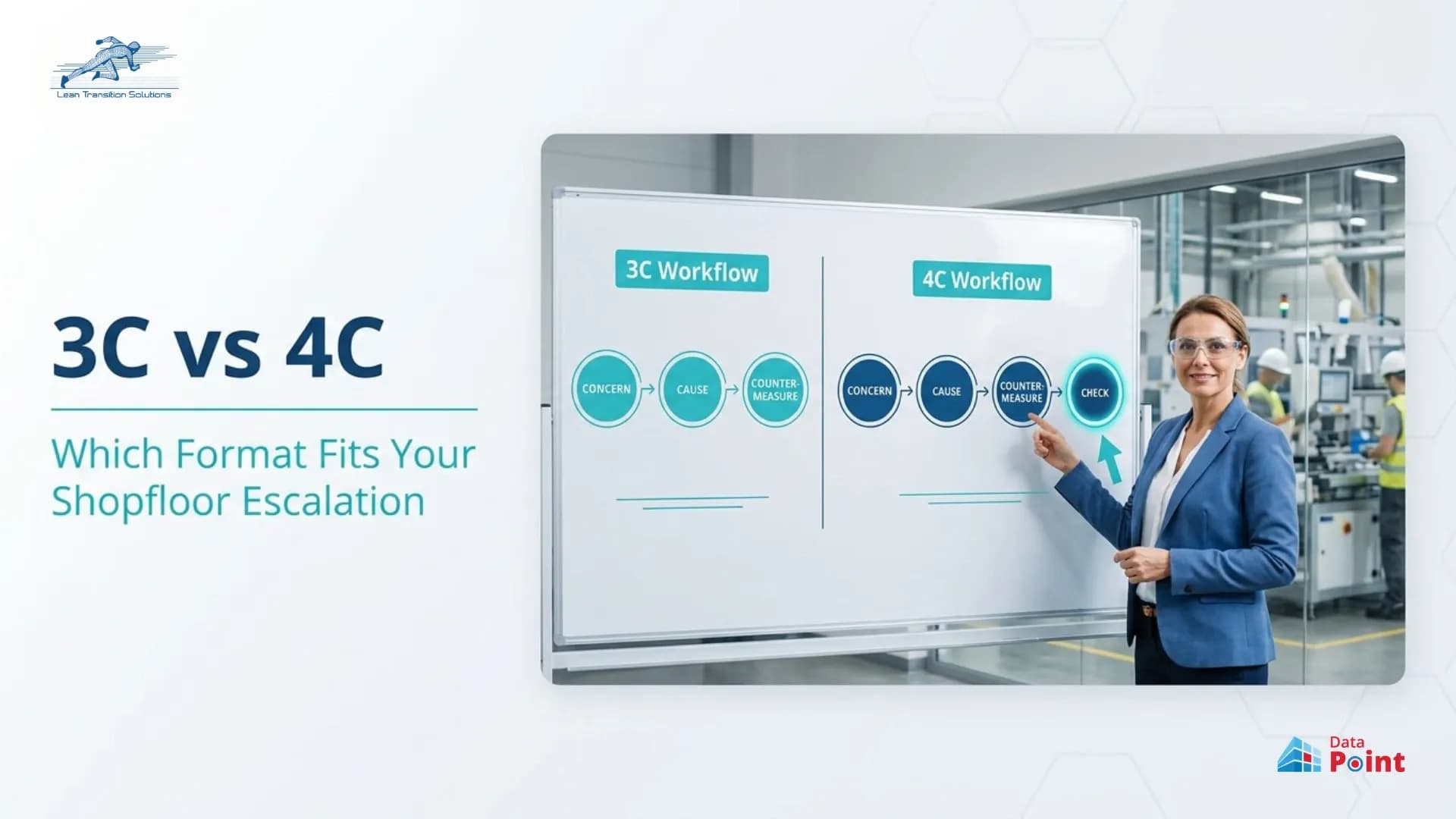
So why bother with a format at all? Because 3C and 4C were never built as rivals fighting over the same ground. Both sit inside the same problem-solving lineage – one grew out of the other, refining a single step rather than reinventing the whole approach. 4C simply sharpens the plan step further than 3C does, adding a layer 3C leaves out. Neither exists to replace judgement or slow a team down with paperwork. Both exist for the same quiet purpose: catching drift before it compounds into something the shift can't recover from.
The difference isn't whether to structure the fix. It's how much structure the problem actually needs and that's the question every team ends up answering, whether they mean to or not.
3C Breakdown: Concern, Cause, Countermeasure
3C runs on three moves, and none of them ask for more than a team already knows.
- Concern: state the deviation plainly, no assumptions, no solution baked in yet
- Cause: a quick, shared read on what’s driving it, often a fast 5 Whys at the huddle
- Countermeasure: a named owner, a due date, a fix that gets the line back to standard
This is deliberately light by design. Manufacturers across aerospace and heavy industry use 3C precisely because most problems don't need an investigation. They need someone to name what's wrong, agree on why, and fix it before the next shift starts. The heavier problem-solving methods get saved for the ones that actually demand them.
But three steps mean the format stops the moment the fix goes in. Nobody circles back to check it held. That gap isn't theoretical. Across regulated manufacturing, inadequate verification of corrective actions showed up in more than 60% of FDA enforcement actions against drug manufacturers in 2024; not because teams picked the wrong fix, but because nobody confirmed the fix actually worked. The countermeasure went in, the line moved on, and the same problem came back weeks later wearing a different shift's name.
3C is built for speed. It was never built to prove the speed worked.
4C Breakdown: Concern, Cause, Countermeasure, Confirmed
4C keeps the same first three moves and adds one more that changes what the format can prove.
- Concern: same starting point as 3C, the deviation stated plainly
- Cause: same quick, shared read on what’s driving it
- Countermeasure: same named owner, same due date, same fix
- Confirmed: the fix gets checked against the problem after the fact, not assumed to have worked
That fourth step is the whole difference. Concern, Cause, and Countermeasure ask a team to act. Confirmed asks them to prove the action held. Done properly, that step leaves a record: every 4C action is assigned, tracked, escalated if it stalls, and closed with a documented outcome, not just a countermeasure that quietly disappeared off the board.
That fourth step is the heart of 4C problem solving, and it’s what 3C becomes once someone insists on proof.
3C vs 4C: Where they actually differ
So, what does the choice actually cost, in case you get it wrong?
Take a line that keeps missing its hourly target because of a recurring fixture jam. A team picks 3C, logs a quick countermeasure, and moves on. The jam stops for two weeks, then comes back on a different shift. Nobody has a record of what was tried the first time, so the new shift starts from zero, guessing again. Now flip it: a five-minute changeover delay, obvious cause, obvious fix, gets run through a full 4C card with escalation and sign-off. The paperwork outlasts the problem by three days.
This isn't a preference. It's a spectrum by complexity and risk, and picking the wrong end of it either loses the record or wastes the time. 3C works until a problem persists or grows past what a team alone can absorb, at which point the format itself becomes the thing slowing you down.
Speed and traceability aren't opposites. They're just built for different failure states.
How manufacturers decide between 3C and 4C in practice
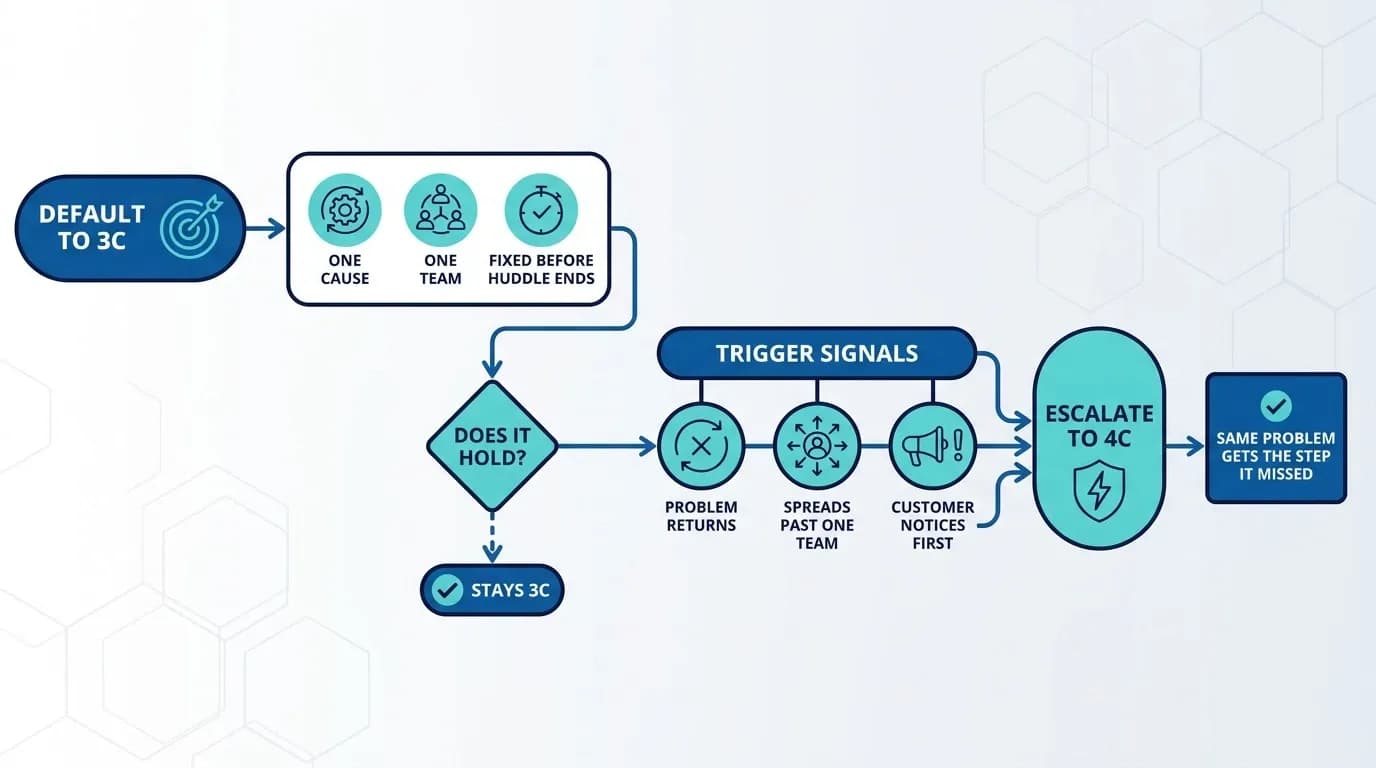
Nobody decides this once. A team picks 3C by default because most of what shows up on a shift is exactly what 3C was built for: an obvious cause, one team, fixable before the huddle ends. That's not a lesser choice. It's the right one, most days.
The switch to 4C isn't scheduled, it's triggered. A problem comes back after it was supposedly fixed. It spreads past the one team that owns it. A customer notices before the plant does. None of those are complexity for its own sake, they're signals that a countermeasure alone won't hold, and something needs to survive being checked later.
Some issues start as one and become the other. A fixture jam that looked like a five-minute 3C fix, then reappeared three shifts later, isn't a different problem. It's the same one asking for a step it didn't get the first time.
LTS Data Point: Built for both formats, not just one
LTS Data Point skips the choice between formats entirely.
- 3C, when that’s what the problem needs: logged, owned, closed inside a shift
- 4C, when it needs to survive being checked later: the same card, one more step, with a record that doesn’t disappear when the shift changes
- Escalation between the two: tracked on the same board, not rebuilt from scratch
A 3C entry that comes back later doesn't start over. It escalates on the same record, with the original countermeasure still attached, so whoever picks it up next isn't guessing at what was already tried or why it didn't hold.
There's a further shift underway in how much of that work gets done for the team rather than by them. AI root cause analysis surfacing the likely cause faster and flagging whether a countermeasure actually held instead of waiting for the problem to resurface, points toward less manual chasing on either format. Not a third format. Less overhead on the two that already exist.
The judgement call still belongs to the team. What changes is whether that call gets lost the moment someone reaches for the wrong card.
Neither format wins. 3C moves fast on problems that don't need more. 4C survives the ones that do. Most teams already know which is which. The harder past has always been keeping the record once the fix goes in. Get that right, and the format stops being the decision that matters most.
Not sure which format fits your shopfloor yet?
FAQs
1. Is 3C the same as PDCA?
No. PDCA (Plan-Do-Check-Act) is a broader improvement cycle, while 3C is a lightweight problem-solving format often used inside a PDCA-driven daily management routine. 3C is deliberately narrower in scope.
2. Can 3C or 4C be used for safety incidents?
Both can, but safety issues typically warrant the traceability. 4C provides, given the audit and accountability expectations that come with incident reporting.
3. Who should own a 3C or 4C entry – the operator or the supervisor?
Ownership sits with whoever is closest to the fix, usually the operator or team leader for 3C, and often escalates to a supervisor or manager once a problem moves into 4C.
4. Does 3C or 4C replace root cause analysis tools like fishbone diagrams?
No. Both formats use a lightweight cause step, but they don't replace deeper root cause tools when a problem's cause genuinely isn't obvious.
5. How long should a team wait before escalating from 3C to 4C?
There's no fixed timeframe. The signal is recurrence or spread, not elapsed time; a problem that returns even once is usually the trigger, regardless of how quickly that happens.
6. Can 3C and 4C be used outside manufacturing?
Yes. Both originated in lean manufacturing but apply anywhere a team needs a quick, structured way to log and act on a recurring issue, including healthcare, logistics, and service operations.