Enterprise Management System: Why Manufacturers Are Replacing Legacy Platforms with Real-Time Execution Systems
Last updated on : September 17, 2026
In today's digital era, most manufacturers have more digital tools up their sleeve, but those tools do not necessarily operate as one enterprise system. They can invest in an enterprise management system and still run critical daily work through Excel spreadsheets or manual cards. This clearly reveals the real limitation of several enterprise systems and the enterprise management software: they may connect central business processes without creating a live view of shopfloor execution. The answer is not necessarily another full-system replacement, but an integrated layer connecting ERP, machine, KPI and sales data across the business.
See how LTS Data Point connects ERP, machine and KPI data without replacing the systems you already use.
What "Enterprise" was supposed to mean and where the definition broke
An enterprise management system is meant to give the whole organisation one shared view of its resources, performance, and operations. Many traditional systems never got there. They achieved enterprise-wide transaction management. They stopped short of shopfloor visibility.
- One transactional backbone: ERP brought inventory, procurement, orders, finance, and workforce information into a common architecture.
- A boundary at the shopfloor: Inventory management sat inside ERP. Plant-floor activity control sat outside it, in separate execution systems.
- Operational data stayed fragmented: Machine conditions, live KPIs, shift-level activity – moving between specialist platforms, spreadsheets, and manual processes to reach anyone at all.
- A delayed enterprise view: The organisation could share processed business records without ever seeing production as it happened.
ERP grew from material and manufacturing resource planning before expanding into finance, HR, and procurement. That made it a powerful enterprise resource management backbone for planning and recording transactions. It did not automatically connect every source of operational data. Those are not the same achievement.
One automotive manufacturer's digitalisation assessment found no real-time production insight. KPI tracking stayed manual. Production figures needed constant correction just to reconcile shopfloor data with ERP records.
The definition of enterprise broke right there – between centralised records and daily execution. Why does enterprise-wide so rarely mean real-time?
Why "Enterprise-wide" rarely means real-time
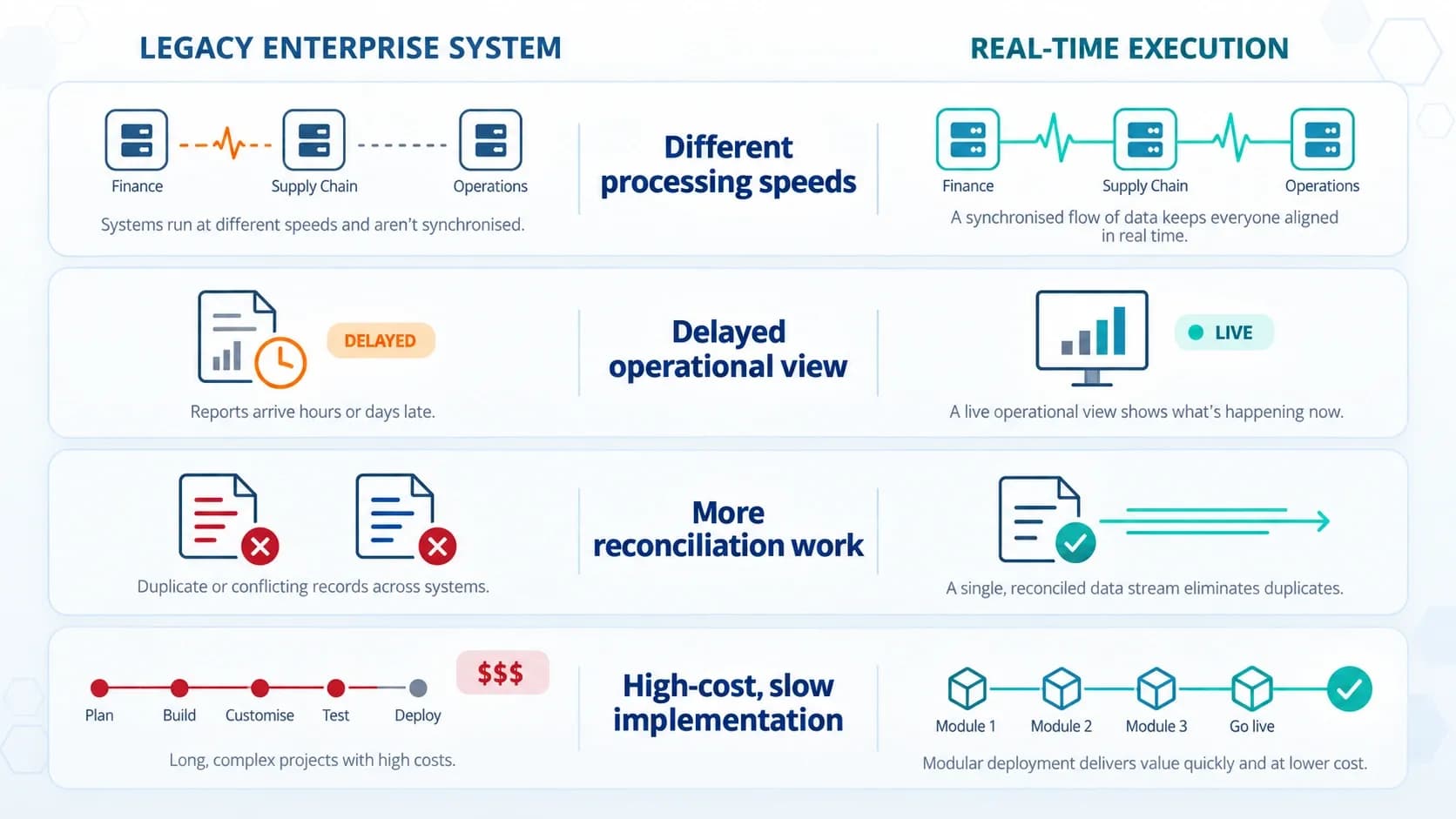
An enterprise management system can consolidate information across the organisation without reflecting what's happening on the shopfloor right now. Machine data updates every few seconds. Many legacy enterprise systems don't. They run on scheduled syncs, batch processing, fixed reporting periods.
- Different processing speeds: Machines generate production data continuously ERP platforms often receive it only at the next scheduled update.
- Delayed operational view: Reports show the last completed data cycle. Not current shift conditions.
- More reconciliation work: Connecting separate operational systems to ERP creates mismatched quantities, duplicate records, inconsistent batch information.
- High-cost, slow implementation: Large installation costs and long-term contracts delay value. Operational needs don’t wait for them.
One manufacturer's ERP and operational tracking system stayed out of sync for three months. Delivery-quantity mismatches. Unadjusted batch numbers. Duplicate entries creating phantom stock. The result: a monthly stock-value discrepancy of roughly £140,000. Not one trusted enterprise view – more manual investigation, more correction, more time spent proving the numbers wrong before anyone could act on them.
When information arrives late, or can't be reconciled, leaders stop trusting the figures they're meant to manage the business by. Enterprise-wide coverage was never the hard part. Real-time was. A system built for the shopfloor has to connect ERP, machine data, and KPIs in one live layer – not three systems reporting three different versions of today.
The real cost of running manufacturing operations on delayed data
Late data doesn't just delay a report. It closes the window to act.
One deployment found limited shift-level planning, delayed manual updates, and not detailed hourly breakdown in the existing ERP system. Problems stayed hidden within the shift itself. By the time performance reached a scheduled report, the output lost during that shift was already gone – nothing recovers it after the fact.
Here's what looks like inside a business. One organisation built three escalation tiers, structured feedback loops, and incentives weighted toward data accuracy and responsiveness. Not to fix the source of the problem. To stop it staying buried at shift level, then dragging into the next team, the next tier, the next report – a workaround built because the data itself couldn't move fast enough.
An enterprise management system that only explains yesterday can't support timely intervention. Escalation structures manage the damage. They don't touch the source. Live, connected data does.
Built to sit alongside what you already run, not replace it
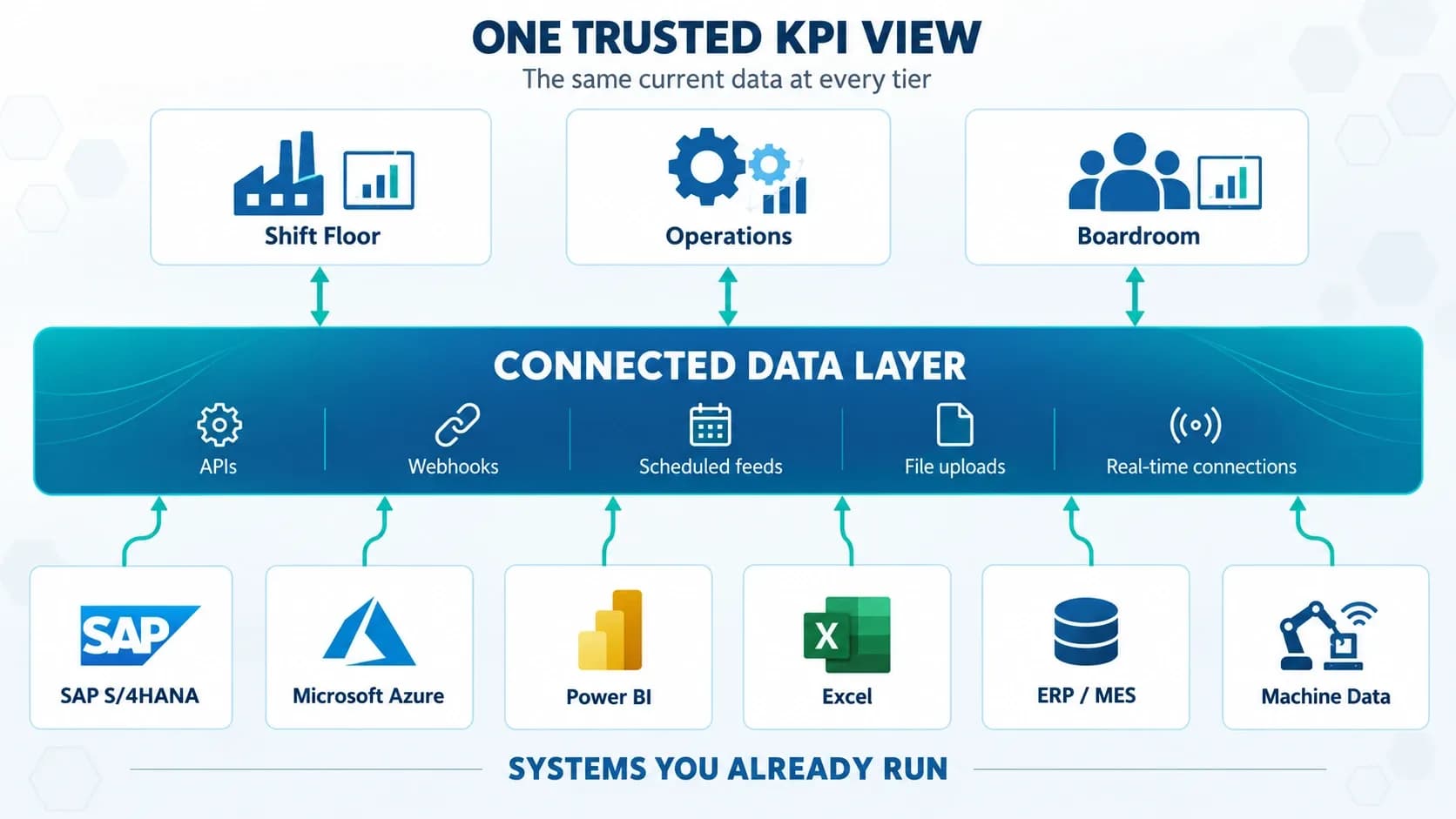
A modern enterprise management system connects the technology a manufacturer already depends on. Live visibility comes from moving data reliability between operational and business systems. Not from replacing every ERP, MES, spreadsheet, or machine connection that's already working.
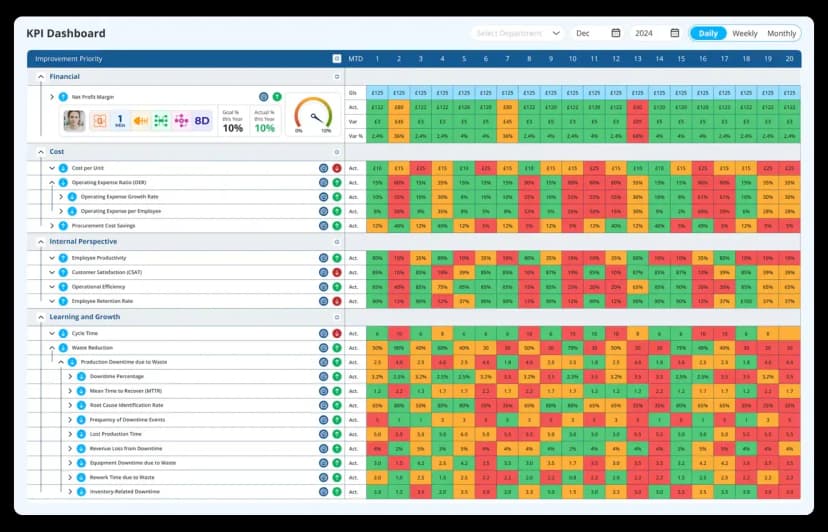
Tiered scorecards give every level of management a role-specific view of the same underlying KPI data. One dataset. No separate reports built in isolation at each tier.
That's the actual test of an enterprise-grade system. Not its size. Not how many modules it ships with. Whether every tier, from shift floor to boardroom, is working from the same trusted, current data.
LTS Data Point: One connected layer, every tier, live
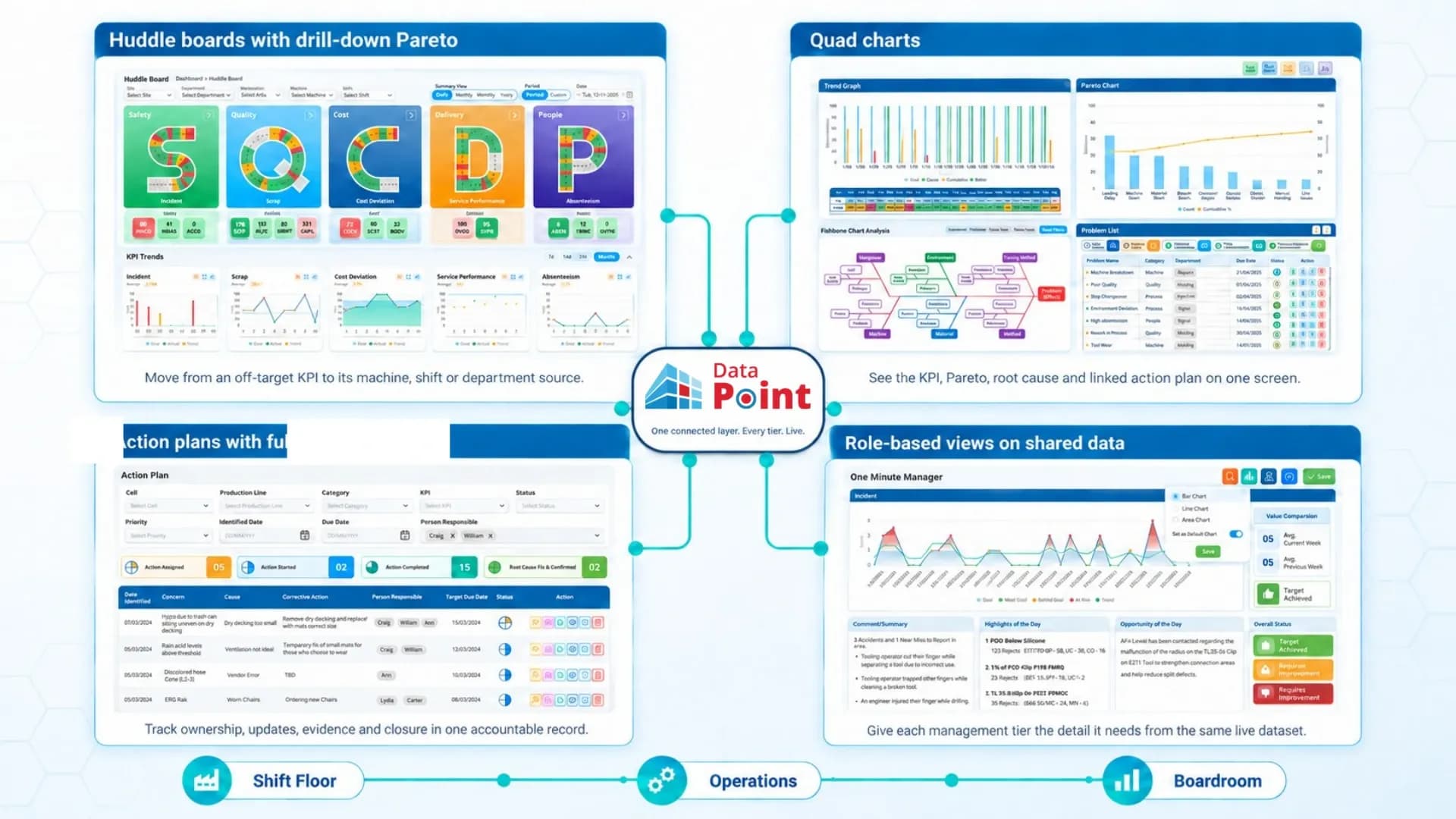
Most systems make you choose detailed data for whoever's closest to the problem, or a clean summary for whoever's furthest from it. Data Point gives both the same board. That's what enterprise performance management software should do.
- Huddle boards with drill-down Pareto: A KPI running off target shows its trend, then a Pareto that drills down by machine, shift, or department to the specific source.
- Quad charts: The KPI, its Pareto, a root cause tool such as a Fishbone, 8D, or 5 Whys, and the linked action plan, all on one screen.
- Action plans with full audit trail: Every entry shows what happened, who opened it, what was done, who closed it, with photos and comments attached.
- Role-based views on shared data: A shift manager sees their line, a director sees the aggregate, both reading the same underlying record.
No separate system to check why a number moved. No separate report summarising it for the next tier up.
LTS Data Point fits alongside existing ERP, machine, and reporting systems. Manufacturers gain connected visibility by extending what already works. Not by rebuilding their entire technology environment around another platform.
An enterprise management system was never supposed to stop at the finance department. The gap was never coverage, it was speed. Connecting ERP, machine, and KPI data into one live layer closes that gap without replacing what's already running. That's the actual measure of enterprise-grade: not size, but whether every tier is working from the same current data.
Talk to an LTS expert about where delayed or disconnected data is limiting visibility across your manufacturing operations
FAQs
1. Can a connected enterprise management system support multiple sites or global operations?
Yes. Deployments can run across single or multiple sites, and across countries, with invoicing and support structured to match.
2. Can an enterprise management system work with our existing ERP?
Yes. Modular, API-based platforms integrate with existing ERP, MES, and legacy systems rather than requiring full replacement.
3. Why does real-time visibility matter more than historical reporting?
Historical reports show what already happened. Real-time visibility gives teams the window to intervene while an issue is still recoverable, before it becomes lost output, a missed shipment, or a quality escape.
4. How long does it typically take to implement a connected enterprise management system?
Deployment experience shows basic implementations taking around two weeks, with more complex onboarding taking four to six weeks. These are illustrative timings, not universal guarantees.
5. Where is the data hosted, and is it secure?
Data is typically hosted on controlled servers, with on-premises hosting available for organisations with stricter compliance requirements, such as ITAR.
6. Is a connected enterprise management system only suitable for large manufacturers?
No. Deployments range from small, single-site manufacturers to large multinational operations, with modular adoption allowing either to start small and expand.