Lean Catchball: How Lean Catchball Turns Ideas into Actionable Plans

Last updated on : April 17, 2026
In many organisations, strategy is created in boardrooms but lost somewhere between planning and execution – like a message distorted in a long game of telephone. Lean catchball solves this by enabling structured back-and-forth dialogue across levels, helping teams refine ideas, build alignment, and convert strategic intent into clear, actionable plans.
Explore how the LTS Data Point strategy deployment and performance management platform supports digital catchball cycles, aligned KPIs, and transparent execution
What is lean catchball and why it matters in strategy deployment
Lean catchball is a structured, iterative communication process used in Hoshin Kanri X Matrix to refine strategic goals through continuous dialogue between leadership and operational teams. Unlike informal discussions, catchball in lean management focuses on decision refinement through feedback loops, ensuring that strategy is not only understood but also feasible to execute.
Where lean catchball fits in the strategy lifecycle
Lean catchball sits between:
- Strategy formulation - defining long-term objectives
- Strategy execution - implementing initiatives and tracking performance
Without this intermediate layer, industries often face:
- Unclear ownership
- Unrealistic targets
- Delayed or inconsistent execution
How lean catchball prevents strategy execution gaps
Catchball addresses common execution issues by:
- Validating goals against operational constraints before finalisation
- Ensuring that teams responsible for delivery contribute to planning
- Identifying risks and dependencies early in the process
How lean catchball transforms top-down planning
Traditional planning:
- Leadership defines strategy
- Departments receive targets
- Execution begins with minimal discussion
Lean catchball changes this by enabling:
- Top-down direction with bottom-up validation
- Shared understanding of objectives across organisational layers
- Alignment before resources and timelines are committed
As a result, strategy becomes:
- Clearer to implement
- Easier to measure
- Less prone to resistance during execution
How the lean catchball process works: From idea exchange to aligned goals
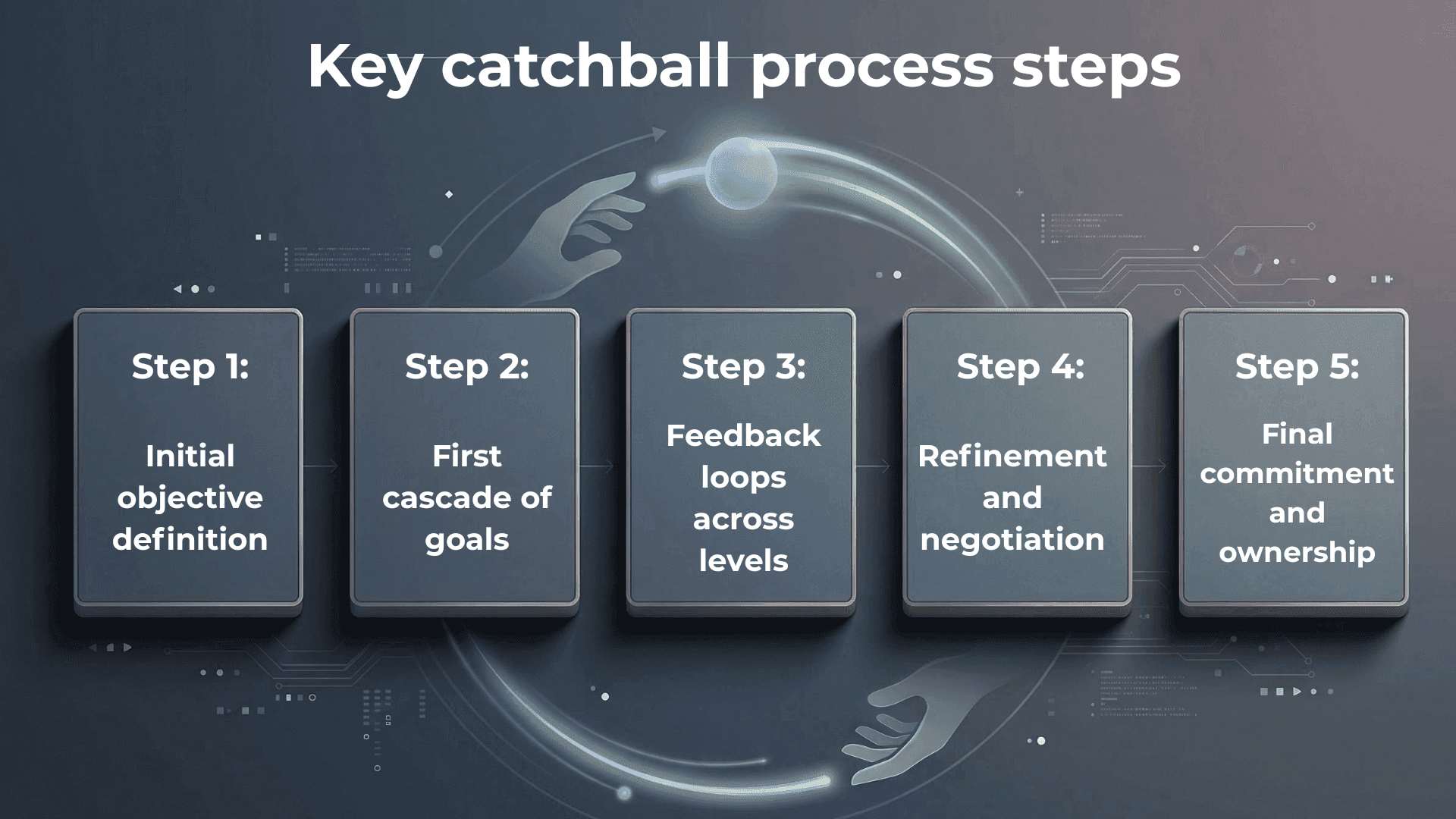
The catchball process operates through structured, repeatable cycles rather than a single round of communication. Each cycle improves clarity, feasibility, and ownership.
Key catchball process steps
Initial objective definition
- Senior leadership defines strategic priorities and breakthrough objectives
- These objectives are intentionally high-level to allow refinement
First cascade of goals
- Objectives are translated into department targets and proposed initiatives
- Teams review assumptions, timelines, and resource requirements
Feedback loops across levels
- Teams provide feedback on – feasibility, risks, and interdependencies
- Leadership reviews and adjusts targets based on this input
Refinement and negotiation
- Targets are recalibrated to balance ambition with practicality
- Conflicts between departments are resolved through facilitated discussions
Final commitment and ownership
- Once alignment is achieved, goals are formally approved
- Responsibilities, timelines, and metrics are clearly documented
Why iterative strategy alignment improves feasibility
Each catchball cycle:
- Reduces ambiguity in objectives
- Exposes unrealistic assumptions
- Ensures that execution teams understand both the “what” and the “why”
This iterative strategy alignment leads to:
- Fewer mid-year strategy changes
- More predictable execution outcomes
Typical catchball cycles in real organisations
In practice:
- Small companies may complete alignment in 2-3 cycles
- Complex enterprises often require 4-6 cycles across multiple levels
Catchball process maturity levels
Industries typically evolve through stages:
- Basic: One-way communication with limited feedback
- Intermediate: Structured feedback but inconsistent documentation
- Advanced: Fully integrated catchball with defined cadence, templates, and tracking mechanisms
Lean catchball in Hoshin Kanri: Connecting long-term vision to daily execution
Hoshin Kanri provides the framework for strategy deployment, while lean catchball acts as the communication engine that keeps the framework functional and aligned.
Relationship between Hoshin Kanri and lean catchball
- Hoshin Kanri: Defines vision, breakthrough objectives, and annual priorities
- Lean catchball: Ensures these objectives are understood, refined, and accepted across organisational levels
Without catchball:
- Hoshin planning risk becoming static documents rather than living management systems
How catchball is used when building the X Matrix
During X Matrix development:
- Leadership proposes strategic objectives
- Departments propose initiatives and key performance indicators that support those objectives
- Catchball discussions validate whether initiatives truly contribute to strategic goals and whether KPIs are measurable and controllable at the operational level
Validation of objectives, KPIs, and initiatives
Through structured dialogue:
- Unrealistic targets are adjusted before approval
- Redundant or conflicting initiatives are removed
- Cross-functional dependencies are clarified
Ensuring alignment across organisational layers
Hoshin Kanri catchball ensures alignment between:
- Corporate strategy
- Functional plans
- Operational activities
This prevents:
- Departments optimising locally at the expense of organisational goals
- Initiatives being launched without clear strategic relevance
Benefits of lean catchball beyond alignment: Engagement, ownership, and better decisions
While alignment is a primary outcome, the benefits of catchball in strategy deployment extend into cultural, operational, and financial areas.
1. Improved decision quality
Lean catchball improves decision-making by:
- Incorporating operational insights into strategic planning
- Challenging assumptions through structured questioning
- Ensuring that trade-offs are explicitly discussed rather than implied
2. Early identification of operational constraints
Through collaborative goal setting, teams can highlight:
- Capacity limitations
- Skill gaps
- Technology constraints
- Supplier or process dependencies
Addressing these constraints early reduces:
- Last-minute firefighting
- Unplanned resource allocation
3. Reduction in rework during execution
When strategy is refined through catchball:
- Fewer initiatives require major scope changes
- Project teams spend less time clarifying unclear objectives
- Performance reviews focus on improvement rather than explaining deviations
4. Increased engagement and accountability
Catchball participation creates:
- Psychological ownership of goals
- Clearer understanding of how individual work contributes to strategy
- Stronger commitment to timelines and targets
5. Measurable organisational outcomes
Organisations that adopt structured catchball often report:
- Faster strategy execution cycles
- Fewer stalled or abandoned initiatives
- Improved consistency in KPI performance across departments
Common challenges in the lean catchball process and how organisations overcome them
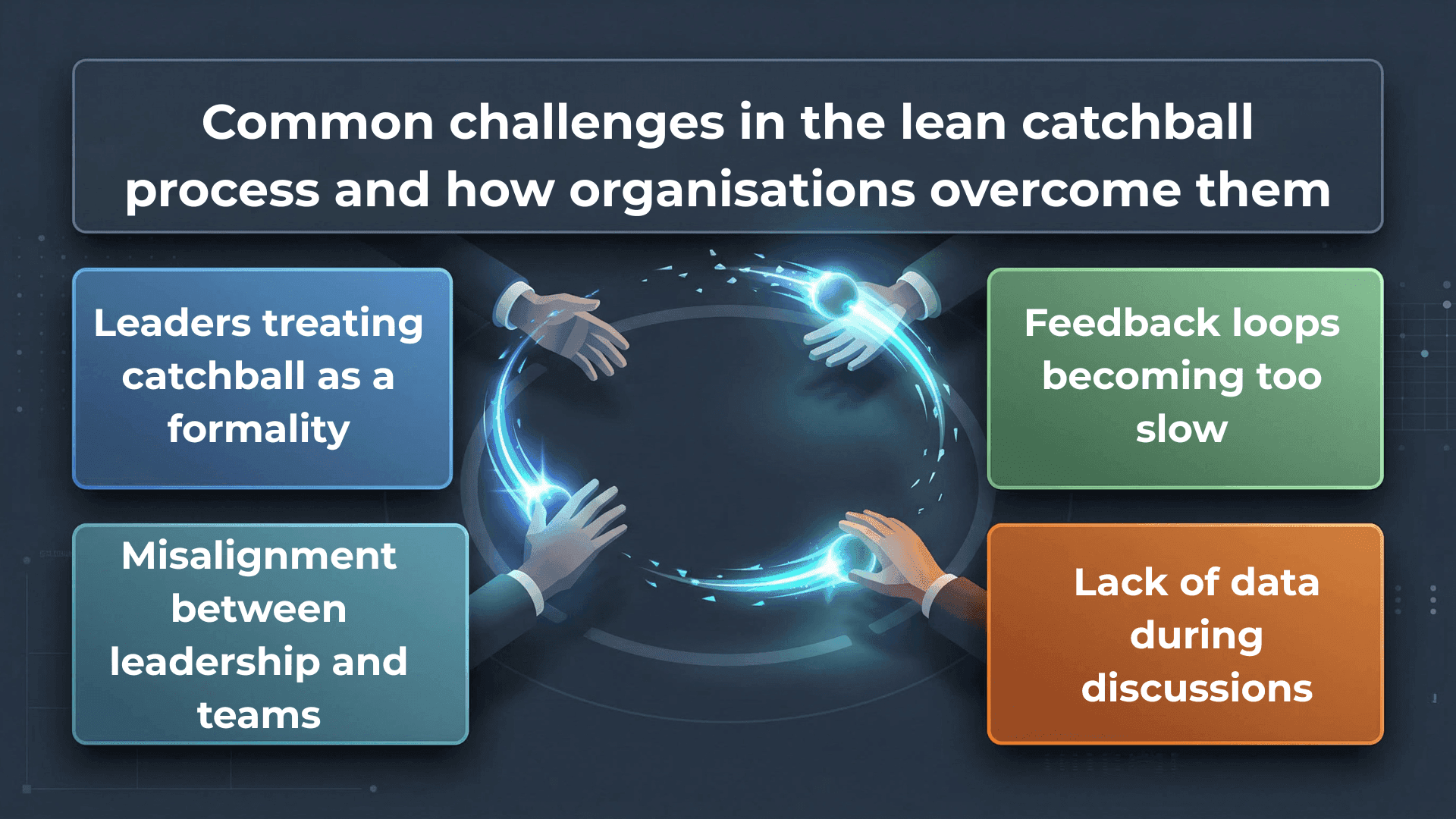
Despite its benefits, the catchball process can fail if it is implemented without clear governance or discipline.
1. Leaders treating catchball as a formality
A common issue is:
- Leadership presenting fixed targets while expecting only superficial feedback.
This leads to:
- Reduced trust in the process
- Limited or symbolic participation from teams
How organisations address this:
- Leaders explicitly state which elements are negotiable
- Feedback is visibly incorporated into revised plans
2. Feedback loops becoming too slow
Excessive iteration can delay strategy finalisation and create frustration.
Typical causes include:
- Unclear timelines
- Too many participants in each discussion
- Lack of structured documentation
Recommended practices:
- Define a fixed number of catchball cycles
- Establish response deadlines for each level
- Use standard templates for capturing feedback
3. Lack of data during discussions
When catchball conversations rely on opinions rather than evidence:
- Decisions become subjective
- Conflicts between departments intensify
Mitigation approaches:
- Require data-backed proposals for target changes
- Use historical performance and capacity data during reviews
4. Misalignment between leadership and teams
Differences in priorities and risk tolerance can create tension during discussions.
This is especially visible when:
- Leadership emphasises growth
- Operations emphasise stability and resource constraints
Governance mechanisms that help:
- Facilitated cross-functional workshops
- Clear escalation paths for unresolved conflicts
- Defined roles for strategy owners, reviewers, and approvers
With these mechanisms in place, catchball becomes:
- Faster
- More objective
- More trusted across the organisation
Scaling lean catchball with digital tools and structured performance systems
As organisations grow, manual methods such as spreadsheets, slide decks, and email chains become insufficient for managing digital strategy alignment and multi-level catchball cycles.
Limitations of manual catchball at scale
Manual approaches often lead to:
- Version control issues when objectives are reviewed
- Difficulty tracking which feedback has been addressed
- Lack of transparency across departments
- Fragmented documentation stored across multiple tools
These challenges reduce:
- Confidence in the process
- Speed of decision-making
- Traceability of strategic changes
How digital systems support catchball in performance management systems
Modern performance management platforms enable:
- Centralised documentation of objectives, KPIs, and initiatives
- Structured workflows for feedback and approvals
- Visibility into alignment across organisational layers
This ensures that:
- Each catchball cycle is recorded and auditable
- Stakeholders can review historical decisions and rationale
- Strategy updates propagate consistently across all levels
Capabilities that enable scalable catchball
Effective systems typically provide:
- Role-based access for leadership, functional heads, and operational teams
- Automated notifications for feedback and approval stages
- Dashboards that show alignment between strategic objectives and operational KPIs
Where structured performance systems fit in strategy deployment
A structured performance management system is typically used when industries:
- Manage multiple strategic themes and initiatives simultaneously
- Require consistent alignment across geographically distributed teams
- Need real-time visibility into progress against strategic goals
In such environments, platforms such as the LTS Data Point performance management system are designed to support:
- Structured strategy deployment
- Digital catchball cycles
- Ongoing monitoring of aligned KPIs and initiatives
By integrating catchball into a single system of record, companies can maintain:
- Clarity of strategic intent
- Traceability of decisions
- Sustained alignment from leadership vision to frontline execution
Lean catchball transforms strategy from a static leadership exercise into a dynamic, organisation-wide dialogue that ensures clarity, feasibility, and ownership before execution begins. By embedding structured feedback loops within frameworks like Hoshin Kanri X Matrix, companies can close the gap between planning and results – turning ambitious ideas into aligned, measurable, and actionable plans that teams are both capable of delivering and committed to achieving.
Get guidance on aligning leadership goals with operational execution using the LTS Data Point digital performance management and strategy execution platform
FAQs
1. Is lean catchball only used in manufacturing?
No. While lean catchball originated in manufacturing, it is now widely used in services, healthcare, IT, and corporate strategy functions to improve alignment and decision-making.
2. How is lean catchball different from regular meetings?
Regular meetings often focus on updates or decisions, whereas lean catchball is a structured, iterative dialogue specifically designed to refine goals and validate strategy through multiple feedback cycles.
3. Does lean catchball require a formal framework to work?
Lean catchball is most effective when used within structured frameworks such as Hoshin Kanri, but organisations can still apply its principles informally to improve collaboration and alignment.
4. How long does a typical lean catchball cycle take?
The duration varies by organisational size and complexity, but most cycles range from a few days in small teams to several weeks in large, multi-layered organisations.
5. Can lean catchball be applied to operational problem-solving?
Yes. Although commonly used in strategy deployment, the same structured feedback approach can be applied to process improvements, project planning, and cross-functional problem-solving.
6. Who should participate in the lean catchball process?
Participants typically include senior leaders, functional managers, and operational teams – anyone responsible for executing or supporting the goals being discussed.
7. Is lean catchball suitable for fast-moving organisations or startups?
Yes. Startups can benefit from lean catchball by using shorter, faster feedback loops to ensure rapid alignment as strategy and priorities evolve.
8. What skills are important for effective lean catchball discussions?
Key skills include active listening, data-based decision-making, and the ability to negotiate trade-offs between ambition and operational feasibility.

Abel Jiménez, Lean Consultant
Abel is a Lean Consultant with over 30 years of expertise in operational analysis, process improvement, and organisational change across Mexican industries. Currently serving as Director of Insurance Promotions at CESCEMEX, he helps organisations leverage technology and lean practices to improve efficiency and manage change with continuity.