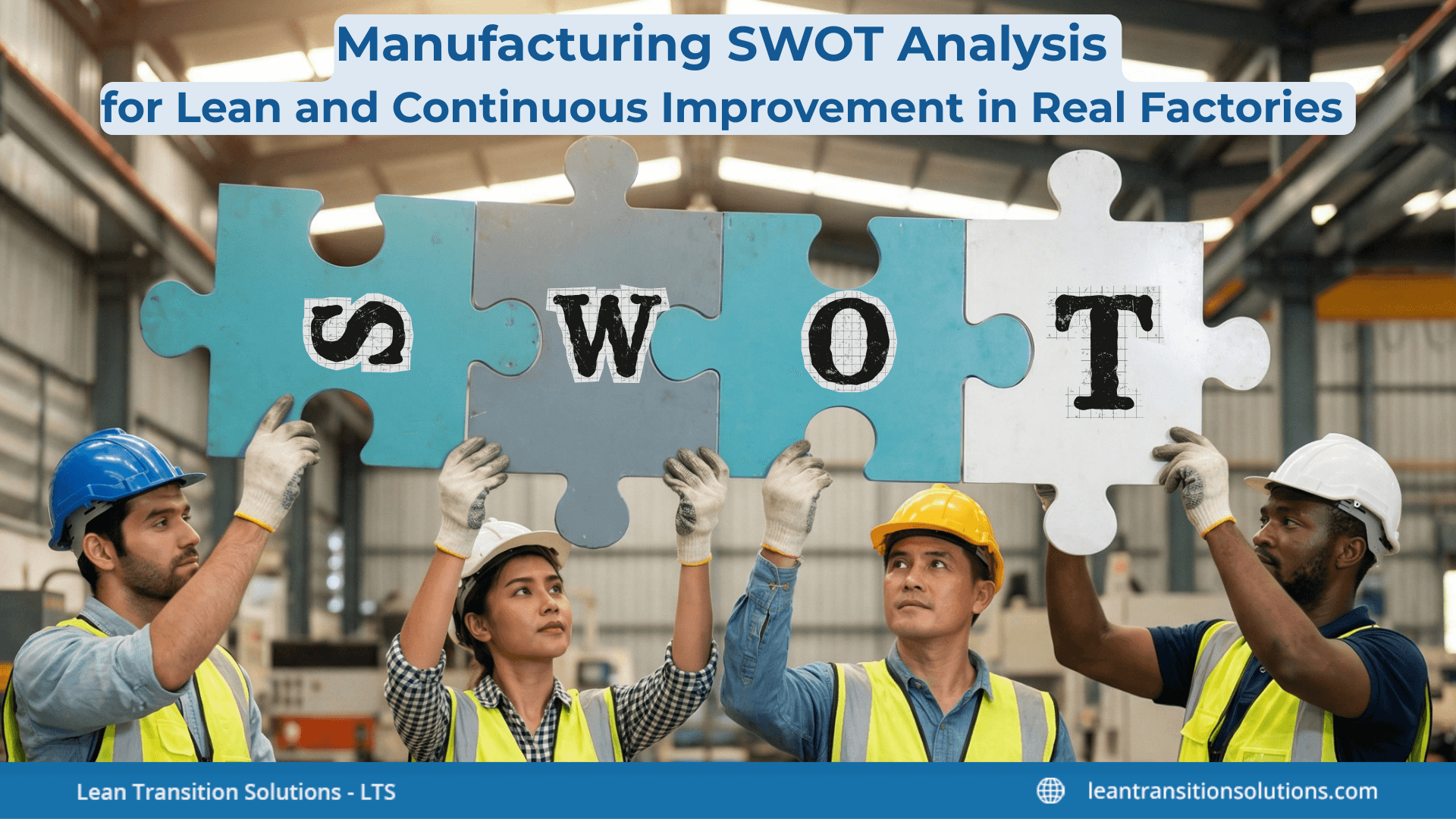
Manufacturing SWOT Analysis for Lean and Continuous Improvement in Real Factories
Last updated on : March 2, 2026
Running a factory can feel like steering a ship through thick fog while alarms keep going off below deck. You know the engines are straining, something’s rattling, and the crew is doing their best — but no one has a clear map of where the real danger or opportunity lies. On the shop floor, that shows up as missed targets, rushed fixes, and teams who sense problems long before they appear on a report. A manufacturing SWOT analysis works like switching on the radar — revealing hidden risks, untapped strengths, and the smartest course forward — and by the end of this blog, you’ll see how to use it to turn everyday turbulence into steady, lean progress.
See how SWOT priorities turn into real-time factory actions with LTS Data Point
Manufacturing SWOT analysis: What it means in a real factory environment
A manufacturing SWOT analysis is a practical way to understand how well a factory is really performing – not just in theory, but on the shopfloor. Unlike a high-level business review, a manufacturing industry SWOT analysis looks at production, quality, delivery, safety, and workforce performance as connected parts of one system. SWOT analysis in the manufacturing industry helps teams see how strengths and weaknesses are defined using operations KPIs, quality KPIs, maintenance KPIs, and production KPIs such as output, scrap, downtime, and delivery performance.
In simple terms, manufacturing SWOT is about turning what people feel on the floor into something leaders can see, measure, and act on.
What a manufacturing SWOT analysis looks at in real factories
- Strengths: What the plant already does well (Eg: stable processes, skilled operators, reliable machines)
- Weaknesses: Where performance breaks down (Eg: bottlenecks, rework, inconsistent shift handovers )
- Opportunities: Where improvement is realistically possible (Eg: better scheduling, leaner material flow, more visual management )
- Threats: What could disrupt output or quality (Eg: supplier delays, ageing equipment, rising customer demands )
This is why a manufacturing company SWOT analysis is so different from a generic business SWOT. It is built around how work actually flows through machines, people, and processes – not just financials or market trends.
Why this matters in the manufacturing industry
In the manufacturing industry, even small problems can scale into big losses. A few minutes of downtime, a missed quality check, or a weak handover can ripple through the whole plant. Using SWOT analysis in the manufacturing industry helps teams:
- Spot hidden performance risks before they become major issues
- Connect shopfloor data to management decisions
- Focus improvement efforts on what will have the biggest operational impact
By grounding the manufacturing SWOT analysis in real factory conditions, teams move from gut-feel decisions to clear, structured insight – creating a stronger foundation for lean manufacturing and continuous improvement.
How a manufacturing SWOT analysis supports Lean manufacturing
A manufacturing company SWOT analysis helps bind daily factory performance to lean manufacturing goals. Instead of depending on opinions, it turns operational data and team input into clear priorities for waste reduction, flow improvement, and problem solving.
How a manufacturing SWOT analysis supports lean manufacturing
- Identifies process strengths that assist stable, repeatable production
- Spotlights waste and variation that block lean flow
- Reveals skill gaps and training needs that affect standard work
- Exposes bottlenecks and constraints limiting throughput
- Shows where process discipline is breaking down
Using manufacturing SWOT analysis in lean daily management
- Brings shopfloor issues into daily review meetings
- Aligns lean daily management tools with real performance risks
- Helps teams prioritise what to fix today, not later
- Supports fact-based escalation instead of guesswork
- Keeps improvement actions tied to quantifiable outcomes
Why this matters for lean manufacturing teams
- Lean manufacturing relies on seeing problems early
- A manufacturing company SWOT analysis makes weak signals visible
- Lean daily management becomes focused on what truly matters
- Improvement work remains connected to real production impact
By using a manufacturing SWOT analysis inside lean manufacturing routines and lean daily management, factories create a clear line between daily issues and long-term operational improvement.
Manufacturing SWOT analysis examples from the manufacturing industry
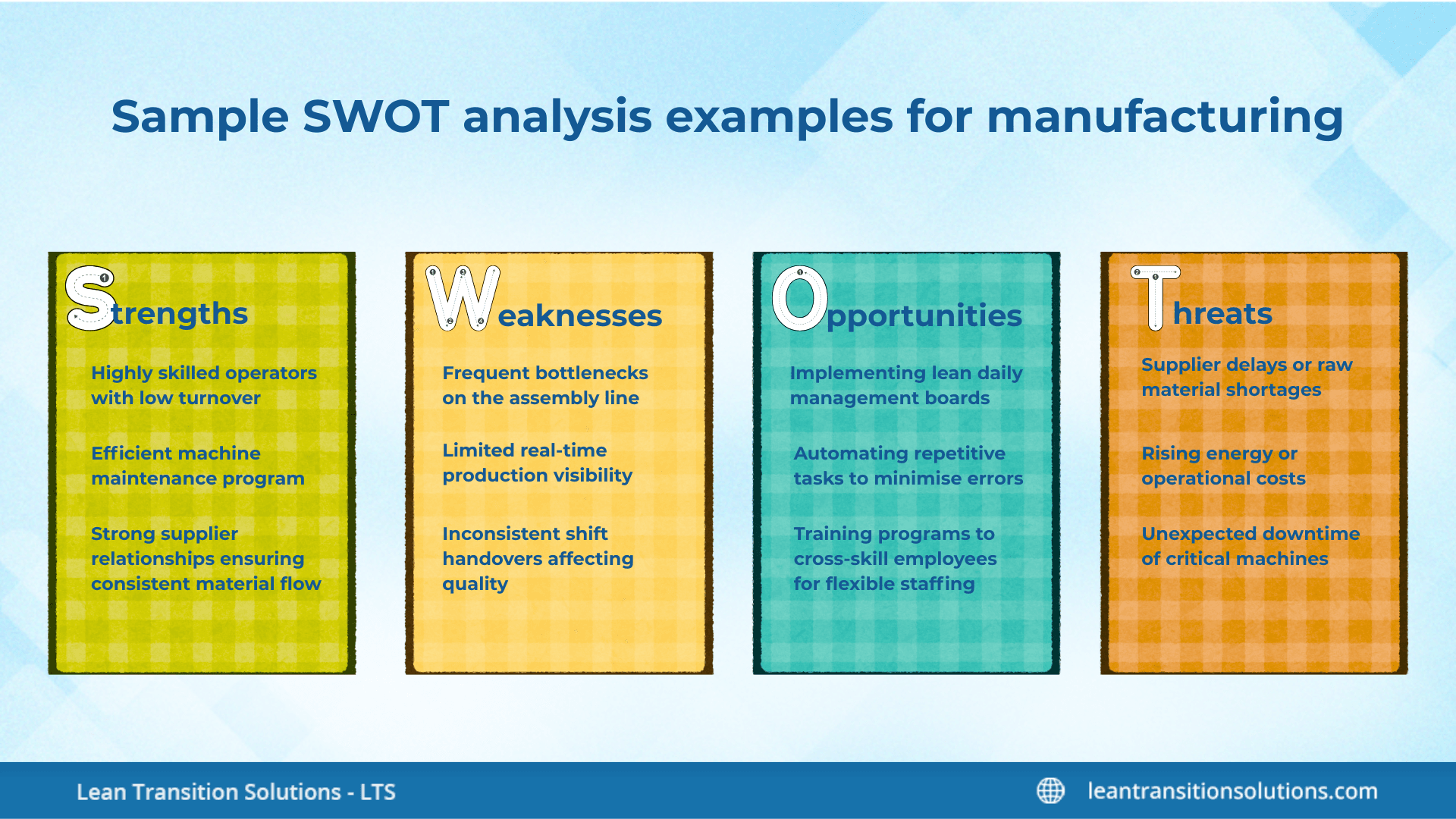
Understanding manufacturing SWOT analysis examples helps teams see how abstract concepts translate into real improvements on the shopfloor. In the manufacturing industry, practical examples make it easier to focus on problems and identify opportunities.
Sample SWOT analysis examples for manufacturing
1. Strengths
- Highly skilled operators with low turnover
- Efficient machine maintenance program
- Strong supplier relationships ensuring consistent material flow
2. Weaknesses
- Frequent bottlenecks on the assembly line
- Limited real-time production visibility
- Inconsistent shift handovers affecting quality
3. Opportunities
- Implementing lean daily management boards
- Automating repetitive tasks to minimise errors
- Training programs to cross-skill employees for flexible staffing
4. Threats
- Supplier delays or raw material shortages
- Rising energy or operational costs
- Unexpected downtime of critical machines
How these examples work in practice
- A SWOT analysis example in manufacturing industry can help spot which machine downtime issues cost the most and prioritise fixes.
- SWOT analysis examples for manufacturing enable teams to connect weak areas directly to continuous improvement processes, making improvement plans actionable.
- By looking at manufacturing SWOT analysis examples, leaders can benchmark plant performance and uncover hidden improvement opportunities.
Using these examples, factories can build their own manufacturing SWOT analysis customised to real conditions – turning insight into measurable improvements.
Real-world example: How a SWOT analysis solved factory challenges
A mid-sized automotive components manufacturer was struggling with frequent assembly line delays, quality defects, and frustrated operators. Machines would stop unexpectedly, shift handovers were inconsistent, and management lacked clarity on which problems were most critical.
By conducting a manufacturing company SWOT analysis, the team detected:
- Strengths: Experienced operators and well-maintained core machinery set
- Weaknesses: Bottlenecks at the painting and assembly stations, limited real-time visibility
- Opportunities: Introduce lean daily management tools and cross-training programs
- Threats: Supplier delays and ageing equipment
With this insight, the factory prioritised machine maintenance, standardised shift handovers, and implemented visual tracking boards for real-time monitoring. Within months, production delays dropped by 25%, scrap rates decreased, and the team had a structured roadmap for continuous improvement – proving the value of applying manufacturing SWOT analysis in real operational setting.
Using manufacturing SWOT analysis in the continuous improvement process and strategic planning
A manufacturing SWOT analysis plays a crucial role in both the continuous improvement process and strategic planning. It links daily factory performance with long-term business direction, ensuring that improvement work is not random but aligned with strategic goals.
How manufacturing SWOT analysis supports continuous improvement
- Spots the biggest performance gaps holding back results
- Highlights root causes behind quality, delivery, and productivity issues
- Helps teams focus on high-impact improvements instead of isolated fixes
- Aligns improvement activities with real operational priorities
- Supports data-driven continuous improvement best practices
Where SWOT fits into the continuous improvement process
- Strengths show what should be protected and standardised
- Weaknesses underline where process discipline is breaking down
- Opportunities guide where lean initiatives should be applied
- Threats reveal risks that could disrupt future performance
This makes manufacturing SWOT analysis a practical tool for steering the continuous improvement process instead of reacting to problems after they occur.
How manufacturing SWOT analysis supports strategic planning
- Connects shopfloor performance to business objectives
- Provides structured input for SWOT strategic planning
- Ensures investment decisions are based on operational reality
- Helps leaders prioritise which processes, lines, or plants need attention
- Turns improvement data into strategic direction
Using SWOT analysis in strategic planning prevents leadership teams from making decisions based on assumptions. Instead, they use real manufacturing performance to decide where to invest, where to improve, and where to reduce risk.
By combining the continuous improvement process with SWOT strategic planning, a manufacturing SWOT analysis becomes a bridge between daily operations and long-term factory success – keeping lean efforts focused, measurable, and aligned with strategy.
Turning your manufacturing SWOT analysis into a visual SWOT diagram
A SWOT diagram turns a manufacturing SWOT analysis into a clear visual that teams and leaders can quickly understand. In a swot analysis example for a manufacturing company, this is usually shown as four simple boxes – strengths, weaknesses, opportunities, and threats – so everyone can see how the factory is really performing.
What a SWOT diagram needs to be effective
- Accurate production, quality, and delivery data
- Clear machine, line, and shift-level trends
- Evidence behind every strength and weakness
- A shared, fact-based view of performance
Without solid data, even a well-designed SWOT diagram can become opinion driven.
How data supports a manufacturing SWOT analysis
Data is what turns a SWOT from a workshop exercise into a decision-making tool. In a SWOT analysis example for a manufacturing company, teams typically use:
- Downtime, scrap, and OEE to confirm strengths and weaknesses
- Throughput and schedule adherence to spot constraints
- Quality and rework trends to reveal improvement opportunities
- Stability and variability metrics to highlight operational risk
This allows the manufacturing SWOT analysis to mirror what is actually happening on the shopfloor, rather than what people think is happening. When this information is visualised in a SWOT diagram, leaders and teams can quickly see where to protect performance, where to focus improvement, and how to turn insight into action.
Turning SWOT insight into real-time action
Once a manufacturing SWOT analysis and SWOT diagram identify what needs attention, teams still need a way to act on those insights day by day. That's where LTS Data Point, a manufacturing performance visibility platform, fits into the workflow.
It is typically used to:
- Track the KPIs linked to SWOT strengths and weaknesses
- Provide a real-time visibility into machines, lines, and shifts
- Show whether improvement actions are actually working
- Keep teams aligned as conditions change
This closes the loop between strategic SWOT insight and daily operational execution, helping factories turn analysis into measurable results.
A manufacturing SWOT analysis is only useful when it moves beyond a one-time exercise and becomes part of how factories think, plan, and improve. By grounding strengths and weaknesses in real operations metrics, quality metrics, maintenance metrics, and production metrics, teams gain a clear view of what is truly helping or holding back performance. When that insight is connected to lean manufacturing, continuous improvement practices, and strategic planning, SWOT becomes more than a framework — it becomes a practical way to focus effort, align teams, and drive measurable results across the shop floor.
Get expert guidance on moving from SWOT to shopfloor results
FAQs
1. How often should a manufacturing SWOT analysis be updated?
Most factories update their SWOT quarterly or after major operational changes such as new product launches, equipment upgrades, or process redesigns.
2. Who should be involved in a manufacturing SWOT analysis?
The best results come from involving operators, supervisors, maintenance, quality, and operations leadership so the analysis reflects real conditions, not just management views.
3. Can manufacturing SWOT analysis be used for multiple plants?
Yes. Many organisations run separate SWOTs for each plant, then combine the results to identify group-level strengths, risks, and improvement priorities.
4. How is manufacturing SWOT different from a value stream mapping?
A SWOT identifies strategic strengths and risk, while a value stream map shows how work flows through process. They are often used together to guide improvement.
5. Can SWOT be used for new production lines?
Absolutely. Running a SWOT before ramp-up helps identify risks, training gaps, and capacity issues before they affect delivery or quality.
6. How do you validate SWOT inputs in a factory?
Most teams use historical performance data, audits, and operator feedback to confirm whether something is truly a strength or weakness.
7. What is the biggest mistake teams make with manufacturing SWOT?
Treating it as a one-off workshop instead of using it to guide ongoing improvement and decision-making.
8. Can manufacturing SWOT support investment decisions?
Yes. SWOT results are often used to justify spending on new equipment, automation, or training by showing how they address key weaknesses or threats.

Geandra Queiroz, Operations Management Consultant
Geandra is an Operations Management Consultant at Lean Transition Solutions, specialising in Lean philosophy, Lean Six Sigma, and strategic planning across manufacturing and healthcare. She is currently completing her PhD in Industrial Engineering at the Federal University of São Carlos, researching the integration of Operations Strategy, Lean, and Green Manufacturing.