OGSM Framework in Manufacturing: Turning Strategy into Daily Execution
Last updated on : April 13, 2026
Many manufacturing strategies are like a detailed blueprint left on the table – carefully designed, but never fully built on the factory floor. The OGSM framework (Objectives, Goals, Strategies, and Measures) acts like the construction plan that turns strategy into coordinated daily work, connecting long-term direction with measurable actions across teams.
See how LTS Data Point turns your OGSM framework into measurable execution
What the OGSM framework means in strategic planning
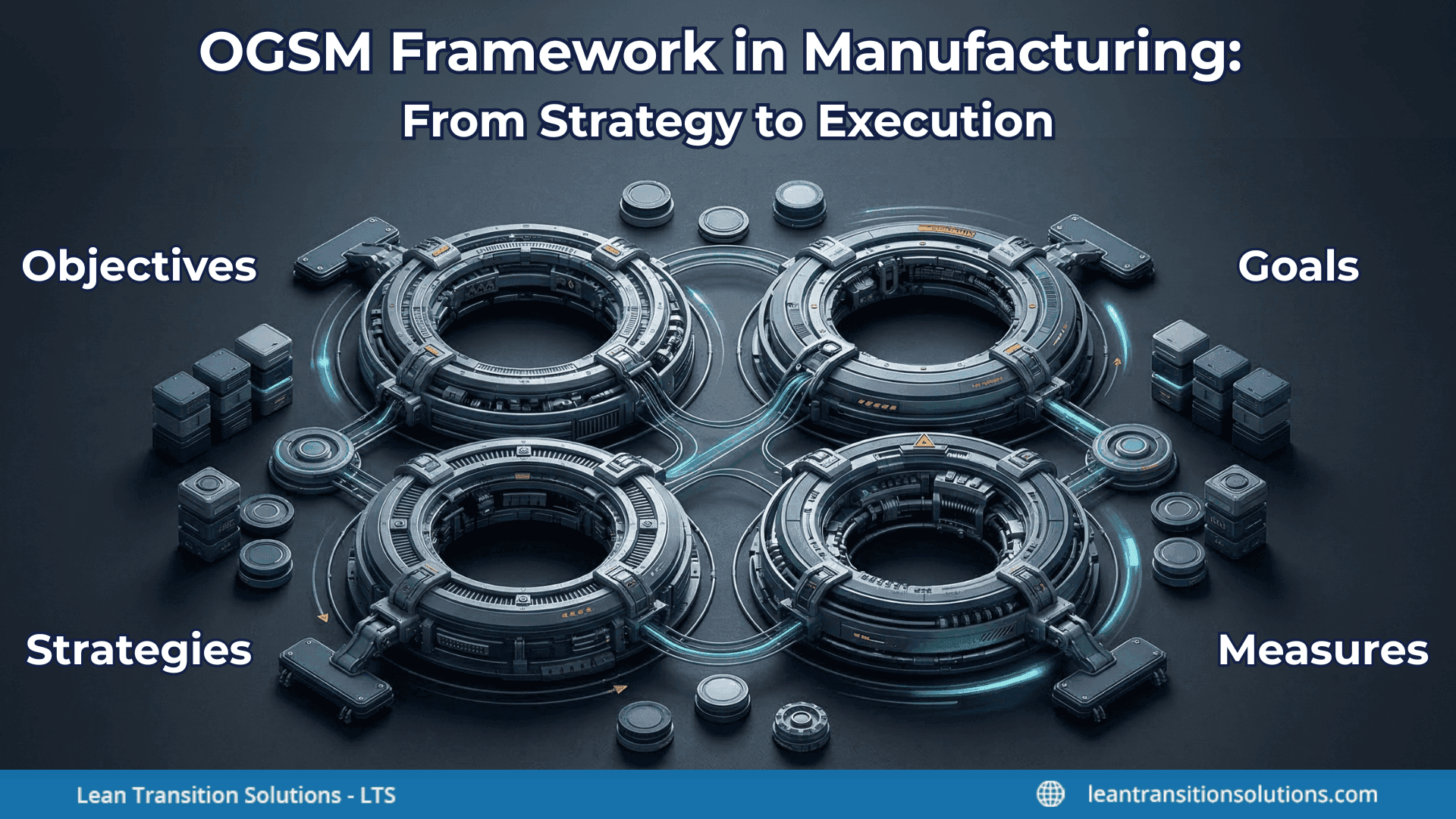
The OGSM framework is a structured strategic planning approach that converts high-level ambitions into measurable operational actions. It defines how an industry translates long-term direction into clear goals, strategic priorities, and performance metrics that guide everyday decision-making.
The name itself represents four key components:
1. Objective
The long-term ambition or strategic direction the organisation aims to achieve.
- Defines the overall purpose of the strategy
- Typically focused on 3–5-year horizon
- Sets the guiding direction for all initiatives
2. Goals
Specific and measurable outcomes that indicate progress toward the objective.
- Quantifies success using clear targets
- Often expressed as growth, efficiency, or performance improvements
- Helps teams understand what results must be achieved
3. Strategies
The key choices and initiatives that define how goals will be achieved.
- The key choices and initiatives that define how goals will be achieved.
- Guides investment, improvement projects, and operational focus
- Ensures teams work toward shared strategic priorities
4. Measures
Metrics, KPIs, and performance indicators used to track execution.
- Monitors whether strategies are producing results
- Creates accountability through measurable tracking
- Connects strategy directly to operational performance
Because of this structured approach, the OGSM model is widely used by industries to maintain strategic alignment. Instead of long planning documents, teams work with a focused one-page strategy that clearly communicates priorities across the business.
In many organisations, the strategy is documented using an OGSM template which helps standardise the planning process. A typical OGSM model template can then be cascaded to departments, plants, or teams so that the strategy is translated into coordinated operational actions.
How the OGSM framework connects strategy with daily execution
The OGSM framework bridges the gap between strategy and execution by creating a clear link between long-term ambition and daily operational work. Instead of strategy remaining at the leadership level, it becomes measurable, trackable, and actionable across teams.
Each component plays a specific role in connecting strategy to execution:
1. Objective → Strategic direction
Defines the industry’s long-term ambition.
- Sets the overall direction for 3-5 years
- Aligns leadership vision across functions
- Acts as the foundation for all planning
2. Goals → Measurable targets
Translates ambition into quantifiable outcomes.
- Converts strategy into clear performance targets
- Includes metrics like revenue, quality, or efficiency
- Helps teams understand expected results
3. Strategies → Strategic choices
Outlines how goals will be achieved.
- Focuses on key initiatives and priorities
- Guides resource allocation and improvement efforts
- Ensures alignment across departments
4. Measures → Operational tracking
Connects strategy to daily performance.
- Tracks KPIs and operational metrics
- Links actions to measurable outcomes
- Enables continuous monitoring and course correction
How the OGSM model drives execution
Because of this structured flow, the OGSM model transforms strategy into a working system rather than a static document.
- Creates a clear chain from vision to action
- Aligns leadership priorities with operational metrics
- Enables teams to track progress in real time
- Reduces the gap between planning and execution
What this means for manufacturing organisations
In manufacturing environments, the OGSM framework ensures strategy is not just discussed – it is executed.
- Production targets align with strategic goals
- Improvement projects reflect strategic priorities
- KPIs directly track strategic outcomes
- Performance reviews focus on measurable execution
This is why the OGSM method is widely used in operations-heavy industries – it embeds strategy into daily workflows, making execution consistent and measurable across the organisation.
How to build an OGSM framework using templates and practical tools
Many organisations begin implementing the OGSM framework using structured documents such as an OGSM template. These tools help convert strategy into a clear, one-page format that is easy to communicate and execute.
Standard OGSM structure (one-page view)
A typical OGSM model template organises strategy into four key sections:
- Objective → Long-term ambition
- Goals → Quantifiable targets
- Strategies → Strategic initiatives
- Measures → KPIs and actions
This structure ensures that every part of the strategy is clearly defined and connected.
Key elements in an OGSM model template
When building an OGSM framework, each section should capture:
1. Objective section
- Defines the strategic ambition for the next 3-5 years
- Sets the overall direction for the industry
- Provides a clear focus for all teams
2. Goals section
- Includes 3-5 measurable outcomes aligned with the objective
- Uses quantifiable targets (e.g., % improvement, cost reduction)
- Helps track progress toward strategic success
3. Strategies section
- Lists major initiatives or improvement programmes
- Focuses on high-impact priorities
- Aligns cross-functional efforts
4. Measures section
- Defines KPIs, milestones, and ownership
- Establishes review cadence (daily, weekly, monthly)
- Ensures accountability and performance tracking
Why teams use OGSM template in Excel
Using an OGSM template in Excel format is common in early stages because it:
- Provides a quick and structured way to build strategy
- Is easy to share across teams
- Requires minimal setup or tools
However, as industries scale, spreadsheet-based planning starts to show limitations.
When to move beyond templates to OGSM software
As complexity increases, many organisations shift from static templates to digital OGSM software solutions.
Common limitations of templates:
- Difficult to maintain across multiple teams or plants
- Limited visibility into real-time performance
- No direct connection between KPIs and actions
- Manual updates reduce accuracy and speed
Benefits of using OGSM software:
- Centralised strategy tracking across the industry
- Real-time KPI monitoring and updates
- Integrated performance reviews and action tracking
- Better alignment between strategy and execution
Using templates in an effective starting point, but for sustained execution, organisations often transition from a static OGSM model template to a connected digital environment where strategy, metrics, and actions are continuously aligned.
OGSM framework examples in manufacturing strategy
The OGSM framework is highly effective in manufacturing because it connects strategic planning directly with shopfloor execution. It enables organisations to move from high-level intent to measurable outcomes, ensuring strong strategic alignment across operations.
Example of OGSM model for manufacturing company
A simplified OGSM example structure looks like this:
1. Objective
Become the most reliable supplier in the industry within three years.
- Defines long-term corporate strategy direction
- Sets a clear ambition for strategic management
2. Goals
- Reduce product defects by 40%
- Improve on-time delivery to 98%
- Increase production efficiency by 20%
- Translates strategy into measurable outcomes
- Supports consistent strategic execution
3. Strategies
- Implement predictive maintenance across all plants
- Standardise quality management processes
- Improve production planning and scheduling
- Focuses on high-impact initiatives aligned to strategic planning
4. Measures
- Weekly defect rate tracking
- Overall equipment effectiveness (OEE) monitoring using an OEE tracker
- Production lead-time metrics
- Ensures continuous tracking and accountability
How OGSM enables cascading strategy across the industry
In large manufacturing companies, the OGSM model is not limited to a single plan – it supports cascading strategy across multiple levels:
- Corporate OGSM → Defines enterprise-level corporate strategy
- Business unit OGSM → Aligns division-level priorities
- Plant OGSM → Connects strategy to factory operations
- Department OGSM → Drives team-level execution
This cascading approach ensures strong strategic alignment, where every level of the industry contributes to shared goals.
Applicability across different types of organisations
The OGSM framework is flexible and can be adapted across industry types:
- MNC strategy → Aligns global operations with central strategic priorities
- SME strategy → Provides clarity and focus with limited resources
- Manufacturing enterprises → Connects operations with long-term strategic management goals
Why OGSM works in manufacturing environments
These real-world OGSM examples highlight why the framework is widely used:
- Links strategic planning directly to operational metrics
- Enables consistent strategic execution across teams
- Supports structured strategic management and performance tracking
- Drives alignment between leadership vision and factory-level actions
This is what makes the OGSM framework a practical tool for turning strategy into measurable, day-to-day execution in manufacturing environments.
Challenges organisations face when managing the OGSM framework
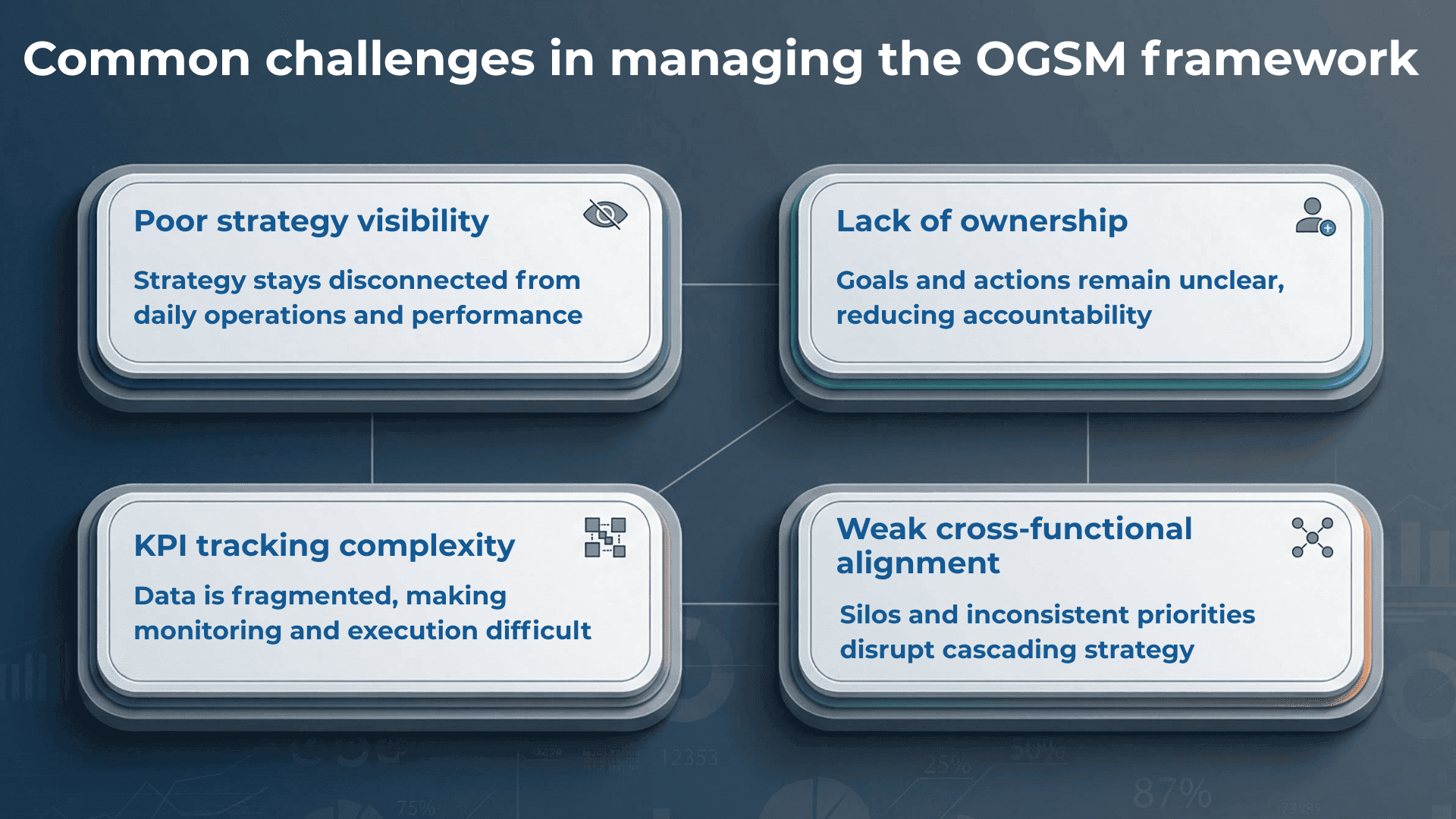
While the OGSM framework simplifies strategic planning, many industries struggle to sustain it in real-world environments. The challenge is not in designing the framework, but in maintaining consistent strategic execution and visibility over time.
Common challenges in managing the OGSM framework
1. Strategy visibility
When the OGSM template is limited to spreadsheets or presentations:
- Strategy remains static and disconnected from daily operations
- Teams lack visibility into how goals link to performance
- Weakens overall strategic alignment across functions
2. Ownership and accountability
Without structured tracking systems:
- Strategies remain theoretical rather than actionable
- Ownership of goals and measures becomes unclear
- Limits effective strategic management and follow-through
3. KPI tracking complexity
The “Measures” component requires continuous monitoring:
- Performance data is spread across multiple systems
- Manual updates reduce accuracy and timelines
- Makes consistent strategic execution difficult
4. Cross-departmental alignment
When teams manage separate OGSM model template files:
- Silos emerge between departments or plants
- Inconsistent priorities weaken cascading strategy
- Reduces alignment between operational and corporate strategy goals
Why organisations move beyond templates
Because of these challenges, many companies transition from static templates to digital OGSM software solutions.
Limitations of spreadsheet-based OGSM:
- No real-time visibility into performance
- Difficult to scale across teams or locations
- Weak integration between strategy and execution
Advantages of OGSM software:
- Centralised view of strategy and performance
- Real-time KPI tracking and updates
- Integrated action management and review systems
- Stronger alignment between planning and execution
To sustain the OGSM framework effectively, industries need more than structured templates – they require systems that support continuous tracking, accountability, and organisation-wide strategic alignment.
Hoshin Kanri X Matrix vs OGSM framework: How strategy execution is sustained
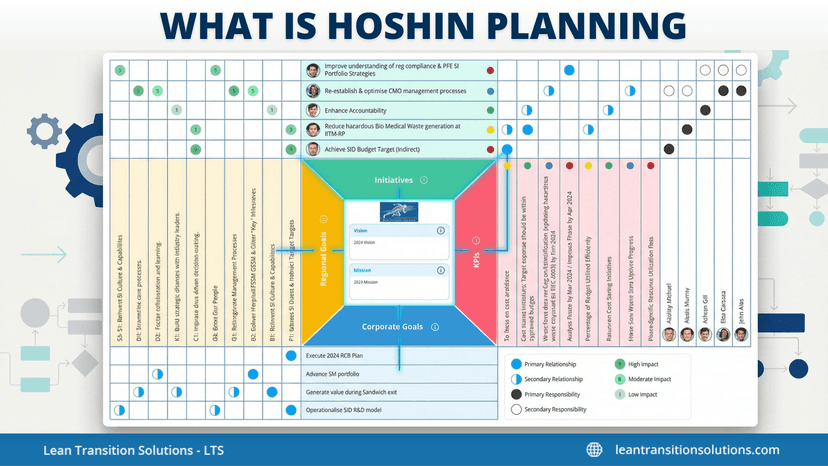
While the OGSM framework provides a clear structure for strategic planning, many organisations often need a system to sustain execution, alignment, and continuous tracking. This is where Hoshin Kanri X Matrix plays a complementary role – focusing on how strategy is deployed, reviewed, and managed across the organisation.
OGSM framework vs Hoshin Kanri X Matrix
How Hoshin Kanri X Matrix executes the strategic plan created with OGSM
While the OGSM framework defines what needs to be achieved, Hoshin Kanri X Matrix ensures that the plan is executed consistently across the organisation.
It enables organisations to:
- Translate OGSM goals into clear, actionable initiatives across teams
- Drive cascading strategy from leadership to shopfloor execution
- Establish structured review cycles for continuous tracking and improvement
- Link KPIs with ownership, accountability, and follow-through
This makes Hoshin Kanri X Matrix a practical system for executing the strategic plan created using OGSM, especially in manufacturing environments where disciplined execution is critical.
What this means for organisations
Using the OGSM framework alongside Hoshin Kanri X Matrix allows industries to combine strategic clarity with execution discipline through structured Hoshin planning.
- OGSM provides the strategic direction
- Hoshin Kanri X Matrix ensures consistent execution and tracking
- Systems like LTS Data Point performance management system support this by enabling structured deployment and review of strategy across the industry.
This approach ensures that strategy is not just defined – it is actively managed, continuously tracked, and consistently executed across the organisation.
The OGSM framework brings clarity to strategic planning by defining what an organisation aims to achieve and how success will be measured. However, real impact comes from consistent strategic execution. By combining OGSM with a structured approach like Hoshin Kanri X Matrix, organisations can move beyond static plans to achieve true strategic alignment, effective cascading strategy, and measurable results. When supported by a system like the LTS Data Point performance management system, strategy becomes a continuously managed process – ensuring that objectives are not just defined but actively executed and sustained across the industry.
Speak with an expert to understand how LTS Data Point supports your OGSM framework
FAQs
1. How is the OGSM framework different from OKRs?
The OGSM framework focuses on structured strategic planning with a fixed hierarchy, while OKRs are more flexible and cycle-based, often used for short-term goal tracking.
2. Is the OGSM framework suitable for small teams?
Yes. The OGSM framework works well for SMEs by simplifying strategy into a clear one-page format, making it easier to focus limited resources.
3. How often should an OGSM plan be updated?
Typically, the OGSM framework is reviewed annually, with quarterly or monthly updates to goals and measures for tracking progress.
4. Can OGSM be used outside manufacturing?
Yes. The OGSM framework is widely used across industries like healthcare, retail, and services for structured strategic planning and execution.
5. What makes a good OGSM objective?
A strong objective in the OGSM framework is clear, ambitious, and aligned with long-term business direction, without being overly detailed.
6. How many goals should an OGSM include?
Most OGSM models include 3-5 goals to maintain focus and avoid overcomplicating execution.
7. Is OGSM a long-term or short-term planning tool?
The OGSM framework is primarily used for long-term strategy (3-5 years), supported by short-term execution tracking through measures.
8. Can OGSM replace other strategic frameworks?
The OGSM framework can complement or replace other frameworks depending on organisational needs, especially when simplicity and clarity are priorities.
9. What industries benefit most from OGSM?
Industries with complex operations – like manufacturing, logistics, and pharmaceuticals – benefit most from the structured execution of the OGSM framework.