How to Use Production Boards for Managing Daily Output in US Plants
Last updated on : April 22, 2026
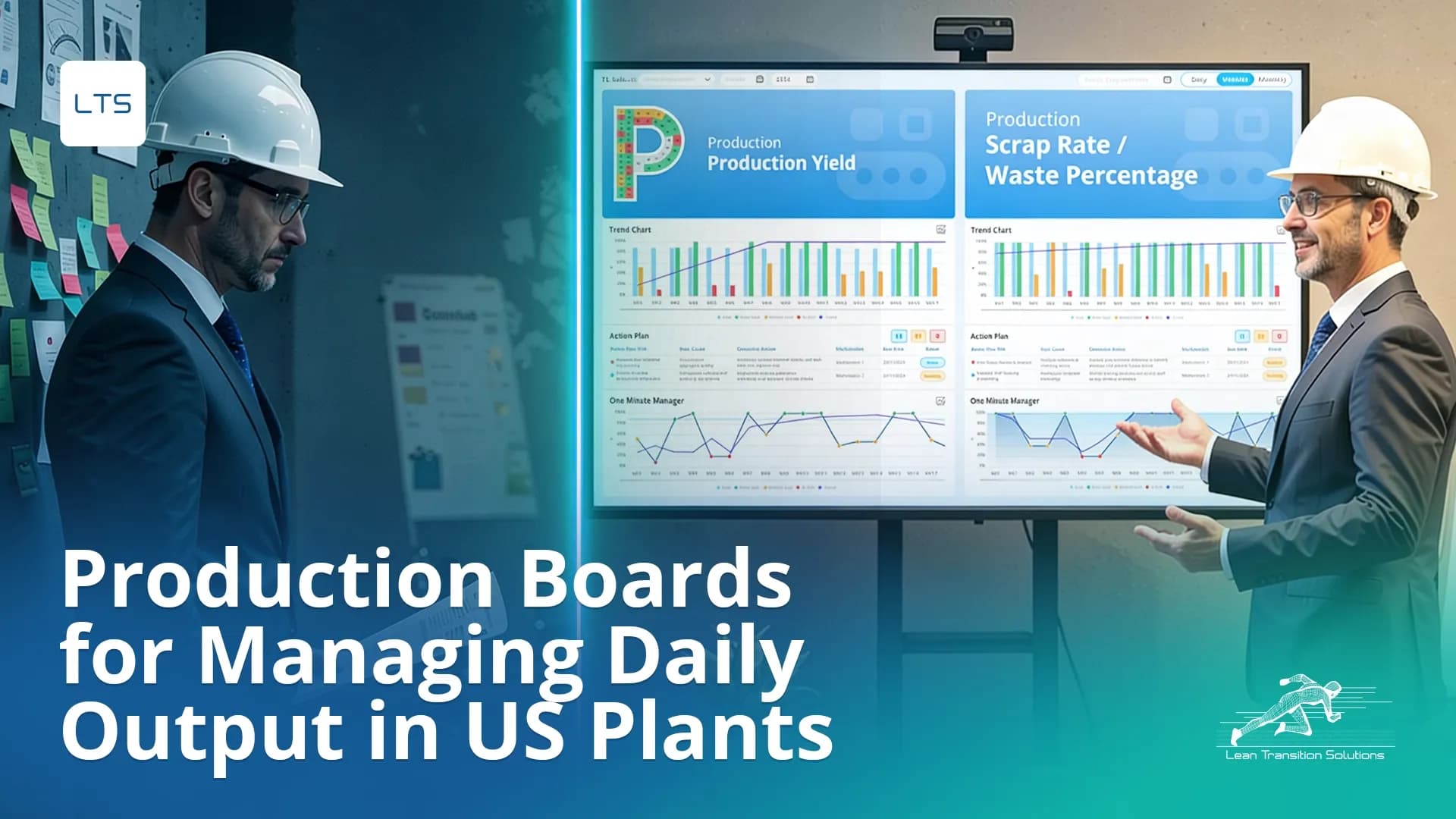
When daily output targets are slipping, the problem is rarely effort – it is visibility. Production boards for managing daily output in US plants give plant managers a structured, real-time view of what is happening on the shop floor, shift by shift. They make performance transparent, problems actionable, and conversations focused.
A well-designed daily production board closes the gap between what was planned and what was actually produced – before the shift ends, not after the week is reviewed. For any plant running multiple shifts against tight delivery schedules, that difference is everything.
What is a production board, and why does it matter?
A production management board is a visual tool positioned on the shop floor to display planned versus actual output, surface performance gaps, and capture issues the moment they arise. In US manufacturing plants – where multi-shift operations and lean delivery windows are standard – these boards sit at the heart of daily production management.
They answer three questions at a glance:
- Are we hitting our hourly shift targets right now?
- Where have we lost output, and what caused it?
- Who owns the fix, and what action is underway?
Without a board in place, teams rely on gut feel or end-of-day summaries that arrive too late to act on. With one, the shop floor has a shared source of truth that drives focus and accountability across every shift. This is where a structured lean daily management approach makes all the difference – turning daily boards from static displays into active performance tools.
What should appear on a production board in a US plant?
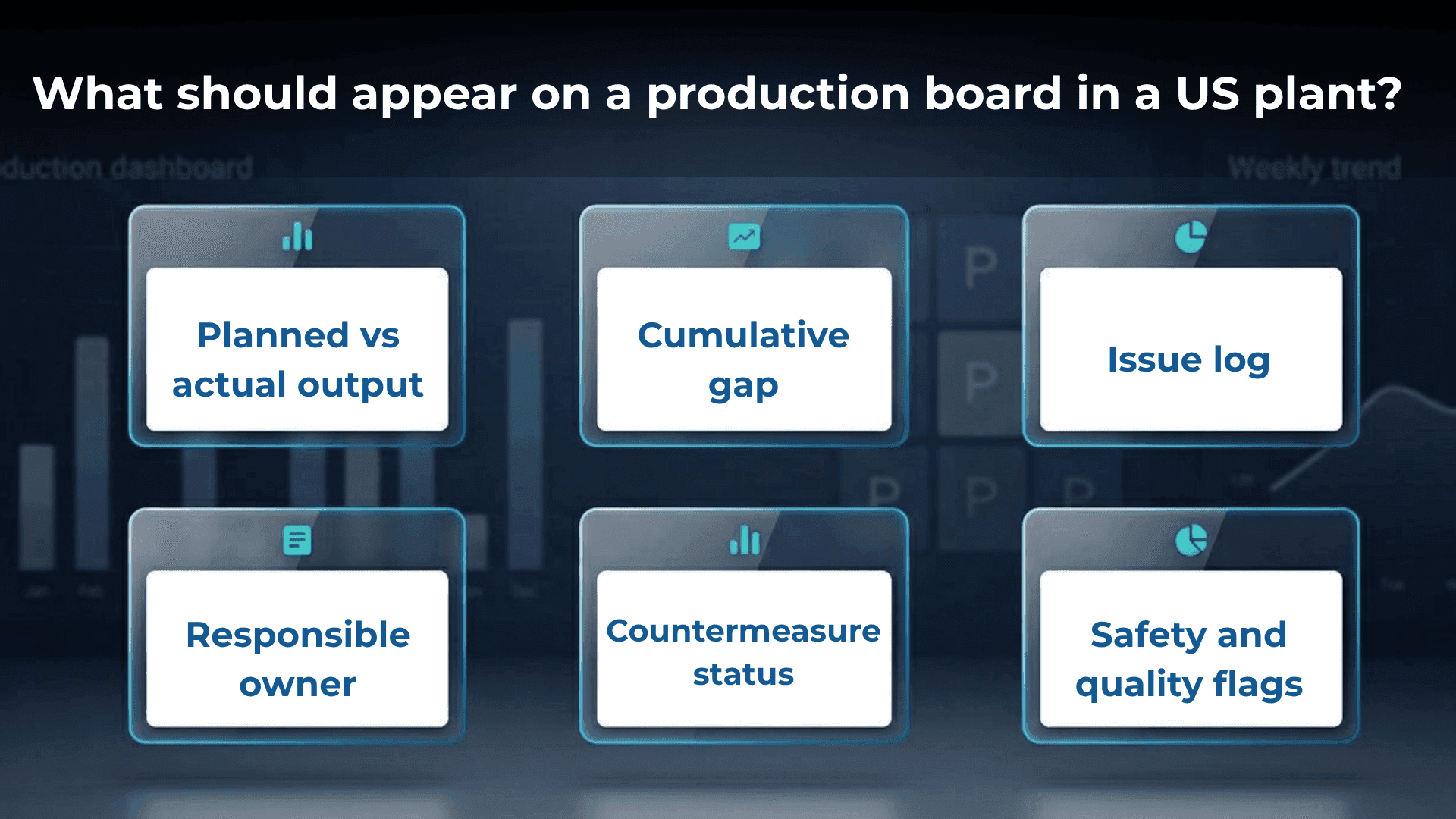
The content of a shop floor production board must be relevant, current, and readable at a glance. Every element must earn its place.
A well-structured board in production boards in USA environments typically includes:
- Planned vs actual output – tracked hourly or by cell, not just end-of-shift totals
- Cumulative gap – the running shortfall so teams understand what recovery is needed
- Issue log – what caused each dip, categorized by type such as equipment, quality, staffing, or material
- Responsible owner – who is accountable for each open issue
- Countermeasure status – what action has been taken or is in progress
- Safety and quality flags – brief indicators that keep critical themes visible alongside output data
This structure supports effective production issue tracking and prevents problems from being noted once and forgotten. It also generates the data needed for tiered production reviews at set points throughout the shift or day. An accountability board sits alongside this structure well – making ownership of each issue visible and non-negotiable.
How production boards solve the shift handover problem
One of the most damaging patterns in multi-shift US plants is the inconsistent shift handover. When an outgoing shift does not communicate clearly, the incoming team wastes critical time rediscovering problems that were already known.
A consistently maintained manufacturing daily management board eliminates this by making the handover structured and visible. At the point of shift change, the board should show:
- Output achieved and the gap carrying into the next shift
- Every open issue with its current status and assigned owner
- Any quality, safety, or equipment flags that require continuity
- The incoming shift target, adjusted for any recovery needed
This removes ambiguity from daily output management and replaces reactive firefighting with a process both shifts can see and verify. It also builds accountability – because what was logged is visible to every team walking onto the floor.
Poor communication between shifts in US plants is one of the most common causes of recurring production loss. Addressing it through board discipline is one of the lowest-cost, highest-impact steps a plant manager can take. Consistent board discipline is what turns operational KPI visibility from an aspiration into a daily operational reality. Pairing this with a structured visual management approach ensures the discipline holds across every cell and every shift.
Tiered production reviews: Connecting the board to leadership
A shop floor production board is only as powerful as the conversations it enables. Tiered production reviews connect shop floor data upward through organization – ensuring that what is visible at Tier 1 is escalated to Tier 2 and Tier 3 when it cannot be resolved locally.
This is how plant-level performance boards become more than wallpaper. The cadence works as follows:
- Tier 1 – Hourly or end-of-cell: Team leaders review the board against targets, log issues, and attempt immediate resolution.
- Tier 2 – Start of shift or mid-shift: Supervisors review escalated issues, confirm resource allocation, and update countermeasure ownership.
- Tier 3 – Daily or shift summary: Plant managers review aggregate performance, identify systemic patterns, and connect production gaps to strategic priorities.
Running effective tier meetings using tier meeting guide is what transforms board data into action at every level of the organization. When this structure is working, production boards for USA operations become a live performance management system. Issues are caught early, teams stay aligned, and the daily management system functions as designed – with problems resolved at the lowest possible tier before they compound.
Digital vs physical production boards: What US plants are moving forward
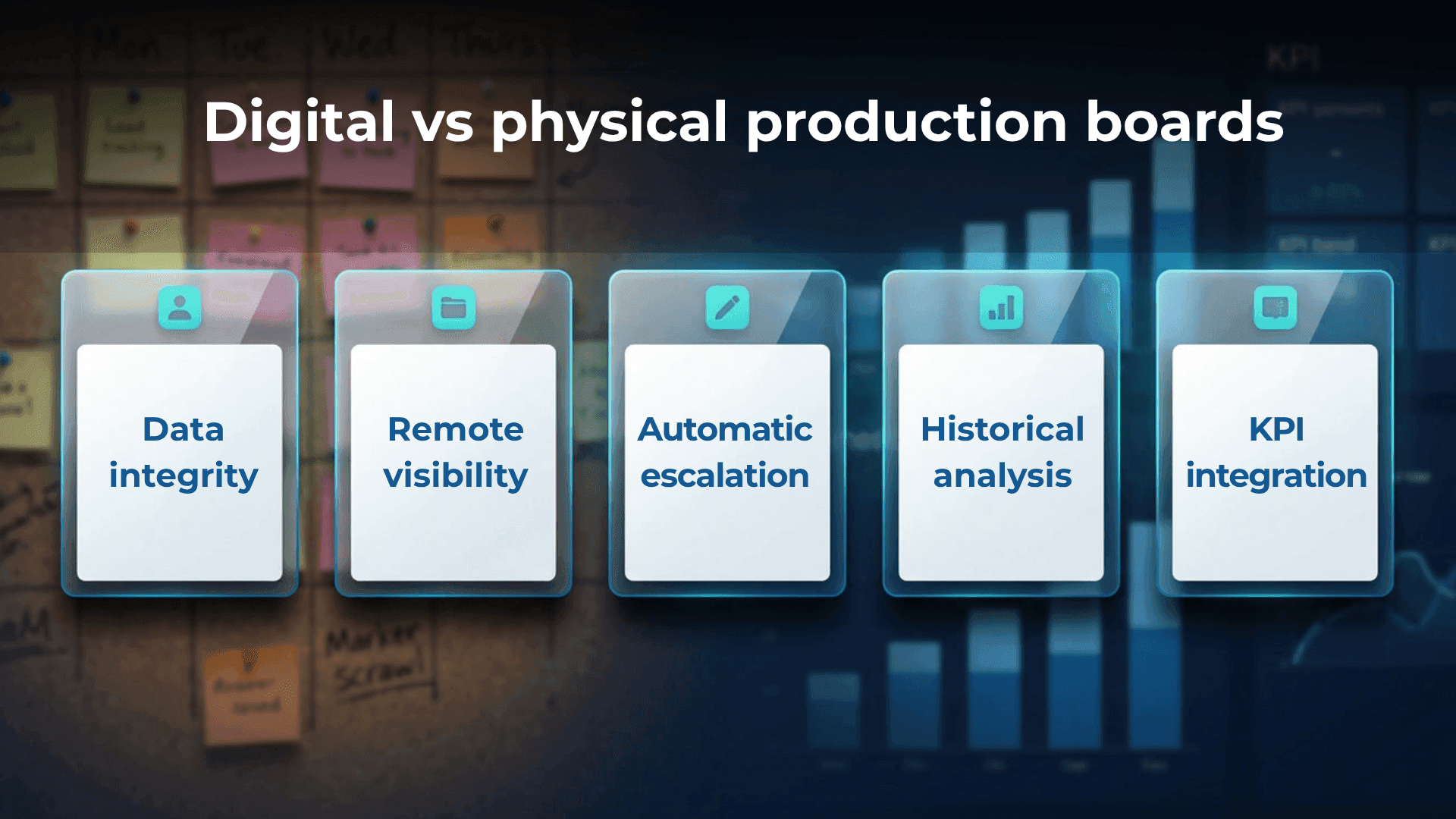
Physical whiteboards have served US plants for decades. But they carry real limitations – especially when plants run multiple shifts, operate across several lines, or have leadership teams who need real-time production tracking without walking the floor.
The shift toward digital shop floor visual management is accelerating for several clear reasons:
- Data integrity – digital boards cannot be accidentally wiped between shifts
- Remote visibility – supervisors and managers can view live performance from any location
- Automatic escalation – digital systems flag unresolved issues without manual follow-up
- Historical analysis – patterns in production losses become visible over time, enabling root cause work rather than repeated firefighting
- KPI integration – output data feeds directly into a KPI dashboard for manufacturing, connecting shop floor performance to plant-level and strategic targets
Operational performance metrics that exist only on a whiteboard cannot be aggregated, trended, or reported upward without significant manual effort. A digital board removes that friction entirely.
Physical boards also depend on individual discipline and team culture. A digital system enforces structure – every shift records against the same fields; every issue is logged in the same format, and visual production tracking is standardized across every line and cell in the plant.
How LTS Data Point supports production board management
LTS Data Point is a computerized balanced scorecard designed for manufacturing organizations that need more than isolated boards. It connects daily production management on the shop floor directly to plant strategy. That connection starts upstream, at production planning, where targets are set before they ever reach the board.
Within LTS Data Point, production board capability sits alongside broader performance management tools:
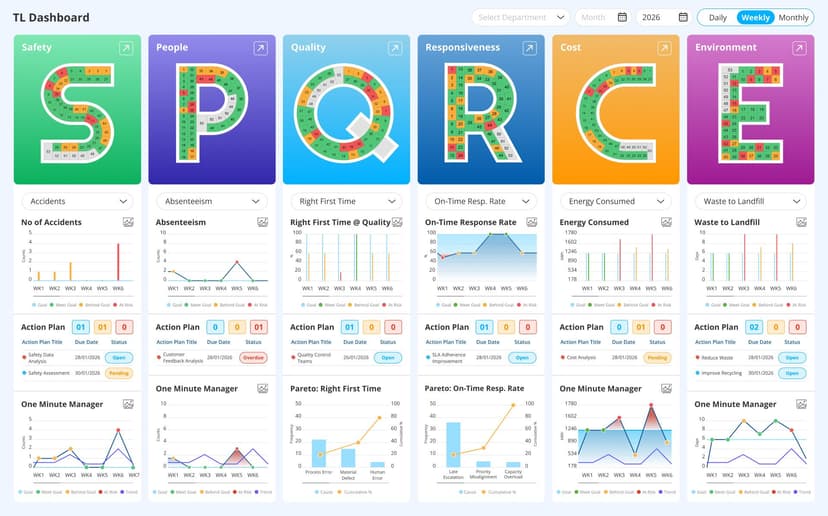
- Real-time dashboards display planned vs actual output at cell, line, and plant level – delivering full operational KPI visibility without manual consolidation
- Issue logging and tracking ensures every gap is recorded with an owner, a cause category, and a countermeasure – making production issue tracking structured and auditable
- Tiered review support allows Tier 1 data to escalate naturally into Tier 2 and Tier 3 views, enabling effective tiered production reviews without duplicating effort
- Shift-level reporting provides the structured data needed for clean handovers, removing ambiguity from shift transitions
- KPI alignment connects daily output performance to the plant scorecard, keeping persistent gaps visible within the broader strategic picture
For US manufacturers moving from fragmented physical boards to a single, reliable plant-level performance board environment, LTS Data Point provides the structure, visibility, and accountability framework to make that shift sustainable.
Production boards for managing daily output in US plants are not a new concept – but the discipline behind them, and the systems that support them, determine whether they drive results or simply occupy wall space. Track planned versus actual, surface issues fast, assign ownership, and review at every tier. Those fundamentals do not change.
What has changed is the capability available to plant managers ready to go further. Digital systems remove the fragility of paper-based boards, extend visibility beyond the shop floor, and connect daily production management to the plant’s full strategic performance picture.
Upgrade your shop floor management with LTS Data Point production board
FAQs
1. How often should a production board be updated during a shift?
Production boards should be updated on an hourly basis. In high-speed or high-volume environments, updates at every interval or takt cycle give teams the earliest possible warning of output gaps.
2. Who is responsible for maintaining the production board?
Ownership sits with the team leader or cell supervisor. They are accountable for keeping the board current, logging issues in real time, and ensuring nothing carries forward without an assigned owner.
3. What is the difference between a production board and a huddle board?
A production board tracks output performance – planned vs actual, gaps, and countermeasures. A huddle board is used to structure the meeting conversation around that data. The two are complementary, not interchangeable.
4. Should every production line have its own board?
Yes. Each line or cell should have a board that reflects its own targets and issues. Aggregated plant-level views are useful for leadership, but line-level boards are where frontline accountability is built.
5. Can a production board be used in a mixed-model manufacturing environment?
Yes. In mixed-model manufacturing environments, the board should track output by product type or job alongside total units, so gaps can be attributed to the right cause without masking performance behind blended totals.
6. How do you prevent a production board from becoming ignored over time?
Discipline and leadership visibility are the two most common answers – but the real driver is whether the board actually leads to action. When teams see that issues logged on the board get resolved, they keep updating it. When nothing happens, they stop.
7. Is there a standard format for production boards used in US manufacturing plants?
There is no single mandated format. Most US plants follow a lean-based structure aligned with their daily management system – typically covering safety, quality, delivery, and output performance. The format should be standardized within the plant but adapted to what each team needs to act on.

Geandra Queiroz, Operations Management Consultant
Geandra is an Operations Management Consultant at Lean Transition Solutions, specialising in Lean philosophy, Lean Six Sigma, and strategic planning across manufacturing and healthcare. She is currently completing her PhD in Industrial Engineering at the Federal University of São Carlos, researching the integration of Operations Strategy, Lean, and Green Manufacturing.