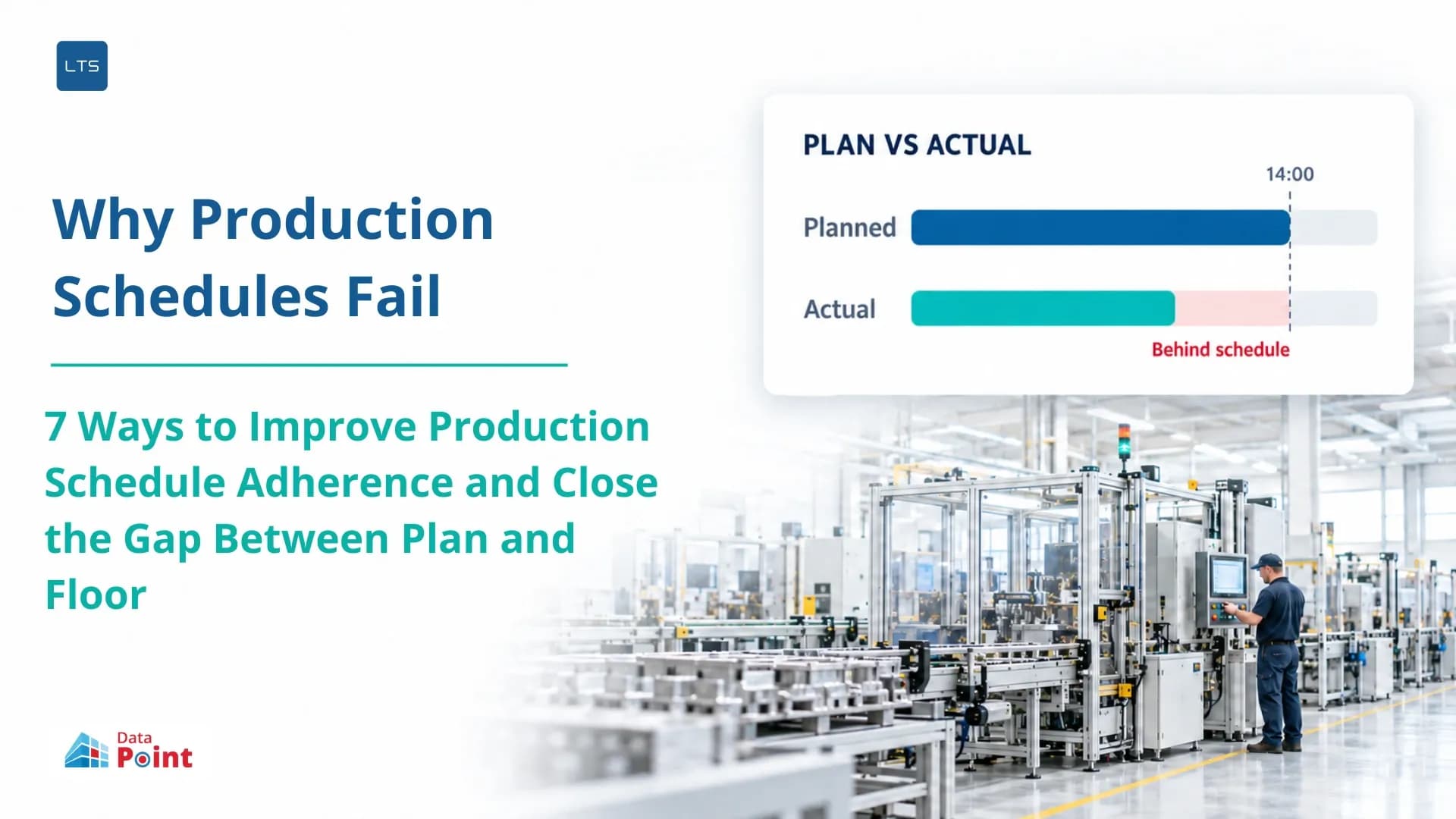
Why Production Schedules Fail: 7 Ways to Improve Production Schedule Adherence and Close the Gap Between Plan and Floor
Last updated on : October 19, 2026
One shift is enough to show why production schedules fail and why production schedule adherence slips.
The plan says job two runs first, but its material is still on the dock, so the team starts job three. The wall board still shows job two. Operators delay tasks or run them out of order to keep the line moving. Rescheduling research shows the same: the floor repairs the schedule while the official version stays unchanged, and a gap opens.
So, what does the gap cost? The time the shift needed to recover.
Seven ways to improve production schedule adherence close it, from measuring execution to recovering within the shift. The aim is a schedule teams can follow, not one that only looks right.
See how LTS Data Point connects production schedules with shopfloor visibility, clear ownership and timely action
Why production schedules fail
A schedule can list the right quantity and still be wrong. In one plant, the plan was built by weight rather than by hours, so it never said how long each machine would run.
Add changeover time in production scheduling that the plan left out, and production capacity constraints surface the moment the shift starts. The workload outgrows the hours before the first job begins.
Then the resources that the plan assumed go missing. Elsewhere, unplanned downtime, material and labour shortages, limited multi-skilling and slow communication between planning and production all disrupted the plan.
Material shortages delaying production are the clearest case. One blocked operation pushes back every job behind it, and production schedule slippage starts there, one operation at a time.
Here is the hardest part. An ERP can be the source of truth and still leave the floor waiting. In one setup, limited shift-level planning, delayed manual updates and missing hourly splits kept supervisors waiting for numbers while the shift ran.
Shopfloor execution visibility arrives after the damage. Planned vs actual production drifts apart unseen.
Late discovery triggers the scramble. In one operation, new and changed orders travelled through fragmented channels, with alerts reaching the right people late. Teams re-sequence, expedite and rearrange what remains.
Every revision adds disruption of its own. Repeated changes to the plan, known as schedule nervousness, leave schedule instability behind, and constant firefighting in production becomes routine.
The failure is not on big miss, but three small ones: assumptions that break, gaps that stay hidden and changes that pile up. Each breaks quietly, and each can be fixed. Teams that improve production schedule adherence start by making the hidden gap visible.
Seven ways to improve production schedule adherence
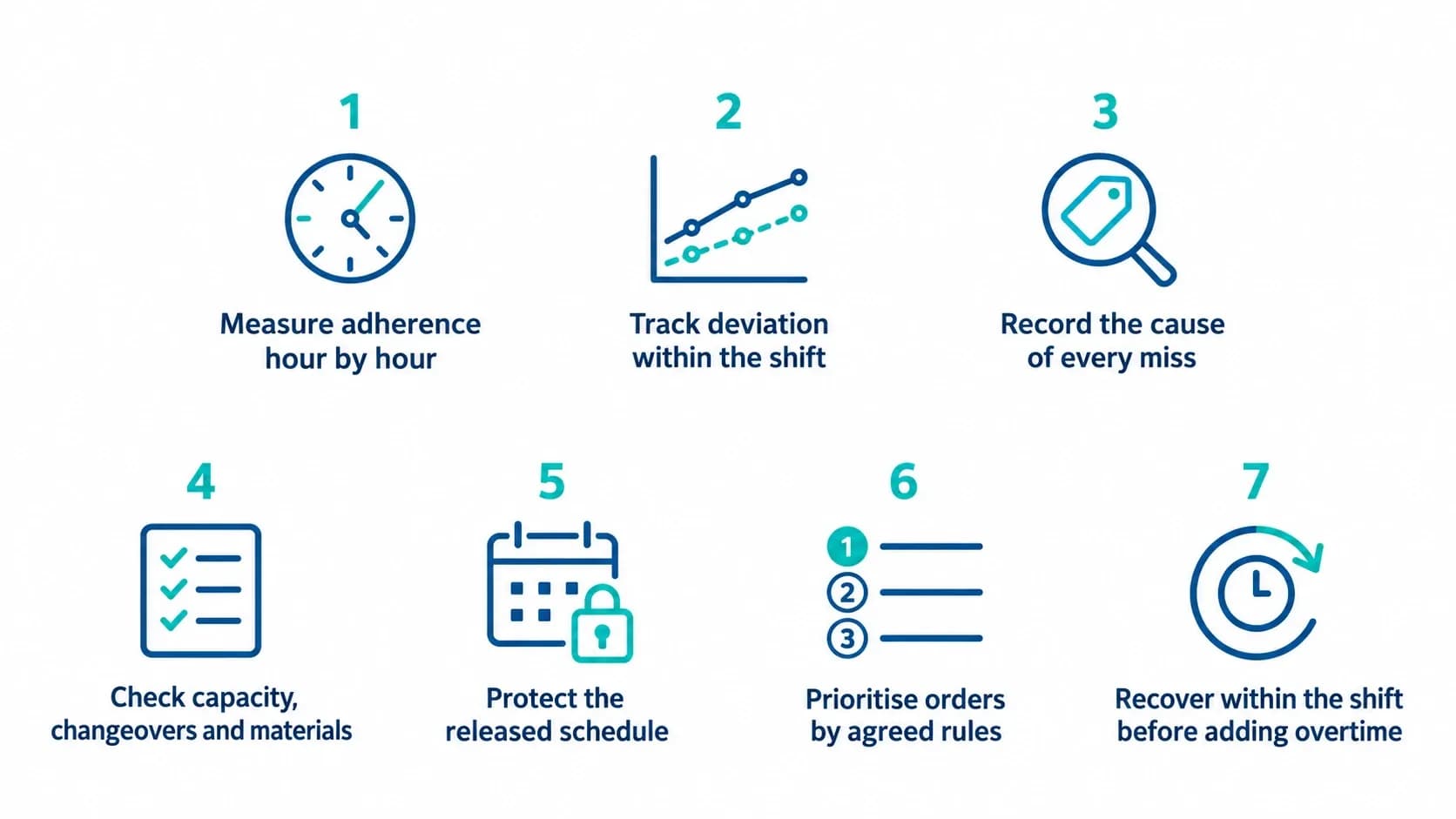
Production schedule adherence is the share of scheduled work completed as planned within the agreed time. Closing the gap takes seven habits, and each one builds on the last. Measure it, spot it early and name its cause. Then check the plan, protect it, prioritise by rule and recover within the shift.
Way 1: Measure production schedule adherence hour by hour
A shift can hit its output total and still miss the schedule.
- Define the measure first: Orders completed within the agreed tolerance, divided by orders due, times 100 [ (Orders completed withing agreed tolerance / Orders due) x 100 ]
- Keep the original plan visible, so every miss shows up
- Track quantity against the time-phased target, not the day total
One manufacturer expresses the shortfall as hours behind schedule, so a single figure works across products with different volumes. The target needs care too. Spread output evenly across the shift, and planned downtime shows up as a miss. A sound production schedule adherence calculation builds the target around real productive hours, which is how teams reach schedule attainment they can trust.
A trusted measure shows the gap. The next job is finding where it opens.
Way 2: Track deviation by shift while the shift can still recover
An end-of-day figure arrives after the chance to act has gone.
- Compare planned and actual progress at the same point in time
- Show the latest hour and the cumulative shift position together
- Locate each deviation by order, machine or work centre
Hour-by-hour shopfloor execution visibility lets supervisors respond promptly, spot patterns by hour, shift and machine, and hand over a shift with the facts in hand. That is production in view while the shift can still change it.
The board shows what is slipping. The reason comes next.
Way 3: Record the cause of every miss at source
A shortfall figure shows the size of the miss. The cause stays hidden.
- Capture the order, the time, the lost output and the reason
- Use fixed categories: equipment failure, missing material, labour, quality holds and rework
- Treat the first entry as an observed reason, then confirm the cause later
Operators log a shortfall reason at Pareto level at the moment of the miss, and supervisors add detail after the shift. That split keeps entry quick and investigation thorough, so schedule adherence root causes build up shift by shift. Quality holds delaying production and rework disrupting production schedules surface in those categories long before anyone writes a report.
Consistent reasons point to the assumptions that need testing before the next release.
Way 4: Test assumptions against capacity, changeovers and materials before release
A schedule needs the hours and the resources to use them.
- Convert planned quantities into operation hours
- Add changeover time for the intended sequence, plus breaks and planned maintenance
- Check machine, skilled labour and material for the same time window
One operations team validates and standardises bills of materials before release to manufacturing, so production readiness is confirmed before the schedule commits to the work. That single gate surfaces production capacity constraints, gaps in material availability for production and changeover time in production scheduling while a fix is still cheap.
A feasible plan still needs protection once the work is committed.
Way 5: Protect the released schedule from last-minute changes
A priority change moves more than the order at the front.
- Set a protected window for the near term
- Define who can authorise an exception and what it needs
- Communicate every authorised change to everyone affected
Updating a plan mid-run proved hard enough at one manufacturer that operational locks became necessary to keep changes from colliding with jobs already in progress. A frozen production schedule applies the same lesson. It controls last-minute production priority changes and protects schedule stability, while genuine emergencies still get a route through.
Protection lets the necessary exceptions in. A priority rule decides which ones.
Way 6: Prioritise orders by rule when capacity is tight
When orders compete for the same hours, urgency needs one definition.
- Agree the objective: protect commitments, cut lateness or keep the constraint busy
- Set categories and tie-breakers using due date, remaining work and readiness
- Record every exception and its reason
Priority rules, commit policy, planning horizon and late-order policy are decisions agreed once per site and applied consistently. That makes production order prioritisation a rule, not a daily argument. It protects production sequence adherence and keeps production bottleneck management focused on the work that matters most at the constraint.
A rule says what moves next. Recovery decides whether the move works.
Way 7: Recover within the shift without defaulting to overtime
Recovery starts with the remaining work and usable hours.
- Recalculate the remaining work, available time and resources
- Clear the blockage, reassign eligible work or re-sequence ready orders
- Name an owner and review the position at the next interval
One planning workflow unfinished work forward and redistributes the load. How to recover a delayed production schedule starts from the same idea: the remaining work, not the clock. When the shift cannot recover, state the revised commitment openly and weigh overtime against the real constraint. That is production schedule recovery as a routine.
Each of the seven rests on the same four things: a reliable baseline, current progress, recorded reasons and an accountable response. Teams that improve production schedule adherence treat recovery as a routine, not a rescue.
LTS Data Point: Connecting the schedule to shopfloor execution
A plan on paper becomes a schedule that teams can follow only when the floor can see it. LTS Data Point connects to your existing systems through ERP and MES integration, so the plan stays where it is and the floor gets the view it was missing.
- Hour-by-hour boards bring shopfloor execution visibility to every hour. Takt timer integration adds shift-level accountability, and the short interval control board sits at the centre.
- Delivery adherence dashboards, together with KPI dashboards, track planned vs actual production against your delivery KPIs.
- Root cause logging with escalation records the reason at the moment of the miss, so schedule adherence root causes build up shift by shift.
- The 4C problem solving workflow takes each concern through cause and countermeasure to a confirmed fix.
- Master Production Scheduling, resource allocation and operator scheduling support the capacity and sequence checks before work is committed. That is the production planning side of adherence.
- KPI action plans give full traceability: assign, track, escalate and close, with an audit trail for every action.
Picture a line where the ERP shows an order on track at two o’clock. On the board, the hours tell another story: output has dropped since noon because material never arrived. The supervisor logs the reason, escalates it and opens an action with an owner. By the next hour, the team has a production schedule recovery plan, not a surprise at the end of the shift.
The schedule still starts in the ERP. Adherence is won or lost on the floor, hour by hour.
Production schedules fail in the gap between plan and floor, and that gap can be closed. Measure it, see it early, name its cause, protect the plan and recover within the shift. Teams that improve production schedule adherence work from the hour, not the end-of-shift number, because the hour is where the schedule is still within reach.
Speak with an LTS Data Point expert about spotting schedule slippage earlier and improving your team’s response
FAQs
1. How do you calculate production schedule adherence?
Divide the orders completed within the agreed timing tolerance by the orders due, then multiply by 100. Measure against the original plan, and track quantity against a time-phased target so the figure shows when work finished as well as how much.
2. Is hitting the daily output target the same as production schedule adherence?
A shift can reach its output total and still miss the schedule. Adherence compares quantity with a time-phased target, so it shows whether work followed the plan hour by hour, which a day-end total cannot.
3. Should a revised production schedule replace the original when measuring adherence?
Keep both. Measure adherence against the agreed baseline, then use the revised schedule to guide execution. Replacing the original removes visibility of the miss and makes repeated schedule changes harder to assess.
4. Should planned downtime count as a schedule adherence failure?
Planned downtime should already be reflected in the schedule. Breaks, maintenance and planned changeovers should not create an artificial shortfall. If they exceed their allocated time and delay scheduled work, the resulting deviation should be recorded.
5. What is schedule nervousness in production?
Schedule nervousness describes repeated changes to a released plan. Each revision adds disruption of its own, leaving schedule instability behind and making firefighting the norm. A protected window for the near term, with authorised exceptions only, limits the damage.
6. How long should a frozen production schedule window be?
The window should reflect how far ahead of materials, people, equipment and preparation are committed. It needs to protect near-term work while allowing authorised exceptions. Its length should suit the operation rather than follow a fixed industry rule.
7. How can teams recover a delayed production schedule without overtime?
Start from the remaining work and the usable hours. Clear the blockage, reassign eligible work or re-sequence ready orders, then name an owner and review the position at the next interval. If the shift cannot recover, state the revised commitment openly and weigh overtime against the real constraint.

Geandra Queiroz, Operations Management Consultant
Geandra is an Operations Management Consultant at Lean Transition Solutions, specialising in Lean philosophy, Lean Six Sigma, and strategic planning across manufacturing and healthcare. She is currently completing her PhD in Industrial Engineering at the Federal University of São Carlos, researching the integration of Operations Strategy, Lean, and Green Manufacturing.