Shift-Based Production Tracking Boards for India: How C-Suite Leaders Are Turning Real-Time Shift Visibility into Competitive Advantage

Last updated on : April 23, 2026
Every shift that ends without a clear record is a decision that was never made. For senior leaders managing multi-shift manufacturing operations across India, that gap between what happens on the shopfloor and what reaches the boardroom is where competitive advantage is quietly lost.
Shift-based production tracking boards for India are closing that gap – giving leadership teams live, structured visibility into shift performance before problems compound across an entire day. For Indian manufacturers competing on speed, quality, cost, that visibility is no longer a nice-to-have. It is the operational foundation for sustained competitive edge.
See how LTS Data Point gives your leadership team real-time shift visibility across every production floor in India
Why shift visibility is a strategic issue – not just an operational one
Most senior leaders in Indian manufacturing do not lack data. What they lack is timely, shift-level data that connects shopfloor execution to strategic outcomes. A shift performance gap in Indian factories rarely looks catastrophic in a single shift – but compounded across three shifts, five days a week, and multiple production lines, it becomes a measurable drag on output, quality, and cost.
The scale of the opportunity is significant. According to a recent study, digital tools applied to shopfloor operations have the potential to lift plant productivity by 7-11% in Indian factories – gains that remain largely unrealised across the majority of operations today.
The scale of the opportunity is significant. According to a recent study, digital tools applied to shopfloor operations have the potential to lift plant productivity by 7-11% in Indian factories – gains that remain largely unrealised across the majority of operations today.
Shift-based production addresses this directly. It creates a structured, real-time record of what each shift produces, where it deviates from target, and what actions are taken in response.
The strategic case for C-suite attention is clear:
- Unresolved shift losses are carried forward and never fully recovered
- Blind spots between shifts in production prevent accurate root cause analysis
- Leaders making decisions from end-of-day reports are always operating in the past
- Factories with live shift visibility respond faster, waste less, and plan better
For Indian manufacturing organisations competing in domestic and export markets, manufacturing performance management begins at the shift level – not the monthly review.
What production boards actually track in a shift-based environment?
A daily production meeting board for shift tracking is not simply a display of numbers. In a well-structured operation, it is the single source of truth for everything that happened during a shift – updated continuously and accessible to every level of the industry.
Daily production tracking across shifts typically covers:
- Units produced versus target, tracked at defined intervals by hour or by takt time
- Downtime events – machine, material, or manpower related
- Quality rejections and first-pass yield per shift
- Attendance and workforce coordination status
- Safety observations and near-miss incidents
- Corrective actions raised and closed within the shift
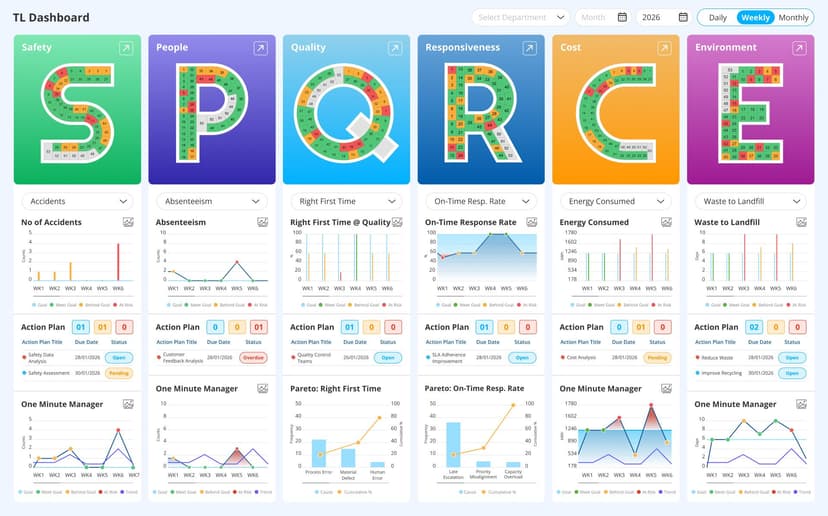
Line supervision boards extend this further by giving supervisors and team leaders a live operational picture they can act on – without waiting for a management meeting. When a line falls behind target at the second hour, the supervisor sees it immediately – not at the end of the shift when recovery is impossible.
This level of granularity transforms production boards for India from a reporting tool into an intervention tool.
The true cost of manual to digital production boards – Why the shift cannot wait
Indian manufacturing has long relied on physical whiteboards, paper log sheets, and verbal handovers to manage shift performance. In smaller, single-site operations, these methods can work reasonably well. As organisations scale – multiple plants, multiple shifts, complex product mixes – manual production tracking limitations in India become impossible to ignore.
The cost of staying manual is well documented. Research into manual data handling in industrial environments suggests that approximately every fifth production record contains faulty data. When figures are noted on paper and then re-entered into a system, roughly 40% of records include errors. Human errors in manufacturing – many originating from manual data entry – contribute to scrap and rework costs that can represent 5% to 30% of total manufacturing expenses.
Consider a mid-sized auto components manufacturer running three shifts across two plants. Each shift supervisor fills in a paper production log at shift end. By the time that data reaches the plant manager, it is four to six hours old. The signal that Line 3 had lost 18% output during the night shift - due to a recurring material flow issue – disappears entirely. This is shift data loss in manufacturing – and it is not a data problem. It is a visibility problem.
Manual to digital production boards eliminate this loss by:
- Capturing shift data at the point of occurrence, not after the shift ends
- Making live data accessible to plant managers, operations heads, and senior leadership simultaneously
- Preserving shift records for trend analysis and performance benchmarking
- Reducing dependency on verbal handovers and subjective shift summaries
- Enabling short interval management – reviewing performance at defined intervals within the shift, not only at its end
- Avoiding the hidden losses that manual boards cannot capture in real time
The move from manual to digital is not just technology upgrade. It is a governance upgrade that changes how companies account for production performance. Structured shift management software sits alongside this – aligning workforce planning with the same operational rhythm that production boards enforce.
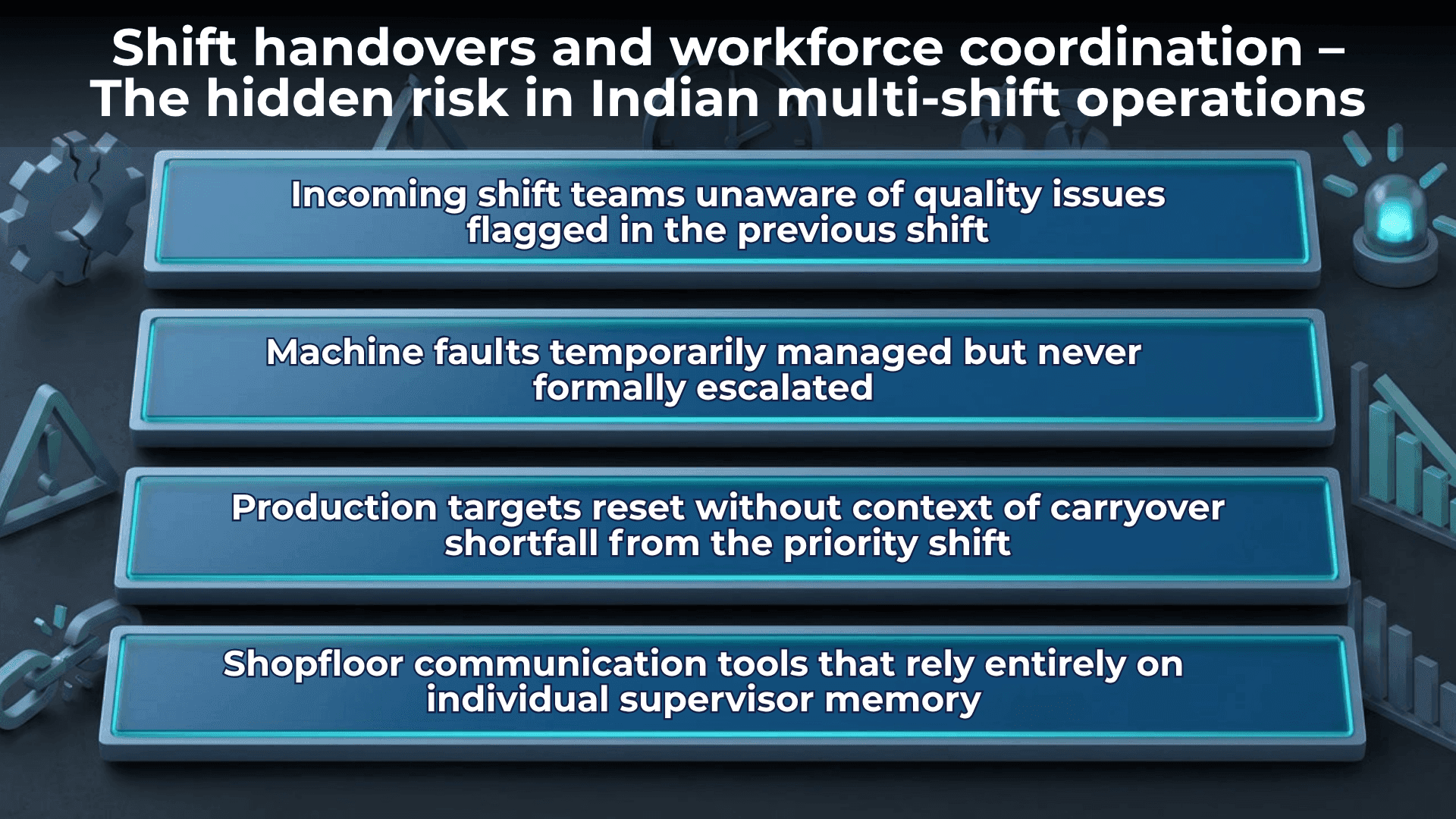
Shift handovers and workforce coordination – The hidden risk in Indian multi-shift operations
The handover between shifts is the most vulnerable moment in any continuous production environment. Industry research into process safety shows that while shift changeover accounts for less than 5% of total operations time, roughly 40% of plant incidents occur during these periods. For Indian manufacturers running three-shift operations across large, complex facilities, this risk is not theoretical.
Workforce coordination gaps in manufacturing during handovers typically result in:
- Incoming shift teams unaware of quality issues flagged in the previous shift
- Machine faults temporarily managed but never formally escalated
- Production targets reset without context of carryover shortfall from the priority shift
- Shopfloor communication tools that rely entirely on individual supervisor memory
A structured digital visual management board solves this by making the shift handover a data event rather than a conversation. Every issue, deviation, and open action item is visible on the board when the incoming team begins. Nothing depends on who remembers to mention it.
For C-Suite leaders, this matters because:
- Consistent handovers reduce rework, scrap, and unplanned downtime
- Incoming shift teams start with full context, not guesswork
- Shift-wise KPI tracking carries forward cleanly without data gaps
- Leadership has a reliable, unbroken record of production performance across the full operating day
How real-time shift data strengthens leadership decision-making across Indian plants
The value of real-time production tracking extends well beyond the shopfloor. For C-Suite teams overseeing multiple plants across India, live shift data fundamentally changes the quality and speed of strategic decisions.
According to a recent research report, on Industry 4.0 adoption in Indian manufacturing, despite 85% of senior business leaders considering digitalisation a top priority, only 30% of industries have successfully scaled their digital initiatives beyond pilot stage. The gap is not ambition – it is execution visibility.
Without live shopfloor performance tracking, leadership receives consolidated reports that smooth out variation, hide outliers, and present average performance. Average performance never reveals what is actually driving results – or quietly undermining them.
With shift production visibility boards in place, leadership gains:
- Live output performance against target – visible without waiting for shift-end summaries
- Shift-wise KPI tracking that captures variance at the earliest possible point
- Cross-plant comparisons that identify which facilitates are consistently outperforming targets and why
- Early signals of lack of real-time visibility on the shopfloor that would otherwise surface only in monthly reviews
Lean daily management in India depends on this layer. Without shift-level visibility, daily management reviews are retrospective. With it, they become genuinely predictive – and that is where competitive advantage lives.
How LTS Data Point powers shift-based production tracking boards for India
LTS Data Point is built for exactly this operating context – multi-shift, multi-plant Indian manufacturing organisations where senior leaders need structured, real-time visibility across every tier of the operation.
As a digital production board, LTS Data Point enables industries to:
- Configure shift-based production tracking boards tailored to each line, cell, or department
- Track hourly and shift-wise performance against defined targets in real time
- Capture downtime, quality deviations, and safety observations at the point they occur
- Support structured shift handover visibility through live, shared dashboards that incoming teams access immediately
- Enable line supervision boards at team leader level while giving plant managers and C-Suite leaders a consolidated, multi-site view
- Drive short interval control discipline by making interval-level performance data visible and actionable within the shift
LTS Data Point also supports the transition from manual to digital production boards without disrupting existing workflows. Teams can begin with digital tracking on priority lines and expand across the operation progressively – making the move both manageable and sustainable.
For Indian manufacturers seeking to strengthen manufacturing performance management and turn daily production tracking into a genuine source of competitive advantage, LTS Data Point provides the structure, visibility, and control that senior leaders need – at every level of the industry.
Shift visibility is the foundation on which competitive manufacturing is built. Indian manufacturers that invest in structured, real-time shift-based production tracking boards create an operational discipline that compounds over time – fewer losses, faster responses, stronger accountability, and leadership decisions grounded in live data rather than yesterday’s summaries. The gap between factories that track shifts on paper and those that track them digitally is not a technology gap. It is a performance gap – and in India’s manufacturing landscape, that gap is widening every shift.
Talk to an LTS Data Point specialist about deploying shift-based production tracking boards across your Indian manufacturing operations
FAQs
1. Are shift-based production tracking boards suitable for small and mid-sized Indian manufacturers?
Yes. Digital production boards scale to fit single-plant SMEs as well as large multi-site operations, and implementation can begin with a single line or shift.
2. How many shifts can a digital production board track simultaneously?
Modern platforms support tracking across all active shifts – day, evening, and night – simultaneously, with live data visible to each shift team and to leadership.
3. Can production tracking boards be configured for different production types – discrete, process, or assembly?
Yes. Boards can be configured to reflect the specific KPIs, intervals, and metrics relevant to each production type.
4. What happens to shift data after the shift ends – is it stored and accessible?
Yes. All shift data is retained and available for trend analysis, benchmarking, and performance reviews at any time.
5. How do digital shift boards support Tier 1 and Tier 2 review meetings in Indian plants?
Live shift data feeds directly into Tier meetings, giving team leaders and plant managers structured, accurate information without needing to manually compile reports before each meeting.
6. Can shopfloor operators use digital production boards without extensive training?
Yes. Well-designed boards are visual and intuitive. Operators interact with simple inputs – actual versus target – rather than complex data entry.
7. Is it possible to set up alerts when a shift falls below target?
Yes. Digital boards can be configured to trigger notifications when performance drops below defined thresholds, enabling immediate corrective action.

Abel Jiménez, Lean Consultant
Abel is a Lean Consultant with over 30 years of expertise in operational analysis, process improvement, and organisational change across Mexican industries. Currently serving as Director of Insurance Promotions at CESCEMEX, he helps organisations leverage technology and lean practices to improve efficiency and manage change with continuity.