Shopfloor Management in India: Why High-Volume Manufacturing Needs a New Operating Model

Last updated on : March 19, 2026
Running a high-volume factory in India today is like managing peak-hour traffic at a busy city junction in Mumbai or Bengaluru. Hundreds of vehicles are moving at the same time, every lane is under pressure, and one small signal failure can cause a long jam. In the same way, Indian shopfloors run multiple lines, shifts, suppliers and quality checks all at once. When information is late, decisions are slow, or problems are not visible in real time, delays and losses spread across the entire plant. That is why shopfloor management in India can no longer rely on manual boards, scattered Excel sheets and end-of-day reports – high-volume manufacturing now needs a new operating model that brings daily control, fast response and clear accountability on the factory floor.
See how LTS Data Point brings real-time control to your shopfloor
Why shopfloor management in India breaks down in high-volume factories
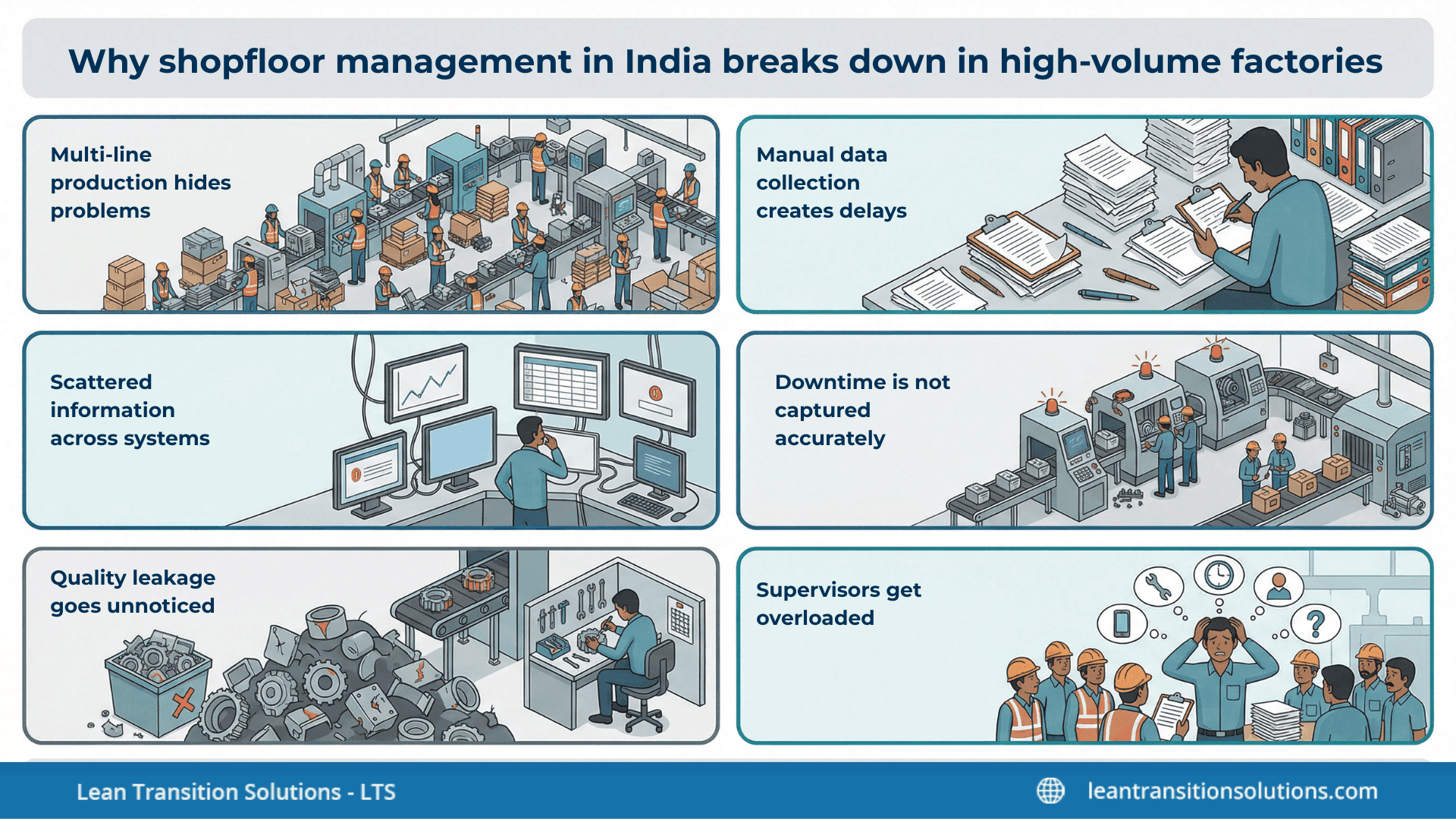
In most Indian factories, shopfloor management becomes difficult the moment production scales beyond a few lines and shifts. Automotive, FMCG, electronics and engineering plants typically run ten or more lines at the same time, with hundreds of operators, contractors and material movements happening together. When information is delayed or incomplete, control over the manufacturing shopfloor quickly starts slipping.
In India, this loss of control is not just an operational problem – it also becomes a compliance risk. Indian factories must meet requirements related to labour laws, safety regulations, quality standards and pollution control. When production data, manpower records and incident logs are tracked manually, plants struggle to prove compliance during factory inspections and customer audits.
Common reasons why shopfloor management fails in high-volume plants
- Multi-line production hides problems: When five or ten lines are running at the same time, small stoppages on each line add up to large output losses, but they remain invisible in daily reports.
- Manual data collection creates delays: Operators note numbers on paper, supervisors update Excel, and reports are compiled hours later. Decisions are made on old data, not real-time conditions.
- Scattered information across systems: Quality data, batch records and downtime reasons sit in different files and systems, which creates risk during ISO audits, customer checks and regulatory.
- Downtime is not captured accurately: Minor stoppages, changeover delays and machine idling often go unrecorded, even though they eat into daily production.
- Quality leakage goes unnoticed: Rejections, rework and deviations are discovered late, sometimes after a full batch is already produced.
- Supervisors get overloaded: Instead of managing the line, supervisors spend most of their time collecting data, answering calls and preparing reports.
The result is predictable. Even though machines, manpower and materials are available, high-volume factories struggle to control output, quality and delivery on a daily basis. Without real-time visibility and a structured operating rhythm, shopfloor management in India becomes reactive instead of proactive – problems are explained after they happen, not prevented while they are happening.
How shopfloor management in India impacts productivity, quality, and delivery
In high-volume manufacturing, every small delay on the shopfloor multiplies into a big business impact. When Indian shopfloor management is weak, machines may be running, but shopfloor productivity keeps failing because losses are hidden inside micro-stoppages, waiting time and poor coordination between lines and shifts.
Good shopfloor management in India makes these losses visible and controllable.
Where performance is won or lost on the shopfloor
- Shopfloor productivity improves when supervisors can see real-time output, downtime and bottlenecks instead of waiting for end-of-day reports.
- On-time delivery depends on whether today’s production problems are solved today. Delayed decisions on the shopfloor directly lead to missed dispatch schedules.
- Rejection control becomes possible only when quality issues are detected at the point of production, not after a full batch is already made.
- Poor visibility leads to more rework, which wastes capacity, increases labour cost and creates delivery delays.
- Hidden stoppages, rework and material waiting time cause massive efficiency loss, even though manpower and machines appear fully utilised.
- Missed targets on the shopfloor finally show up as missed customer commitments – delayed shipments, partial deliveries and quality complaints.
In Indian factories, customers expect reliable delivery, consistent quality and predictable output. That reliability is built or broken on the shopfloor every shift. When shopfloor management in India is structured, digital and visible, plants are able to protect shopfloor productivity, maintain rejection control, minimise rework and meet on-time delivery targets – which directly protects customer commitments and business credibility.
What a modern shopfloor management system in India should look like
A modern shopfloor management system in India plays a critical role in keeping factories compliant with Indian manufacturing regulations, not just productive. As volumes increase, manual registers and disconnected systems make it difficult to prove what actually happened on the Indian manufacturing shopfloor during a shift. Digital systems close this gap.
A well-designed Indian factory floor management setup supports compliance by providing:
- Shift-wise labour tracking for working hours, overtime and attendance, helping meet Factories Act, wage and contractor compliance.
- Incident and near-miss reporting on the connected Indian shopfloor, supporting safety audits and statutory safety requirements.
- Batch and lot traceability across lines, critical for pharma manufacturing shopfloor in India, food processing and automotive shopfloor management in India.
- Energy, water and emissions data from the digital shopfloor, helping meet pollution control board and ESG reporting needs.
When these controls are built into the shopfloor management system in India, factories no longer depend on scattered registers and manual audit preparation. Instead, data is captured automatically through real time production tracking and visible through factory dashboards, making Indian factory floor management not just operational, but audit-ready and regulator-ready as well.
How high-volume plants use shopfloor management in India to control daily operations
In large Indian factories, control is not created through monthly reports – it is created through lean daily management system on the shopfloor. High-volume plants depend on shopfloor management in India to run structured shift reviews, monitor live production and take corrective action before losses grow.
This is where production monitoring and downtime tracking become the backbone of Indian manufacturing shopfloor operations. Instead of waiting for yesterday’s numbers, supervisors and plant heads see what is happening right now across every line and shift.
How daily control works on a modern Indian shopfloor
- Shift reviews start with live data from the shopfloor management system in India, showing target vs actual, losses and quality status.
- Production monitoring highlight bottlenecks, material shortages and speed losses as they occur.
- Downtime tracking captures both major breakdowns and small stoppages that usually go unreported.
- Supervisor accountability improves because every action and delay is visible on the digital shopfloor.
- Real time production tracking ensures issues are solved during the shift, not explained later.
This structured daily rhythm is also what makes shopfloor management in India audit ready. When factory dashboards and production monitoring system are used consistently, plants can produce defensible data for:
- Customer audits by OEMs and export buyers
- ISO, safety and environmental inspections
- Government factory and labour inspections
Because data comes directly from the connected shopfloor, it cannot be manipulated or reconstructed after the fact. This gives Indian manufacturers confidence that their factory floor management is not only improving performance, but also protecting them during every audit, inspection and compliance review.
Using shopfloor management in India to manage multiple production lines at scale
In large factories, running multiple lines at the same time is the biggest challenge in Indian shopfloor management. Whether it’s automotive, FMCG or electronics manufacturing, each line has different cycle times, material flows and quality risks. Without a structured Indian manufacturing shopfloor system, some lines run smoothly while others become permanent problem areas.
A modern shopfloor management system in India brings all lines onto one connected Indian shopfloor, giving supervisors and plant heads a single view of what is happening across the factory.
How Indian plants control multi-line complexity
- Line balancing becomes easier when real time production tracking shows output, speed and losses for every line.
- Bottleneck control improves because slow machines and blocked processes are visible immediately on Indian factory dashboards.
- Indian production monitoring system underlines where material, manpower or machine constraints are limiting throughput.
- Factory floor management teams can shift operators, adjust schedules and prioritise orders based on live data.
- Digital shopfloor tools ensure that one underperforming line does not pull down the entire plant.
For Indian automotive shopfloor management, this means synchronising welding, assembly and testing lines. In Indian FMCG factory management, it means balancing filling, packing and dispatch lines. For Indian electronics factory floor, it means controlling takt time, rework loops and inspection queues.
By using shopfloor management in India to drive line balancing and bottleneck control, high-volume plants are able to increase output, reduce waiting time and protect shopfloor productivity across every production line, every shift.
Where shopfloor management in India fits in a modern manufacturing operating model

In today’s competitive environment, Indian shopfloor management is no longer just a production tool – it is a core layer of the Indian manufacturing operating model. High-volume factories that are pursuing operational excellence and long-term factory transformation depend on reliable, real-time shopfloor data to drive every other management system, from planning and quality to safety and compliance.
Without a connected Indian manufacturing shopfloor, leadership teams are forced to run the business on delayed, incomplete or manually compiled numbers.
Why shopfloor data now underpins the entire operating model?
A digital shopfloor management system in India provides defensible, audit-ready data that supports:
- Customer audits by OEMs and export buyers
- ISO, safety and environmental inspections
- Government factory and labour inspections
Because data comes directly from real time production tracking and the connected shopfloor, it cannot be altered after the event. This makes Indian factory floor management not only operationally strong, but also legally and commercially defensible.
Where LTS Data Point fits
LTS Data Point manufacturing performance management software is designed to sit at the centre of this operating model. It connects production monitoring system, quality, downtime, safety and compliance data into one structured performance layer across the Indian manufacturing shopfloor.
As documented on the LTS Data Point platform, it is configured to support multiple performance-management frameworks used by Indian and global manufacturers, including:
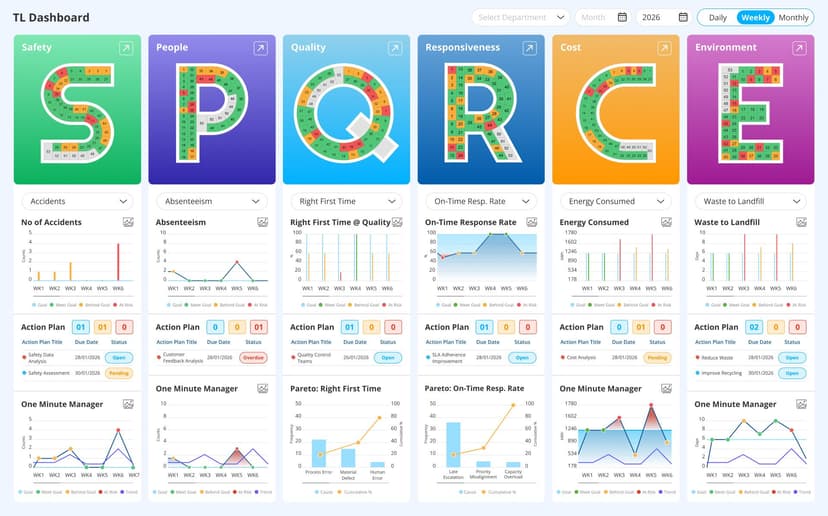
- SPQRCE – Safety, People, Quality, Responsiveness, Cost, Environment
- PQCDSM – Productivity, Quality, Cost, Delivery, Safety, Morale
- EQDCPS – Environment, Quality, Delivery, Cost, People, Site action
- ESQDCP – Environment, Sales, Delivery, Cost, People
- SHEQCPLDCPS – Safety, Health, Environment, Quality, Customer, Production, Lean, Delivery, Cost, People, Site action
These frameworks define what needs to be controlled on the shopfloor – LTS Data Point provides the digital layer that captures, structures and visualises those metrics across lines, shifts and plants.
How this supports Indian factory leaders
LTS Data Point is typically used when high-volume Indian manufacturers need to:
- Run a consistent lean daily management system across multiple plants and production lines.
- Maintain framework-based performance control without relying on Excel and manual boards.
- Provide audit-ready data for customers, ISO bodies and government inspectors.
- Support Indian manufacturing digitalisation and the move towards a smart Indian factory.
By anchoring shopfloor management in India to recognised operational frameworks and real-time factory data, LTS Data Point manufacturing performance management software enables leadership teams to move from reactive reporting to predictable, scalable operational excellence across their factory network.
High-volume manufacturing in India can no longer be run on spreadsheets, whiteboards and end-of-day reports. As factories grow larger and more complex, shopfloor management in India becomes the foundation of productivity, quality, compliance and customer trust. When production, downtime, quality and safety data are captured through a connected Indian digital dashboard and used in daily decision-making, plants gain the control they need to meet customer commitments, pass audits and scale with confidents. In this new operating model, the shopfloor is not just where work happens – it is where business performance is created and protected every single shift.
Find out how LTS Data Point can support your factory transformation
FAQs
1. Is shopfloor management in India different from MES?
Yes. Shopfloor management focuses on daily execution, people, losses and performance control, while MES mainly handles machine and process data. Many Indian factories use both together.
2. How long does it take to stabilise shopfloor management in a large Indian plant?
Typically, 8-16 weeks are required to establish a working daily management rhythm once digital tracking and supervisor routines are in place.
3. Can shopfloor management work in labour-intensive Indian factories?
Yes. It is especially useful in labour-heavy environments where attendance, skill mix and manual processes drive productivity and quality.
4. Do small and mid-size Indian factories also need shopfloor management?
Yes. Even smaller plants benefit because it helps prevent hidden losses, quality drift and poor delivery performance as volumes grow.
5. How does shopfloor management help with export customers?
It provides traceable production and quality records, which export buyers and OEMs require during audits and compliance checks.
6. Can shopfloor management reduce overtime costs?
Yes. Better line balancing and downtime visibility help plants meet targets within normal shift hours, reducing unplanned overtime.
7. Does shopfloor management require new machines and automation?
No. It focuses on how work is managed and monitored, not on replacing existing equipment.

Abel Jiménez, Lean Consultant
Abel is a Lean Consultant with over 30 years of expertise in operational analysis, process improvement, and organisational change across Mexican industries. Currently serving as Director of Insurance Promotions at CESCEMEX, he helps organisations leverage technology and lean practices to improve efficiency and manage change with continuity.