Shopfloor Management in UK: How to Drive Operational Excellence in Manufacturing

Last updated on : March 18, 2026
Imagine a manufacturing floor as a high-speed train, hurtling towards its destination. Every part, from the engine to the carriages, must work in perfect synchrony to maintain speed and efficiency. In the world of UK manufacturing, shopfloor management acts as the conductor, ensuring smooth coordination between processes, teams, and technology. Without effective management, the train risks derailing — from delays to inefficiencies. In this blog, we’ll explore how businesses across the United Kingdom can optimise shopfloor management to keep their manufacturing operations on track, boosting performance and driving operational excellence. Let’s delve into the key strategies that make this possible.
Why shopfloor management in UK is key to operational excellence
Effective shopfloor management in UK is the backbone of any successful manufacturing operation. In the context of UK industries, it drives not only productivity but also compliance with national standards. Here's why it’s essential:
- Improves efficiency: Streamlined shopfloor management reduces downtime and waste, directly improving operational efficiency.
- Ensures compliance: Adhering to UK manufacturing regulations helps prevent costly penalties and ensures a safe working environment.
- Optimises resource use: Proper management maximises the use of materials, machinery, and manpower, enhancing profitability.
- Boosts employee engagement: A well-managed shopfloor boosts morale and keeps employees engaged by providing clear roles and expectations.
- Drives continuous improvement: Encourages a culture of continuous improvement, allowing manufacturers to stay competitive in the global market.
Ultimately, an efficient shopfloor management in UK system lays the foundation for operational excellence, where both compliance and performance go hand in hand.
Key regulations shaping shopfloor management in UK
In shopfloor management in Great Britain, regulation is not a side issue – it is part of how the factory is run day to day. UK manufacturers operate in one of the most tightly governed industrial environments in the world, where safety, quality and worker protection are legally enforced, not optional.
For shopfloor leaders, this means performance and compliance must move together.
The main rules that shape GB factory operations include:
- Health and Safety at Work Act 1974: The foundation of health and safety in UK manufacturing – requiring employers to provide safe equipment, safe systems of work and proper training.
- Management of Health and Safety at Work Regulations: Forces formal risk assessments, hazard controls and documented safety processes on the shopfloor.
- Provision and Use of Work Equipment Regulations (PUWER): Ensures machines are safe, maintained and used correctly by trained operators.
- Working Time Regulations: Controls shift length, rest breaks and overtime – directly affecting production planning.
- UK manufacturing regulations for reporting and audits: Require traceable records for incidents, inspections, maintenance and compliance checks.
What this means for shopfloor management in UK:
- Safety checks must be part of daily work, not separate admin
- Training records and machine status must be visible
- Incidents, near-misses and corrective actions must be tracked
- Production targets must align with legal working limits
When UK factory compliance is built into shopfloor routines, manufacturers reduce risk while keeping output stable. This is why strong shopfloor management in United Kingdom is not just about hitting targets – it is about running a legally secure, inspection-ready operation every day.
Best practices for optimising shopfloor management in UK factories
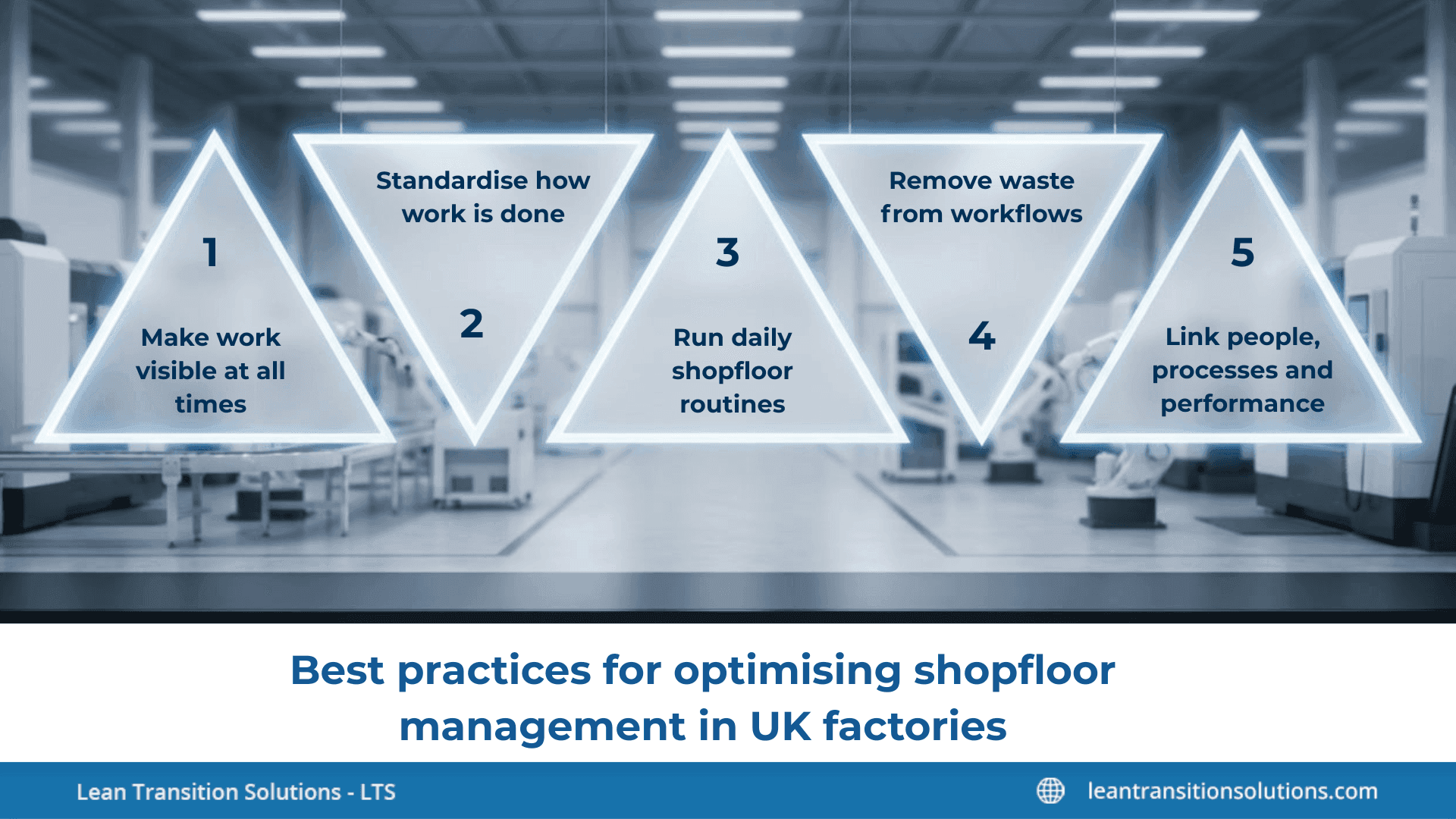
Strong shopfloor management in UK is built through simple, repeatable practices that make work visible, predictable and easier to control. In UK factories, these practices must also support compliance, safety and traceability.
Here are the most effective ways UK manufacturers optimise performance on the shopfloor.
1. Make work visible at all times
- Use visual boards to track output, downtime, quality and safety
- Show daily target vs actuals for every production line
- Display safety alerts, audits and shift responsibilities
This is a core principle of lean manufacturing in the UK – problems should be visible the moment they appear.
2. Standardise how work is done
- Define one best way to run each process
- Lock in safe working methods for every machine
- Ensure operators follow the same steps across all shifts
Standard work improves shopfloor efficiency in UK factories while also meeting regulatory expectations.
3. Run daily shopfloor routines
- Short team huddles at the start of each shift
- Quick reviews of safety, quality, delivery and downtime
- Clear ownership of problems and actions
These routines keep shopfloor management in UK focused on real-time control, not after-the-fact reporting.
4. Remove waste from workflows
- Cut unnecessary movement, waiting and rework
- Simplify handovers between teams
- Reduce overproduction and excess inventory
This is where lean manufacturing in the UK directly boosts cost, speed and reliability.
5. Link people, processes and performance
- Match skills to tasks
- Train teams to spot and report issues
- Track results against clear standards
When these best practices are in places, shopfloor management in GB becomes proactive rather than reactive – helping factories run smoother, safer and more profitable every single day.
How to enhance productivity through UK shopfloor processes
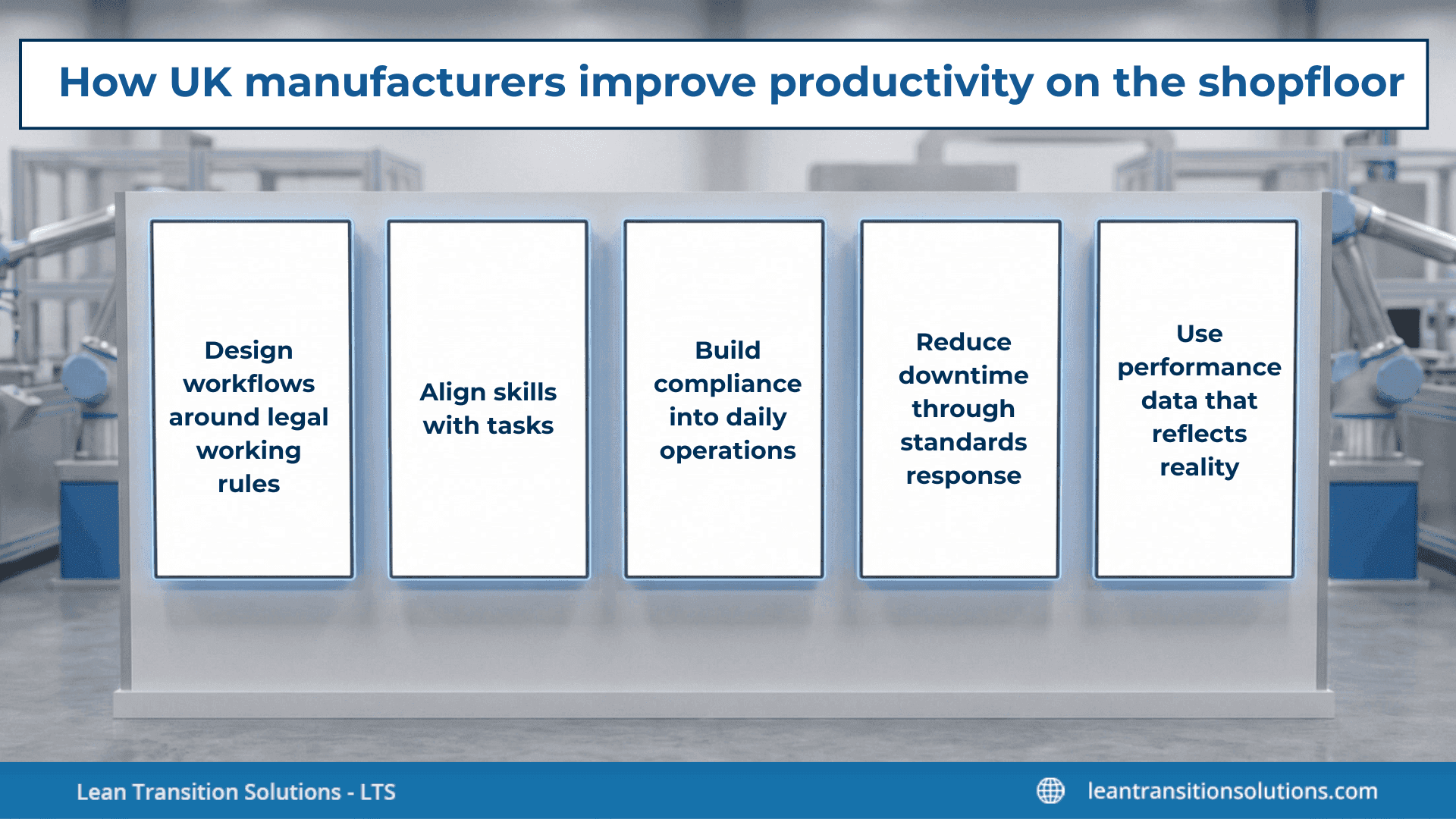
High productivity in UK shopfloor management does not come from pushing people harder – it comes from running better processes that comply with how UK factories are legally and operationally required to work.
When UK industry regulations and UK manufacturing workforce standards are built into daily workflows, performance becomes more stable and predictable.
How UK manufacturers improve productivity on the shopfloor
1. Design workflows around legal working rules
- Shift patterns must align with Working Time Regulations
- Rest breaks must be planned into production schedules
- Overtime and fatigue risks must be controlled
This prevents burnout, errors and unplanned stoppages.
2. Align skills with tasks
- Operators must be trained and certified for the machines they run
- Multi-skilled teams reduce bottlenecks during absences
- Training records support UK manufacturing workforce standards
Skilled people mean fewer breakdowns and less rework.
3. Build compliance into daily operations
- Safety checks become part of start-of-shift routines
- Machine condition is reviewed before production starts
- Incident reporting is simple and immediate
This keeps UK shopfloor management both productive and inspection ready.
4. Reduce downtime through standards response
- Define what happens when a machine stops
- Assign clear ownership for faults and fixes
- Track root causes, not just lost output
This approach cuts repeat failures and protects throughput.
5. Use performance data that reflects reality
- Track output, defects, downtime and safety together
- Compare results across shifts and lines
- Act on trends, not just yesterday’s numbers
By combining structured workflows with UK industry regulations, shopfloor management in UK industry regulations, UK shopfloor management creates a stable operating rhythm – where productivity improves without increasing risk, pressure or legal exposure.
Training and development for effective shopfloor workforce management in the UK
People are the engine of shopfloor management in GB. Even the best systems fail if the workforce is not trained, supported and legally compliant. In UK manufacturing, training is not optional – it is a core requirement of safe and productive operations.
Strong training programmes help companies meet UK manufacturing workforce standards while also improving daily performance.
What effective UK shopfloor training looks like
1. Role-based skills development
- Operators trained for the specific machines they use
- Supervisors trained in safety, quality and people management
- Maintenance teams trained in compliant equipment handling
This reduces errors and supports health and safety in UK manufacturing.
2. Safety-first training culture
- Induction training for all new starters
- Regular refresher courses on hazards and procedures
- Toolbox talks built into shift routines
This protects both workers and the business.
3. Compliance-driven certification
- Records of who is trained on what
- Proof of competence for audits and inspections
- Easy access to training history
These records are essential for GB factory compliance.
4. Continuous improvement through skills
- Upskilling to support lean working
- Cross-training to cover absences and peaks
- Problem-solving training for frontline teams
When skills grow, productivity follows.
By investing in people, shopfloor management in UK becomes more resilient, safer and more efficient – creating a workforce that can meet production targets without breaching UK manufacturing workforce standards.
Leveraging technology to streamline shopfloor management in UK manufacturing
Modern shopfloor management in UK depends on more than whiteboards, spreadsheets and end-of-shift reports. UK factories operate under strict UK manufacturing regulations and Great Britain manufacturing laws, which means production, safety, quality and compliance must be visible in real time – not discovered after the damage is done
This is where LTS Data Point – shopfloor performance management software is typically used: to give UK manufacturers a single, live view of what is really happening on the factory floor.
Why technology now defines shopfloor control in the UK
UK manufacturers face three constant pressures:
- Rising compliance and audit demands
- Workforce shortages and skills gaps
- Tighter margins and delivery expectations
Without digital control, shopfloor management in UK becomes slow, reactive and risky.
LTS Data Point is designed to replace scattered spreadsheets, paper boards and disconnected systems with a live, structured performance layer across the factory.
Using performance frameworks to structure UK shopfloor management
Many UK factories organise their performance thinking using operational frameworks such as:
- SQDCP – Safety, Quality, Delivery, Cost, People
- SQDCM – Safety, Quality, Delivery, Cost, Morale
- PQCDSM – Productivity, Quality, Cost, Delivery, Safety, Morale
- SQDIC – Safety, Quality, Delivery, Inventory, Cost
- SPQRCE – Safety, People, Quality, Responsiveness, Cost, Environment
- PQVC- People, Quality, Velocity and Cost
These are not software tools – they are management lenses used by UK manufacturers to run legally compliant, high-performance factories.
LTS Data Point – Shopfloor performance management software is typically configured so that:
- Every metric on the shopfloor maps to the factory’s chosen framework
- Safety, quality, output, downtime and people data are captured at source
- Leaders see real-time performance across lines, shifts and plants
This allows shopfloor management in UK to operate against a single, structured truth – aligned to how UK factories already manage performance.
How LTS Data Point supports UK compliance and productivity
Because UK regulations demand traceability, visibility and control, LTS Data Point is designed around:
1. Live shopfloor data
- Output, downtime, rejects and delays captured as they happen
- No waiting for end-to-shift spreadsheets
- Faster response to problems
2. Built-in compliance discipline
- Safety checks, audits and actions recorded digitally
- Evidence ready for HSE inspections and internal audits
- Supports UK manufacturing regulations without extra admin
3. Standardised daily management
- Digital shift handovers
- Escalation of issues
- Consistent routines across all teams
This removes the risk that comes from manual reporting and disconnected tools.
Why this matters for Great Britain manufacturers
In Great Britain, factories are judged not just on what they produce – but on how safely, consistently and legally they produce it.
With LTS Data Point – shopfloor performance management software, UK manufacturers gain:
- A single source of truth for performance
- Real-time visibility for supervisors and managers
- Evidence for regulators, auditors and customers
- A scalable platform for growth
This is how shopfloor management in UK moves from reactive firefighting to structured, compliant and high-performance operations – without increasing paperwork, pressure or risk.
Just like a well-run train needs every carriage, signal and control room working in sync, strong shopfloor management in UK depends on people, processes and data moving together in the right direction. When UK manufacturers align daily shopfloor routines with safety laws, workforce standards and performance frameworks, operational excellence becomes sustainable — not fragile. By combining disciplined ways of working with modern digital platforms such as LTS Data Point – shopfloor performance management software, factories across Great Britain can stay compliant, reduce waste and keep production running smoothly, even as regulations and market pressures continue to tighten.
Get expert advice on running safer, more efficient UK factories with LTS Data Point
FAQs
1. What is the difference between shopfloor management and production management?
Shopfloor management focuses on day-to-day control of people, machines, safety and quality on the factory floor, while production management looks at higher-level planning, scheduling and resource allocation.
2. Does shopfloor management in UK differ from other countries?
Yes. UK factories must follow strict health, safety and employment laws, meaning shopfloor routines must be designed around compliance, training and worker protection.
3. Who is responsible for shopfloor management in a UK factory?
Responsibility is shared between supervisors, production managers, health and safety officers and senior leadership – not just the line managers.
4. How often should shopfloor performance be reviewed?
In UK manufacturing, performance is typically reviewed every shift, daily and weekly to ensure safety, output and compliance are maintained consistently.
5. Can small UK factories use formal shopfloor management systems?
Yes. Even small factories benefit from structured shopfloor management, as it reduces risk, improves visibility and supports compliance with UK regulations.
6. How does shopfloor management affect audit readiness?
Strong shopfloor management ensures safety checks, training records and process controls are documented and visible, making audits far easier to pass.
7. What happens when shopfloor management is weak?
Weak shopfloor management leads to higher accident risk, more downtime, quality problems and greater exposure to regulatory penalties.
8. How long does it take to improve shopfloor performance?
With the right structure and tools, UK manufacturers often start seeing improvements in safety, output and stability within a few weeks.

Geandra Queiroz, Operations Management Consultant
Geandra is an Operations Management Consultant at Lean Transition Solutions, specialising in Lean philosophy, Lean Six Sigma, and strategic planning across manufacturing and healthcare. She is currently completing her PhD in Industrial Engineering at the Federal University of São Carlos, researching the integration of Operations Strategy, Lean, and Green Manufacturing.