Short Interval Control Plan vs Actual: Why a Right Plan Still Misses the Shift and How to Keep Production on Schedule
Last updated on : October 26, 2026
At 10 am, a line stops for six minutes, then runs a little slow. Short interval control plan vs actual reviews exist for the hours that follow, when the plan is still right and the shift is already behind. Six minutes sounds like nothing. Yet this is how missed hourly production targets begin. Lean practitioner guidance explains part of why: shift-based data lacks the granularity that interval-level decisions need.
So, where does a right plan actually lose the shift, and who sees it first?
See how LTS Data Point helps your teams spot production gaps and act before the shift ends
Why a realistic plan still misses the shift
Hitting a target once is a different thing to holding it. Short Interval control in manufacturing starts from that gap. One manufacturer’s line has reached its 1.2 linear metres per minute target on some days, then missed it for several days running. It now runs at 1.1. That tenth is roughly 8% of the target, and production running below target rate by that margin looks harmless.
What pulls a right plan off course? Three ordinary things:
- Downtime: unplanned stoppages remove productive minutes without warning
- Material: late arrivals at the line leave stations waiting
- People: absence and single-skilled operators leave nobody to move across
Then the small stops arrive. Misfeeds, jams and blocked sensors get cleared in seconds, so they feel routine, and routine losses stop registering. That is small production losses adding up until they become missed hourly production targets, one quiet minute at a time.
Then comes the record. Manual boards can’t keep up with the shift. On one line, downtime is written on a paper sheet. The sheet reaches admin at the end of the shift, after every stoppage has already happened. Operators may deal with a stop on the spot. The record still arrives too late to support a coordinated response while the shift is running. That is late reaction to production losses in its plainest form: the information exists, but it arrives after the moment it was needed.
The pace data follows the same path. A supervisor runs a report from the office at nine to see the first three hours, and operators only see it once it is relayed through the cell leaders. A short interval control review changes who sees what, and when: the team compares recent output with the interval target while hours remain, so the cumulative production shortfall is known before it becomes the result. Visibility is not a report written after the shift, but a number the team can act on before it ends. So, once the gap is visible, can the rest of the shift still close it?
How to tell whether the remaining shift can still hit the target
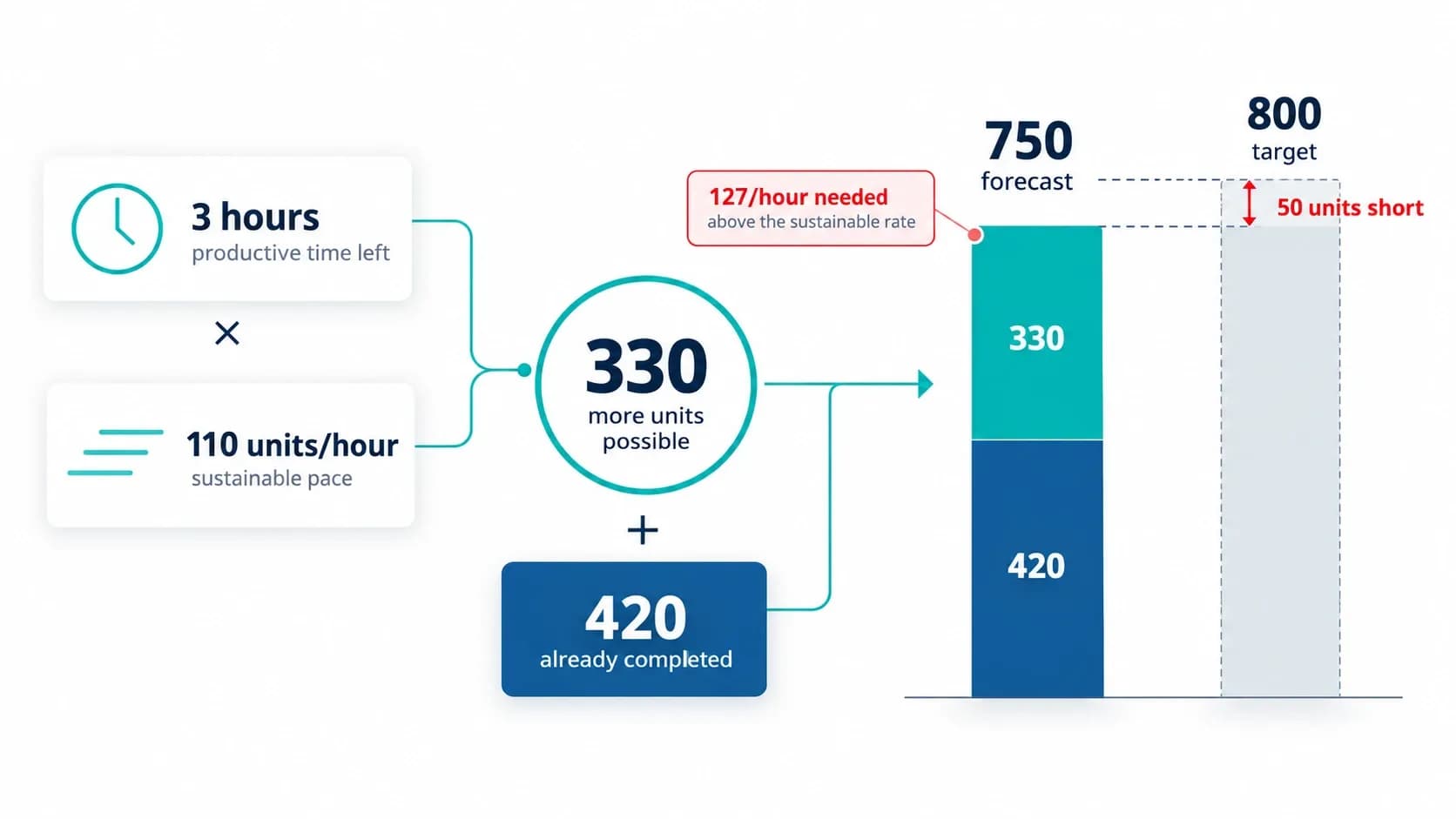
A shortfall is a number. Whether the shift can still recover it depends on the work outstanding, the productive time left and a pace the line can hold. Four checks settle it.
- The gap so far: Compare cumulative good output with the cumulative target due at the review point. Hourly production variance shows one hour. Cumulative production shortfall shows the shift.
- The time left: Start from the review time, not the shift start, and remove the breaks, maintenance and changeovers still ahead. Across a whole shift, one manufacturer’s 6:00 to 14:30 window holds 445 productive minutes once breaks, a pre-shift meeting and clean-down come out. Clock time overstates it.
- The pace available: Multiply those hours by a rate the line can sustain. That gives the remaining shift production capacity. Capacity covers more than a nominal cycle time, because setup and change intervals and manual work all count.
The pace available: Multiply those hours by a rate the line can sustain. That gives the remaining shift production capacity. Capacity covers more than a nominal cycle time, because setup and change intervals and manual work all count.
Even the 110 is an assumption. One manufacturer sets a 10-minute cycle time per panel yet knows it moves because some panels are harder to build than others. A different mix ahead changes the sustainable rate.
An end-of-shift output forecast projects the finish from those assumptions. It informs the call to recover, re-sequence or escalate; the team makes the call. The arithmetic shows what is needed, not what is possible. So, if the target itself moves mid-shift, which number is the team chasing?
What plan vs actual means when the plan changes mid-shift
The plan moves. It always does.
A rush job takes the machine. The order already running slides behind it. One manufacturer’s team described a switch decided minutes before, not days. The production plan keeps changing, and the board is the last to know.
The floor learns late. A change travels from the scheduling team to supervisors or shift leaders, and only then to the line. A job may already have moved out while the line is still building it. The output is real. The target is stale. Every short interval control plan vs actual comparison made in that gap measures the wrong thing.
So, the target has to move. How it moves is the real question.
The original plan stays on record. The new quantity, the reason and the time it took effect get logged. Only the intervals still ahead change. Completed hours keep their comparison, because resetting the baseline wipes the earlier variance. Government guidance on schedule control says the same: undocumented changes distort variance and leave people working from different versions of the plan.
Then comes the trap. An order that overrun shows red. Change its plan quantity and the same run reads as adherence. Against the original it is a miss. Against the revised quantity the shift was asked to run, it is compliance. An authorised overrun is an instruction, not automatically a loss. Neither number tells the full story. The record does: an authorised instruction, an execution loss, or both.
Mid-shift production replanning gives the team a target for the work that remains. The original comparison explains what changed. One answers what next. The other answers why. So, once the target and the loss are both clear, what does the team do to improve the next interval?
How to act on production losses before the shift ends
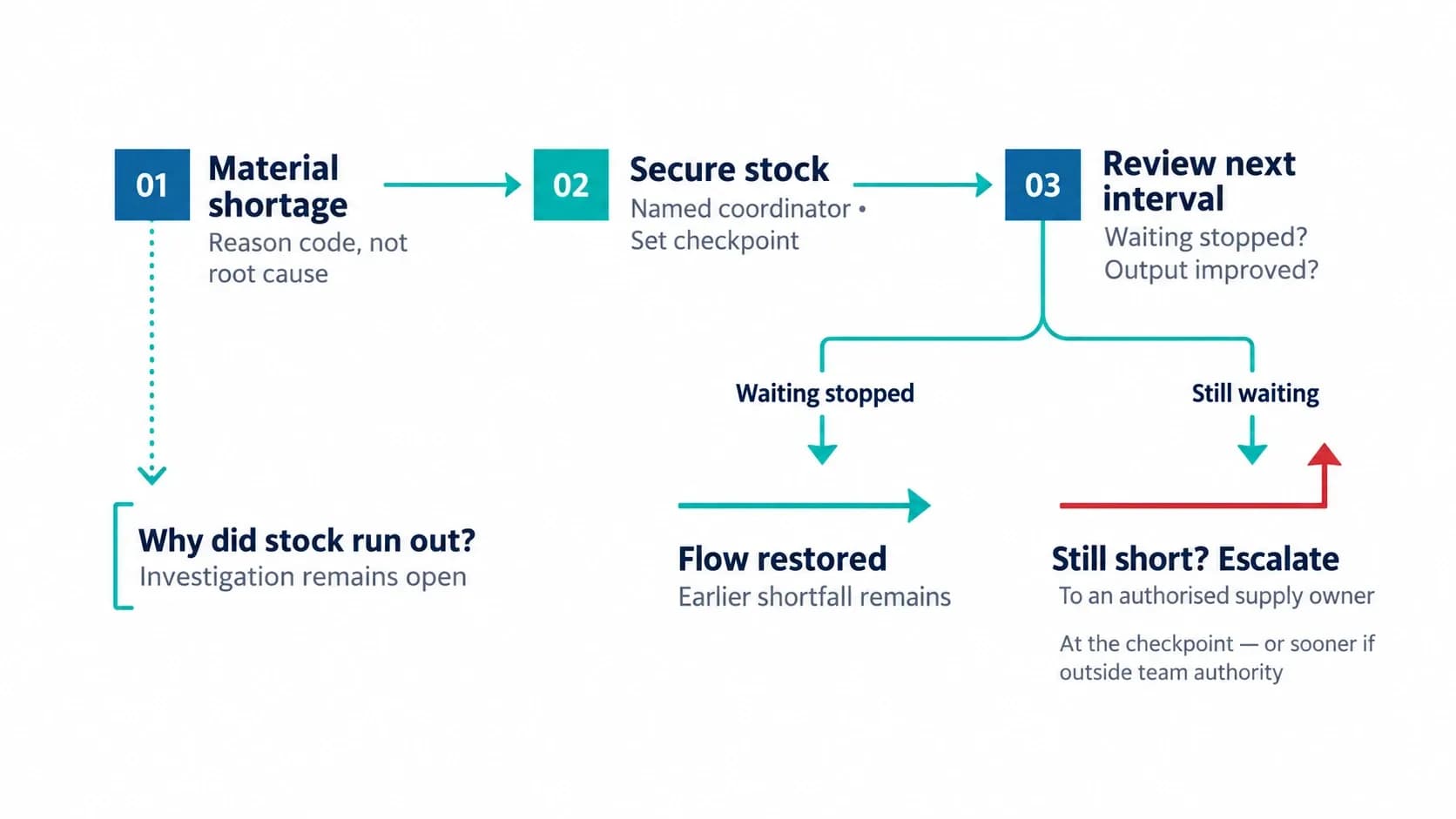
A visible loss is still a loss. Production losses without corrective action repeat, hour after hour, until the shift ends and the shortfall is simply recorded.
- A reason code starts the investigation. It names a category, such as material shortage, and leaves the cause open. One manufacturer ran out of a part mid-build with no visibility on why and waited for stock. Production loss reason codes show where to look; the cause still needs finding, and the 5 Whys of Lean is one way to get there.
- The response needs an owner. Some actions restore flow, like pulling the part forward. Others contain the impact, like re-sequencing the work. Preventing a repeat is slower and depends on the cause. Corrective actions during a production shift each get a named owner and a check point.
- The next interval is the check. Did the output recover, hold or slip? The next interval shows whether the loss moved. One manufacturer note that action plans stall without a supervisor chasing them, because follow-up is manual.
- Escalation follows need. In one lean response chain, a team member restores normal conditions or signals for help, a team leader troubleshoots more broadly, and a group leader can call maintenance or engineering. A missed hourly production target can go up the first time, when the fix sits beyond the team’s skills or authority. Repeated hourly production shortfalls prompt a fresh look at the cause as well.
Picture one line. The code says material shortage. A named coordinator secures the stock. At the next review the team asks two questions: has the waiting stopped, and has output moved? If stock is still short when the agreed response window closes, the issue goes to someone authorised to fix the supply constraint. The line restarts. The question of why the shortage happened stays open.
Restored flow and recovered output are different things. Stopping further loss leaves the accumulated shortfall where it was. The loop needs a recorded owner, action, result and open issue. Short interval control actions keep that record visible from one review to the next. So, what keeps it connected, review after review?
How LTS Data Point connects plan vs actual to action within the shift
A board shows the gap. Closing it takes people, actions and review, and LTS Data Point connects the hourly numbers to all three.
- Plan vs actual, hour by hour. Hour-by-hour short interval control boards sit inside the Downtime Monitoring add-on includes a short interval control board that runs hour by hour, and the KPI dashboards track plan vs actual performance. Short interval control target vs actual becomes one view the whole team shares.
- Losses logged with a reason. Root cause logging records why output fell behind and escalates it, so short interval control loss tracking leads somewhere.
- Actions that reach closure. Each action follows 4C problem solving: Concern, Cause, Countermeasure, Confirmed. It is assigned, tracked, escalated and closed, with a full audit trail.
- Reviews that carry the response up. Tiered reviews take the shift’s issues from the shopfloor to leadership, so escalation happens on time and actions are followed through.
The board also keeps the target honest. Its running total shows whether the shift can still recover its cumulative production shortfall or needs to escalate. When the plan changes mid-shift, the targets follow it, and the original plan stays on record for comparison.
All of this sits alongside the systems a site already runs. Data Point connects to existing systems through MES-ERP integration, so the plan and the actuals arrive from sources already in use.
Technology alone falls short. One lean expert describes an alert system on a production line that was installed and working, yet drew little response, because the habits and management support behind it had not been developed. Tiered reviews, assigned actions, and escalation are those routines. A short interval control review then asks the right question: what changed since the last hour, and who owns response?
A board tells the team where it stands. The system around it decides what happens next.
A right plan can still miss the shift, because the gap opens between reviews. Short interval control plan vs actual shows that distance: the hourly gap, the pace needed, an honest target and an action checked in the next interval. LTS Data Point keeps those pieces connected. The plan decides what should happen. The next hour decides what does.
Discover how LTS Data Point could strengthen your response when production falls behind plan
FAQs
1. How do you calculate hourly production shortfall?
The shortfall for an interval is its target minus the good output. A line with a target of 100 an hour that produces 90, 95 and 105 shows shortfalls of 10, 5 and a minus 5. adding them gives a cumulative shortfall of 10, then 15, then 10 which shows the shift is recovering.
2. How do you account for breaks and changeovers in hourly production targets?
Targets are built on productive time. An hour with a planned break carries a target reduced by the minutes lost, so the break reads as planned and the other hours carry the work. A planned changeover is treated the same way, with its actual duration checked against the allowance.
3. What does an end-of-shift output forecast assume?
It projects the finish from good output so far plus the expected rate multiplied by the productive time left. The result depends on its assumptions: the product mix still to run, staffing and the condition of the slowest step. When one of them changes, the forecast is recalculated at the next review.
4. What can a team do when the required rate is above the sustainable rate?
Three responses are open. Recovering raises output within what the line can sustain, for example by clearing a stoppage faster. Re-sequencing changes the order of work, so the hardest work or the slowest step is handled earlier. Escalating asks someone with the skills or authority to change the conditions, such as securing stock or adding people. The choice depends on the size of the gap, the time left and what the team controls.
5. How is a revised target recorded?
The record holds the new quantity or sequence, the reason, who authorised it and the time it took effect. The original plan and completed intervals stay as they were, and later reviews read each interval against the plan that applied at the time.
6. How do you check whether a corrective action improved production output?
Compare the same measure before and after the action, such as output against target for the affected intervals. A single good interval can come from timing or product mix, so the check covers more than one. A sustained move in the right direction shows the action worked, and a return to the earlier pattern shows the cause is still open.
7. Does every missed hourly production target need action?
Not always. Planned stops and authorised plan changes explain some misses. A miss needs action when it has no explanation, repeats, or sits beyond what the team can fix.

Abel Jiménez, Lean Consultant
Abel is a Lean Consultant with over 30 years of expertise in operational analysis, process improvement, and organisational change across Mexican industries. Currently serving as Director of Insurance Promotions at CESCEMEX, he helps organisations leverage technology and lean practices to improve efficiency and manage change with continuity.