Sustainability KPIs vs ESG KPIs: How to Choose the Right Measurement Framework
Last updated on : March 17, 2026
Choosing between Sustainability KPIs vs ESG KPIs is a bit like deciding whether you need a dashboard or a rear-view mirror. One tells you how the organisation is performing right now so you can steer, adjust, and accelerate; the other documents where you have been so regulators, investors, and stakeholders can assess your journey. Many organisations mix the two together and end up either over-reporting without improving or optimising internally while missing external expectations. Understanding the difference between Sustainability KPIs and ESG KPIs is what allows leaders to measure what truly drives performance while still meeting governance and disclosure demands.
Sustainability KPIs vs ESG KPIs: What they are actually designed to measure
Although sustainability and ESG are often used interchangeably, their measurement systems exist for very different purposes.
Sustainability performance indicators are built to show how well an organisation is using resources, reducing waste, managing energy, and improving environmental and social outcomes inside daily operations. These are the operational sustainability metrics teams use to spot inefficiencies, run improvement programmes, and track whether sustainability initiatives are delivering real performance gains.
ESG metrics, by contrast, are designed for external visibility and risk management. They support ESG reporting, investor disclosures, and regulatory requirements by translating what a company does into standardised, comparable data. These include ESG compliance metrics, governance indicators, and risk-focused measures that allow auditors, regulators, and financial stakeholders to evaluate long-term exposure and credibility.
In simple terms, sustainability KPIs answer the question:
“Are we operating in a more responsible and efficient way?”
ESG metrics answer a different one:
“Can outsiders verify, compare, and trust how we manage sustainability and risk?”
That distinction is what separates performance management from accountability and disclosure – and why organisations need both, but for very different reasons.
How sustainability KPIs run daily operations differently from ESG KPIs
Sustainability KPIs for operations are distinct from ESG KPIs in how they are applied in real-time, on-the-ground. While ESG KPIs are often focused on external reporting, sustainability KPIs are used internally to manage daily performance and drive operational improvements.
Sustainability KPIs for operations
These operational sustainability metrics are embedded into the daily routines of teams on the floor. They allow leaders to:
- Monitor efficiency: Track energy, water and resource consumption on a shift-by-shift or unit-by-unit basis
- Improve processes: Identify areas of waste, scrap, and rework, focusing on continual performance improvement
- Measure live performance: Observe emissions, safety incidents, and workforce stability on an ongoing basis
Sustainability performance indicators are tightly connected to real-time management decisions. They are used by factory managers, team leads, and operational supervisors to:
- Spot inefficiencies and risks early
- Track sustainability goals against performance targets
- Drive corrective actions in real-time
These KPIs empower companies to continuously improve, reduce resource consumption, and enhance productivity, all while managing their sustainability goals.
How ESG KPIs differ in running daily operations
In contrast, ESG KPIs are not focused on real-time performance management. Instead, they are designed for:
- Reporting: ESG metrics aggregate data to meet external demands like investor disclosures, regulatory filings, and audit requirements.
- Risk management: These KPIs focus on long-term sustainability and corporate governance, addressing risks such as climate change, regulatory compliance, and social responsibility.
- Compliance: ESG KPIs help demonstrate that the company is operating within legal and ethical boundaries, often using frameworks like GRI, SASB, and TCFD.
Where sustainability KPIs focus on day-to-day operations, ESG KPIs provide external visibility and help ensure the industry is compliant with global reporting standards.
Why sustainability KPIs are vital for operations
Without operational sustainability metrics, businesses would struggle to:
- Track performance improvement at the granular level
- Identify resource inefficiencies in real time
- Set actionable targets for sustainability and continuous improvement
Unlike ESG KPIs, which are critical for external accountability, sustainability KPIs serve as the operational backbone to ensure that sustainability is being managed at the level of daily business operations.
Why ESG KPIs exist for reporting, governance and compliance
ESG KPIs are not designed to run operations.
They exist to support external accountability, risk control and regulatory trust.
What ESG reporting metrics typically cover
The ESG compliance and governance indicators focus on how the organisation is seen from outside:
- Carbon, climate and environmental risk exposure
- Labour practices, diversity and supply-chain ethics
- Board structure, policies and internal controls
- Regulatory compliance and audit readiness
- Financial and sustainability risk disclosure
Who uses ESG KPIs
ESG metrics are built for:
- Investors and lenders
- Regulators and auditors
- Rating agencies
- Boards and risk committees
- Public sustainability reporting
They allow these groups to compare, score and validate organisations.
What ESG KPIs are designed to answer
They help outsiders understand:
- Is the company managing long-term environmental and social risk?
- Is governance strong enough to prevent failures or misconduct?
- Can sustainability claims be verified and trusted?
This is why ESG KPIs sit at the intersection of regulation, finance and corporate reputation, not on the factory floor.
Sustainability KPIs for operations vs ESG KPIs for regulators
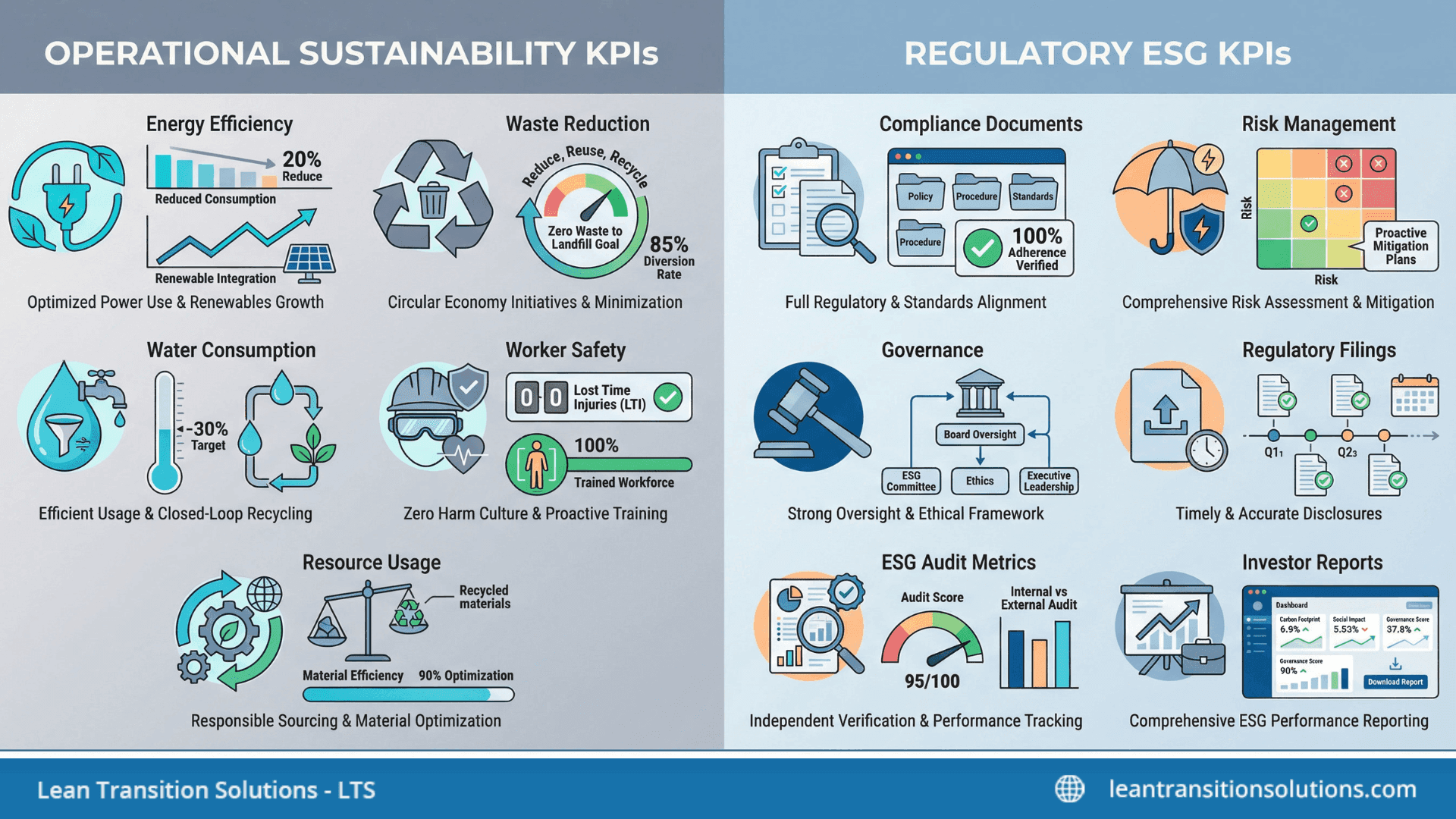
This is where the real divide becomes visible – the factory floor runs on operational sustainability KPIs, while the boardroom and regulators rely on ESG audit metrics and ESG risk indicators.
What sustainability KPIs look like inside operations
These operational sustainability metrics are used by plant managers, operations leaders and improvement teams to control performance:
- Energy efficiency KPIs per line, shift or product
- Water usage KPIs by process
- Waste reduction metrics and scrap rates
- Emissions intensity metrics tied to production volume
- Safety and wellbeing KPIs
- Resource efficiency KPIs
These form the backbone of sustainability performance management, because they:
- Show where losses are happening
- Reveal process-level environmental impact
- Support continuous improvement
- Enable sustainability tracking at the source
What ESG KPIs look like to regulators and auditors
ESG teams and external stakeholders depend on ESG reporting metrics that aggregate and standardise performance:
- ESG compliance metrics for regulatory filings
- ESG risk indicators linked to climate, labour and governance
- Carbon disclosure metrics
- Supply-chain sustainability indicators
- Governance and ethics KPIs
- Audit-ready ESG data
These are designed for ESG performance management and regulatory ESG reporting, not daily operations.
They answer:
- Is the company exposed to sustainability risk?
- Are controls and governance strong enough?
- Can performance be verified and audited?
Why mixing these two creates confusion
When organisations try to run operations using ESG disclosure KPIs, or build ESG reports from raw operational data without structure, they get:
- Delayed and inconsistent sustainability reporting
- Gaps in ESG audit readiness
- Poor sustainability performance visibility
- Leaders who cannot tell whether sustainability is actually improving
The real operating model
High-performing industries separate but connect the two:
- Sustainability KPIs for operations -> Drive process control, efficiency and improvement
- ESG KPIs for regulators -> Provide standardised, auditable and comparable ESG data
This creates a closed-loop sustainability measurement system where:
- Operations generate real sustainability performance data
- ESG teams translate it into compliant, rusted disclosure
That's how companies move from sustainability as a promise to sustainability as a governed, measurable business system.
How companies combine sustainability KPIs and ESG KPIs without confusion
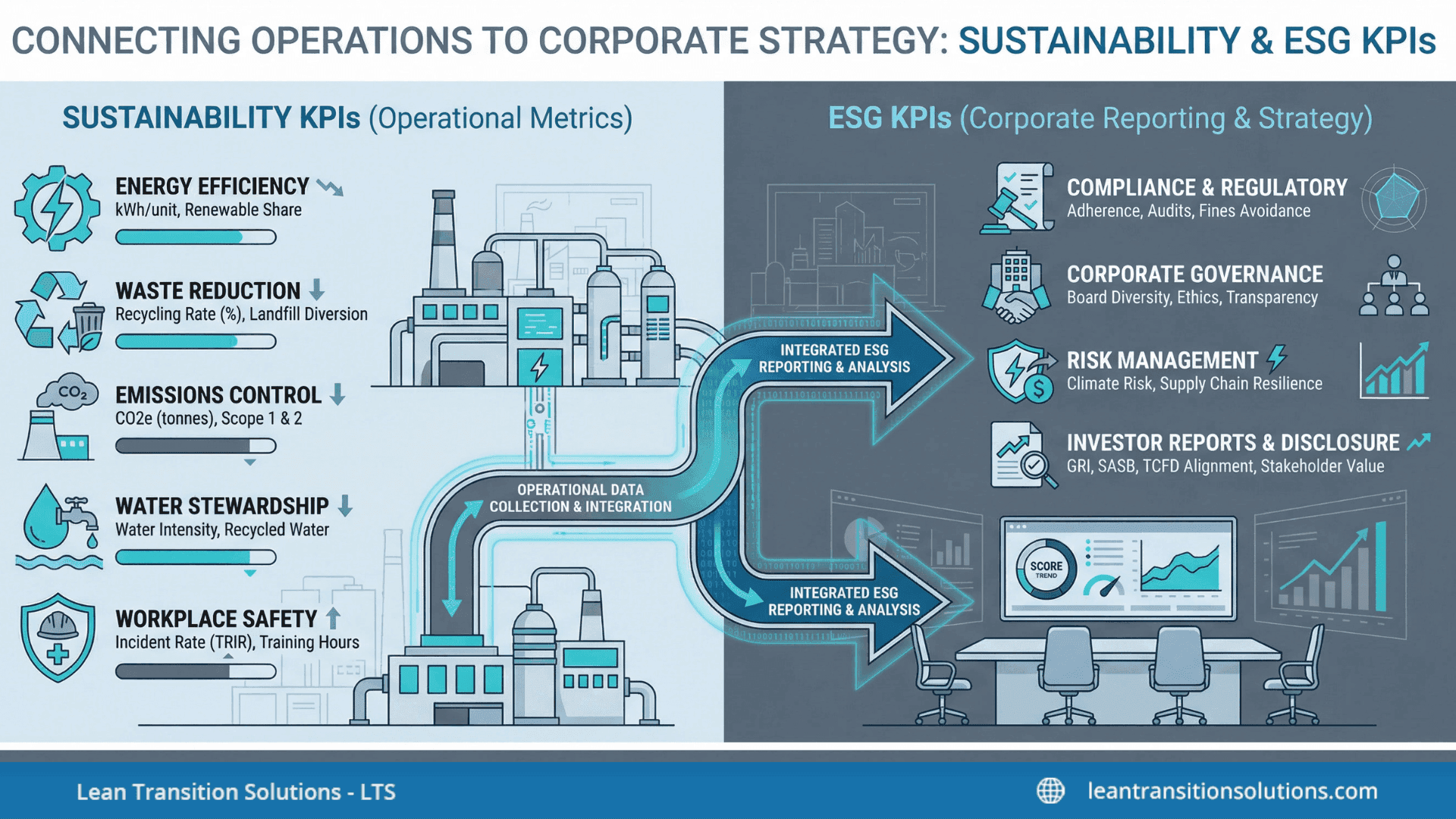
High-performing industries don’t choose between sustainability metrics and ESG metrics – they connect them into one coherent measurement system.
What successful companies do differently
They build a structure where:
- Operational sustainability KPIs capture what is happening on the ground (energy use, waste, emissions, safety, workforce stability)
- Sustainability performance indicators turn that data into consistent, comparable measures
- ESG KPIs translate those indicators into audit-ready, regulator-approved disclosures
This prevents teams from working in silos.
Why this alignment matters
When sustainability and ESG stay disconnected, companies get:
- Spreadsheets and manual reporting
- Inconsistent disclosures
- Weak ESG audit readiness
- Leaders who can’t see whether sustainability is improving or just being reported
When they are connected, organisations get:
- Reliable sustainability performance visibility
- Strong ESG governance and compliance
- Faster, more confident regulatory and investor reporting
- A clear link between operational reality and corporate disclosure
The modern sustainability operating model
The most effective organisations now run a closed-loop sustainability measurement system:
- Sustainability KPIs for operations drive daily and weekly performance
- Structured performance indicators create consistency
- ESG KPIs provide compliance, risk and credibility
- Leadership sees performance and governance in one view
This is what turns sustainability from a reporting exercise into a managed business discipline.
Sustainability KPIs vs ESG KPIs: Summary table
Which sustainability measurement framework should leadership teams use?
Leadership teams don’t need another sustainability framework — they need a way to connect sustainability performance inside operations to ESG reporting outside the business.
The right sustainability measurement approach depends on what leaders are trying to manage.
When leaders are trying to improve performance
They need:
- Operational sustainability metrics
- Sustainability KPIs for operations
- Process-level performance indicators
- Daily and weekly sustainability tracking
These support:
- Resource efficiency
- Waste and emissions reduction
- Safety and workforce stability
- Continuous improvement
This is where sustainability performance management actually happens.
When leaders are trying to meet ESG obligations
They need:
- ESG reporting metrics
- ESG compliance KPIs
- Governance and risk indicators
- Audit-ready ESG data
These support:
- Regulatory filings
- Investor and lender requirements
- ESG ratings and disclosures
- Board-level risk oversight
This is where ESG performance management lives.
What leadership teams actually need
Most industries need both – but not mixed together.
They need a measurement system that:
- Captures operational sustainability data at source
- Structures it into standardised performance indicators
- Makes it usable for ESG reporting and audits
- Allows leaders to see performance, risk and compliance in one place
Where LTS Data Point fits
LTS Data Point is designed for sustainability and ESG performance management, not just reporting.
It is typically used when companies want to:
- Run sustainability KPIs across operations
- Maintain consistent, structured performance data
- Support ESG reporting and audit requirements without re-work
- Align factory-level sustainability with board-level governance
In other words, it connects how the business actually performs with how that performance is reported and governed. Many organisations structure this connection through a sustainability balanced scorecard, which brings operational sustainability KPIs and ESG reporting metrics into a single governed view.
Get guidance on using LTS Data Point for sustainability and ESG measurement
FAQs
1. Can ESG KPIs be used for internal performance tracking?
While ESG KPIs are primarily focused on external reporting and compliance, some companies use them internally to track governance standards, employee wellbeing, and environmental impact. However, they are generally not as operationally detailed as sustainability KPIs.
2. What's the best way to align sustainability and ESG KPIs across teams?
Clear cross-functional communication is key. Sustainability and ESG teams should regularly collaborate to ensure that operational data feeds into ESG reporting, while operational teams should understand the wider implications of their actions on ESG performance. Tools like LTS Data Point can help centralise and streamline this data for consistency and accuracy.
3. What role does data transparency play in sustainability and ESG KPIs?
Data transparency is crucial for both internal performance tracking and external reporting. It ensures that stakeholders can trust the data and understand the impact of company actions. Transparent data also enhances audit readiness and ESG disclosure for regulatory bodies and investors.
4. How does LTS Data Point support sustainability and ESG KPI management?
LTS Data Point provides a centralised platform to track both sustainability performance and ESG compliance metrics. It helps industries streamline data collection, monitor real-time performance, and generate audit-ready reports that support regulatory compliance and stakeholder trust.

Amer Jumah, Senior Lean Consultant
Amer is co-founder of Agile Solutions and a certified Six Sigma Black Belt, Lean Black Belt, and PMP, with over nine years of experience implementing Lean, Six Sigma, and Agile principles across diverse industries. He specialises in process optimisation, waste elimination, and delivering cost savings through organisational change.