Tactical vs Strategic: Why Organisations Confuse Daily Work with Strategy
Last updated on : March 27, 2026
Many organisations run like a busy airport baggage carousel — bags keep moving, handlers stay active, and everything looks productive on the surface. But if the routing system behind the scenes is unclear, bags end up in the wrong destinations despite all the motion. In the same way, teams often focus on daily tasks, reports, and urgent issues, believing they are driving progress, when in reality they are only keeping work in motion. Without a clear strategic direction guiding these activities, effort becomes movement without meaningful advancement — and organisations mistake tactical busyness for strategic progress.
Understand how LTS Data Point helps connect daily activities with long-term priorities
Tactical vs strategic: Understanding the real difference in organisations
Several organisations struggle with the difference between tactical and strategic work because both operate simultaneously in everyday operations. Leaders define direction and priorities, while teams focus on execution and immediate results. Without clear boundaries, strategic priorities vs daily tasks become blurred, making it difficult for organisations to maintain focus on long-term success.
At a basic level, the distinction between tactical vs strategic goals lies in scope and time horizon. Strategic work defines direction and long-term intent, while tactical work focuses on the actions needed to deliver results in the short term. This relationship reflects the broader balance between long-term vs short-term planning, where strategy provides guidance and tactics translate direction into measurable activities.
In practice, the confusion happens when tactical activities begin to dominate decision-making. Teams often prioritise urgent operational issues over strategic initiatives, even when the organisation has clearly defined goals. Over time, this creates a disconnect where daily work continues, but strategic progress slows or becomes difficult to measure.
Understanding tactical vs strategic work is the first step toward preventing misalignment. Organisations that clearly separate direction from execution are better positioned to maintain focus while still responding to operational demands. This distinction sits at the core of effective strategic management, the discipline responsible for keeping direction and execution connected.
Tactical vs strategic planning: Where organisations start to confuse the two
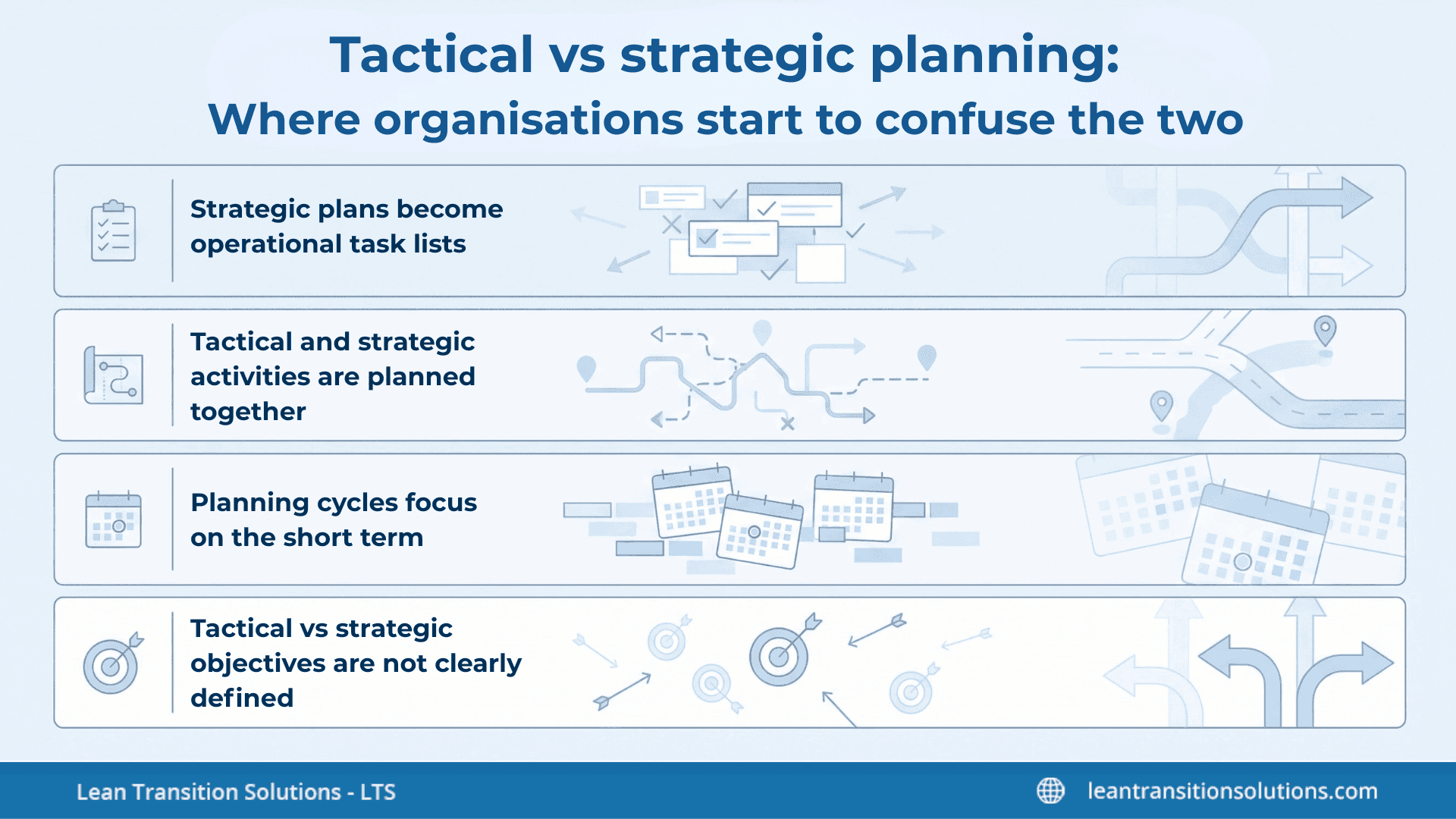
Confusion between tactical vs strategic planning often begins when organisations try to translate high-level direction into practical work. Instead of clearly separating long-term direction from short-term action, planning discussions often mix both levels together.
This leads to unclear priorities, overlapping initiatives, and difficulty measuring progress against tactical vs strategic objectives.
Where tactical vs strategic planning gets blurred
1. Strategic plans become operational task lists
Instead of focusing on direction, operational vs strategic planning discussions often turn into short-term action planning.
Typical signs include:
- Strategy documents filled with detailed tasks
- Excessive focus on short-term deliverables
- Limited emphasis on long-term priorities
2. Tactical and strategic activities are planned together
Many organisations plan tactical and strategic activities in the same meetings without clear separation.
This often results in:
- Urgent issues dominating planning sessions
- Strategic initiatives being postponed
- Confusion over priorities
3. Tactical vs strategic objectives are not clearly defined
When tactical vs strategic objectives are not distinguished, teams struggle to understand what truly matters.
Common outcomes include:
- Teams focusing on immediate results
- Strategic initiatives lacking ownership
- Progress becoming difficult to track
4. Planning cycles focus on the short term
Planning processes often prioritise quarterly or monthly targets instead of balancing long-term direction with short-term delivery.
This typically leads to:
- Reactive decision-making
- Frequent priority changes
- Limited strategic progress
Tactical vs strategic decision making in day-to-day operations
The confusion between strategic vs tactical decision making becomes most visible in everyday operations. While strategies define direction, daily decisions often focus on immediate issues, making it difficult to maintain long-term progress.
When industries consistently prioritise short-term needs, tactical vs strategic initiatives become unbalanced, and strategic priorities gradually lose visibility.
How tactical vs strategic decision making appears in practice
1. Decisions favour urgent issues over long-term priorities
Many tactical vs strategic decision-making examples show how urgent operational problems often override strategic work.
2. Managers focus on operational control instead of direction
Many tactical vs strategic management examples show managers spending most of their time resolving immediate operational issues instead of guiding long-term priorities.
Common signs include:
- Frequent firefighting and issue resolution
- Limited time spent reviewing strategic progress
- Short-term targets dominating discussions
- Reactive decision-making
3. Tactical initiatives replace strategic initiatives
Over time, tactical vs strategic initiatives become difficult to distinguish when short-term improvements take priority.
Typical patterns include:
- Improvement projects focused on immediate gains
- Strategic initiatives repeatedly delayed
- Resources allocated to urgent needs
- Long-term initiatives losing momentum
Tactical vs strategic work: Why teams focus on the wrong priorities
In many organisations, the challenge is not a lack of strategy but an imbalance between tactical execution vs strategic direction. Teams naturally prioritise urgent operational demands, while strategic work often requires sustained attention over time.
This imbalance creates strategy vs execution gap, where daily activities continue but meaningful strategic progress becomes difficult to see. Over time, this is one of the key reasons why strategy fails in organisations, even when plans are clearly defined.
Why tactical work dominates strategic work
1. Urgency often overrides importance
Operational issues demand immediate attention, making tactical work more visible and easier to justify.
Typical patterns include:
- Immediate problems taking priority over planned initiatives
- Daily targets dominating team discussions
- Strategic work postponed repeatedly
- Teams measured mainly on short-term results
2. Strategic work is less visible
Tactical activities produce quick and measurable outcomes, while strategic progress takes longer to become evident.
This often leads to:
- Limited visibility of long-term initiatives
- Difficulty tracking strategic progress
- Short-term wins receiving more attention
- Strategic priorities gradually losing focus
3. Responsibilities are not clearly defined
Without clear ownership, bridging tactical and strategic gaps becomes difficult across teams and departments.
Common signs include:
- Unclear responsibility for strategic initiatives
- Departments working in isolation
- Conflicting priorities across teams
- Strategic work depending on individual effort
4. Performance discussions focus on operations
Regular reviews often emphasise operational performance instead of long-term progress.
This typically results in:
- Meetings centred on operational issues
- Limited discussion of strategic priorities
- Tactical metrics dominating reports
- Strategic initiatives receiving less attention
Tactical vs strategic alignment: Connecting daily actions to business direction
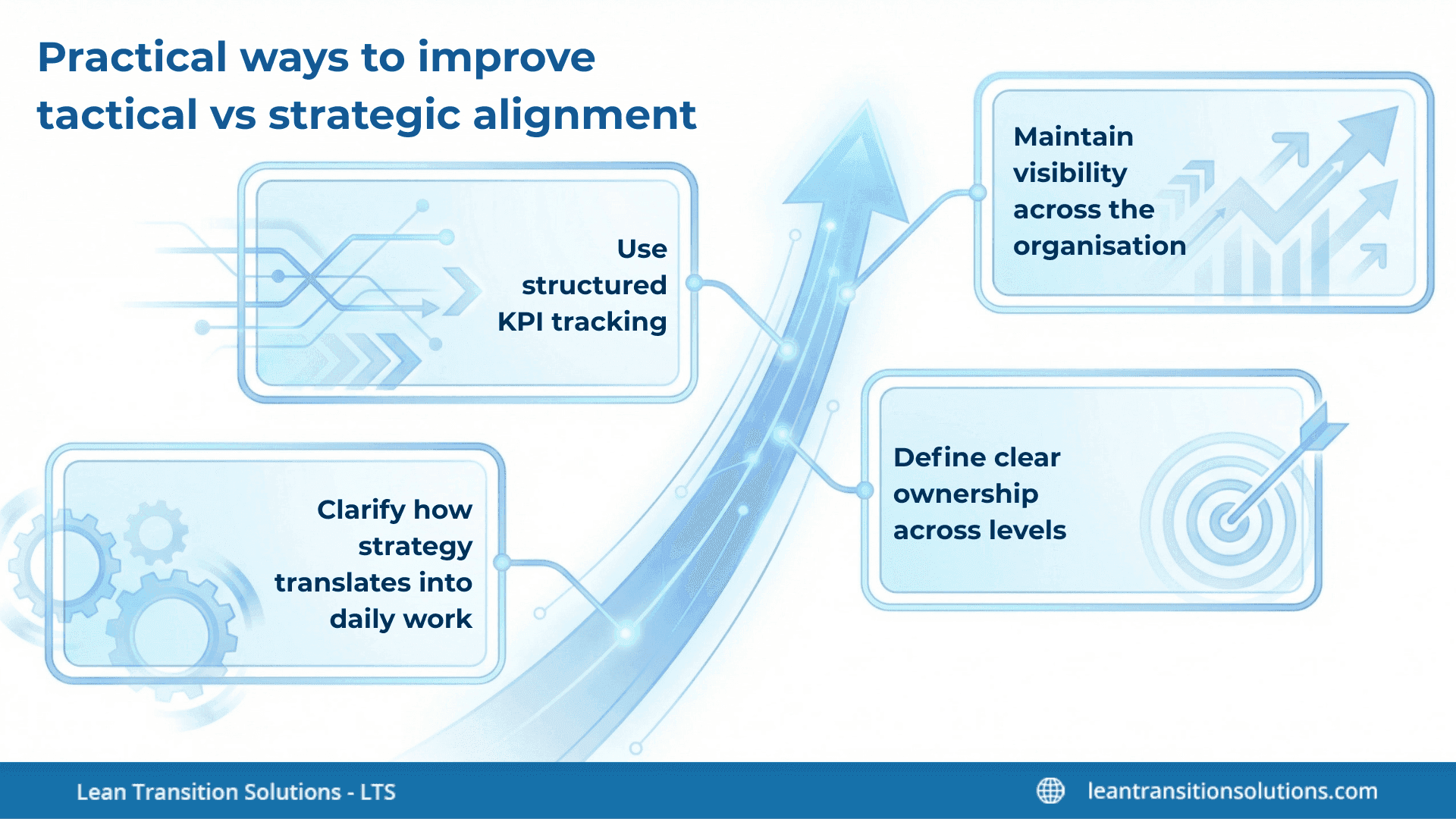
Improving tactical vs strategic alignment requires organisations to clearly connect long-term priorities with everyday work. When teams understand how their activities contribute to organisational direction, it becomes easier to maintain focus and consistency.
Effective alignment is about connecting strategy to daily operations so that strategic priorities remain visible and actionable across all levels of the organisation.
Practical ways to improve tactical vs strategic alignment
1. Clarify how strategy translates into daily work
Organisations improve alignment when they focus on translating strategy into actions that teams can understand and implement.
This typically involves:
- Cascading strategy into clear initiatives across teams
- Defining measurable outcomes
- Linking team activities to organisational goals
- Reviewing progress regularly
2. Define clear ownership across levels
Strong strategic alignment depends on clearly defined responsibilities for both strategic and tactical work across the organisation.
This helps organisations:
- Maintain focus on strategic initiatives
- Avoid conflicting priorities
- Improve accountability across teams
- Ensure consistent progress
3. Use structured KPI tracking
Clear measurement helps organisations maintain balance through tactical vs strategic KPI management, ensuring that both short-term and long-term priorities remain visible.
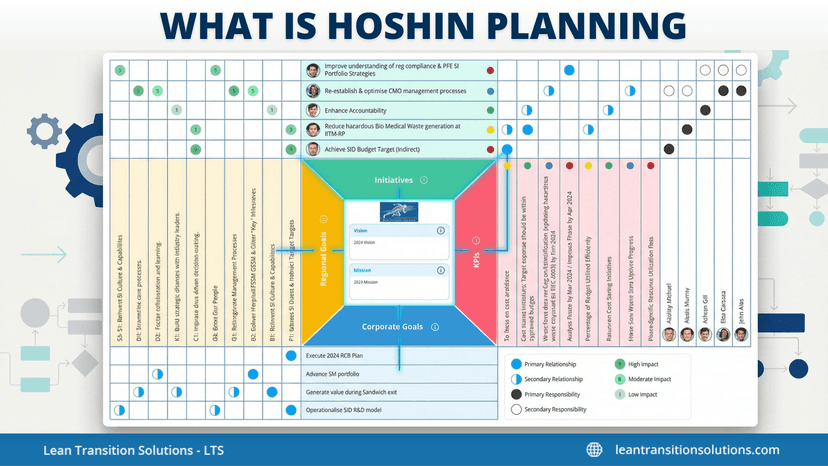
Effective KPI tracking supported by strategy maps typically includes:
- Strategic KPIs that reflect long-term priorities
- Operational KPIs that track daily performance
- Regular performance reviews
- Consistent reporting across teams
4. Maintain visibility across the organisation
Alignment becomes easier when teams can see how daily work supports broader priorities.
This supports:
- Better decision-making
- Consistent priorities across departments
- Improved communication between teams
- Stronger focus on long-term direction
Tactical vs strategic balance: Turning priorities measurable results
Maintaining the right balance between strategic planning vs tactical execution requires a structured approach that connects direction with everyday work. Without clear visibility, industries often struggle to maintain performance alignment, making it difficult to ensure that daily activities support long-term priorities.
LTS Data Point performance management software is designed to support companies in maintaining this balance by connecting strategic priorities with operational performance in one structured system.
Where LTS Data Point performance management software fits best
LTS Data Point performance management software is typically used when industries need a structured way to maintain KPI alignment across strategic and operational levels.
It is designed for organisations that need to:
- Connect strategic priorities with operational KPIs
- Maintain visibility across departments and locations
- Track both strategic and operational performance
- Support consistent performance reviews
- Improve accountability across teams
By providing clear visibility across priorities and performance metrics, LTS Data Point performance management software helps industries support measurable strategy execution without losing focus on day-to-day operations.
Instead of managing strategy and operations separately, organisations can maintain a structured connection between planning and execution, making it easier to sustain long-term progress while responding to operational demands.
Understanding tactical vs strategic work is essential for organisations that want to turn plans into consistent results. When strategic direction and tactical activities are clearly connected, teams can focus on the right priorities while maintaining steady progress. Organisations that maintain this balance are better positioned to align daily work with long-term goals and achieve sustainable performance improvements.
Get guidance on connecting strategic priorities with operational performance using LTS Data Point
FAQs
1. Can tactical work exist without strategic plan?
Tactical work can continue without a strategic plan, but it often becomes reactive and inconsistent. Without clear direction, teams tend to focus on immediate tasks rather than long-term priorities, making it difficult to achieve sustained results.
2. Who is responsible for tactical and strategic decisions in an organisation?
Strategic decisions are typically made by senior leadership and focus on long-term direction, while tactical decisions are usually handled by managers and operational teams to support day-to-day activities. Clear role definitions help prevent confusion between the two.
3. How often should tactical and strategic plans be reviewed?
Strategic plans are usually reviewed quarterly or annually to assess long-term progress, while tactical plans are often reviewed weekly or monthly to track operational performance. Regular reviews help maintain balance between long-term direction and short-term results.
4. What happens when organisations focus too much on tactical work?
When organisations focus primarily on tactical work, long-term initiatives may lose momentum. This often results in slower improvement, inconsistent priorities, and difficulty achieving strategic goals.
5. How do KPIs support tactical and strategic balance?
KPIs help organisations maintain balance by providing visibility into both strategic progress and operational performance. A combination of long-term and short-term metrics helps teams stay focused on organisational priorities.
6. Is tactical work less important than strategic work?
Tactical work is not less important than strategic work. Strategy defines direction, while tactics make progress possible. Organisations need both to achieve consistent results and maintain operational stability.
7. What is a simple example of tactical vs strategic thinking?
A strategic decision might involve improving customer experience across the organisation, while a tactical decision might involve reducing response times in a support team. Tactical actions support strategic priorities when they are clearly connected.
8. How can organisations recognise tactical vs strategic confusion?
Organisations may be experiencing confusing when teams struggle to explain how daily work supports strategic goals. Frequent priority changes, reactive decisions, and unclear objectives are common signs.