Global Performance Management: Optimising Operations Worldwide
Last updated on : March 26, 2026
Managing global operations is like piloting a fleet of drones across multiple cities – each unit has its own route, speed, and mission, but without a central system to coordinate them, collisions happen, delays mount, and objectives are missed. Global performance management acts as the control hub, giving leaders real-time visibility, alignment, and the ability to adjust course instantly – ensuring that every team, in every location, moves toward the same operational goals efficiently.
Global performance management: Driving operational alignment across sites
Managing operations across multiple locations is inherently complex. Each site may have its own priorities, workflows, and reporting styles, which can lead to inefficiencies, duplicated efforts, or missed opportunities. Global performance management provides a structured way to bring these dispersed operations into execution everywhere.
By implementing a clear framework, organisations can achieve:
- Cross-location coordination: Standardising processes and communication channels allows teams in different regions to collaborate effectively, reducing misunderstandings and operational silos.
- Operational consistency: Defining clear standards ensures that every site delivers performance that aligns with organisational goals, making outcomes predictable and measurable.
- Team accountability: Visibility into roles and responsibilities empowers leaders to hold teams accountable, while enabling staff to understand how their work contributes to broader objectives.
- Execution visibility: Real-time insights into operations highlight gaps, bottlenecks, or deviations early, allowing corrective actions before issues escalate.
This approach transforms performance management from a series of disconnected reports into an integrated operational system. Teams are no longer working in isolation; instead, they understand how their daily tasks contribute to the bigger picture. Organisations with cross-site operations benefit from reduced redundancy, faster decision-making, and more predictable outcomes.
Additionally, global performance management supports continuous improvement. By consistently tracking progress across locations, leaders can identify high-performing teams, replicate best practices, and address challenges systematically. The result is dynamic operational environment where strategy, execution, and improvement are tightly coupled.
Global performance management for strategic execution
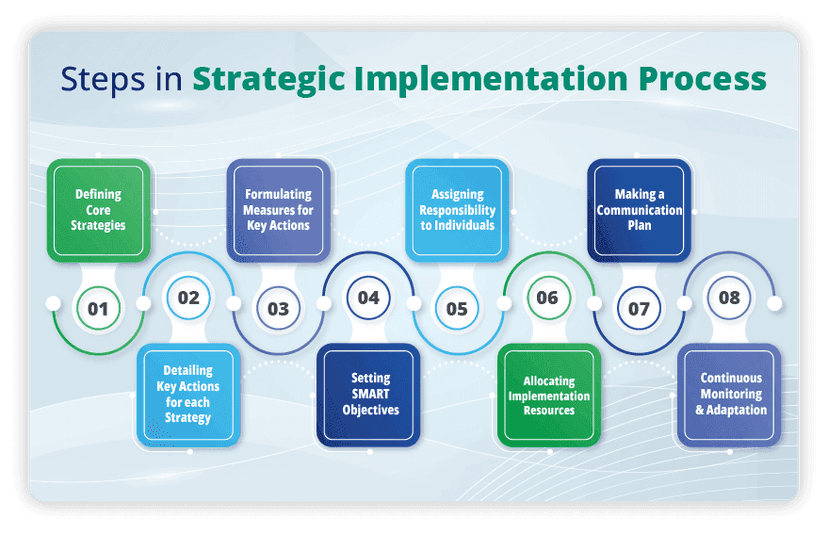
One of the most common barriers to effective strategic implementation is the disconnect between planning and operational execution. Many organisations struggle with strategic alignment challenges, where corporate objectives are defined centrally but interpreted differently across locations. Structured KPI tracking helps bridge this gap by providing measurable indicators of progress, ensuring that strategic priorities remain visible and actionable at every level of the organisation. Visualising this connection through an objective flow chart makes it easier for every site to see exactly how a local KPI ladders up to the corporate objective it supports.
Through this approach, organisations can achieve:
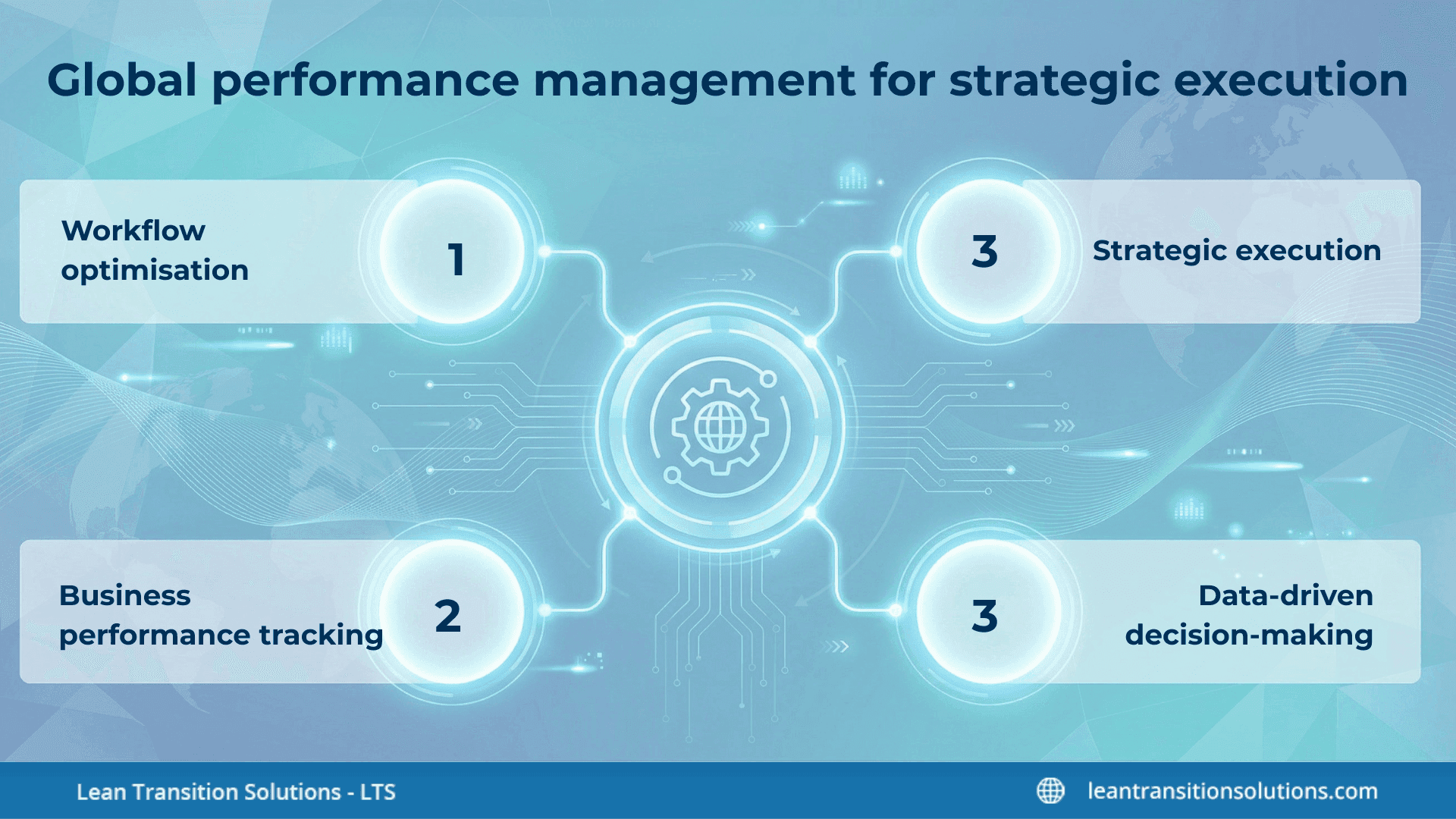
- Workflow optimisation: Streamlining processes ensures that tasks are executed efficiently, reducing delays and eliminating bottlenecks across teams.
- Business performance tracking: Continuous monitoring of operational activities against strategic objectives allows leaders to measure progress accurately and make informed decisions.
- Strategic execution: Aligning initiatives across sites ensures that every team contributes effectively to corporate goals, creating a cohesive path from planning to results.
- Data-driven decision-making: Real-time insights from operations provide actionable intelligence, enabling managers to prioritise initiatives that deliver the highest impact.
By implementing global performance management for strategic execution, organisations not only maintain alignment but also foster an environment of accountability and focus. Teams understand how their contributions tie into broader objectives, while leaders gain the confidence that strategy is being executed consistently across locations.
Moreover, integrating strategic execution into daily operations encourages a culture of continuous improvement, where workflow enhancements and operational adjustments directly feed into achieving business goals. Over time, this creates a more agile organisation capable of responding to changes quickly without losing sight of its strategic direction.
Global performance management in digital era
The complexity of managing operations across multiple locations has increased as organisations adopt more distributed and digital workflows. Traditional manual reporting and fragmented systems make it difficult to maintain alignment, track performance, and respond quickly to operational challenges. Global performance management in a digital era leverages modern tools to bridge this gap, providing a connected framework for teams, processes, and data.
Modern organisations increasingly rely on integrated digital platforms to support structured performance oversight. Alongside broader performance management software, dedicated KPI tracking software helps standardise measurement across locations, ensuring that operational results are captured consistently and made visible to decision-makers. This allows leaders to compare performance across sites and maintain alignment without relying on fragmented reporting methods.
Key benefits of digital approach to global performance management
- Performance management software: Centralised platforms allow organisations to consolidate operational data, standardise processes, and provide a single source of truth for decision-making.
- Live monitoring: Real-time visibility into operations enables leaders to spot deviations, allocate resources efficiently, and take immediate corrective and preventive actions when necessary.
- Connected teams: Digital systems ensure that distributed teams remain aligned, share updates seamlessly, and work collaboratively toward shared objectives.
- Operational transparency: Everyone from site managers to executives can access insights tailored to their role, fostering accountability and informed decision-making.
By digitising global performance management, organisations gain agility and responsiveness that would be impossible with manual methods. Teams are empowered to act quickly, leaders can make decisions with confidence, and cross-location collaboration becomes seamless.
Additionally, a digital approach supports continuous improvement, as historical and real-time data can be analysed to identify trends, optimise workflows, and replicate successful practices across sites. In this way, technology doesn’t just track performance – it actively drives better operational outcomes across the organisation.
Global performance management for operational efficiency
In a global organisation, operational inefficiencies can quickly multiply across locations, causing delays, errors, and rising costs. Global performance management addresses these challenges by creating a structured system that streamlines operations while ensuring every site adheres to consistent standards.
Implementing this approach can drive measurable improvements in efficiency and scalability:
- Process efficiency: Standardising workflows reduces bottlenecks, ensures consistent output, and allows teams to focus on value-added activities rather than repetitive tasks.
- Operational scalability: With clear frameworks in place, organisations can expand or replicate operations across new locations without sacrificing quality or alignment.
- Automation in operations: Integrating automated tools and workflows reduces manual effort, minimises human error, and accelerates routine processes.
- Performance accountability: Monitoring operational metrics ensures teams meet expected standards and allows management to intervene proactively when inefficiencies arise.
By leveraging global performance management, organisations transform operational management from reactive to proactive. Teams can anticipate challenges, deploy resources efficiently, and maintain consistent service levels across all locations.
Moreover, operational efficiency is not a one-time achievement. Continuous monitoring, feedback loops, and process refinement help create an environment where continuous improvement is embedded into daily operations, making efficiency gains sustainable over the long term.
Global performance management for continuous improvement
Sustaining high performance across multiple locations requires more than one-off initiatives – it demands a system that encourages ongoing learning and adaptation. Global performance management provides this foundation by offering clarity into operations, fostering accountability, and enabling teams to identify improvement opportunities continuously.
Key elements of driving continuous improvement
- Execution visibility: Live insights into workflows and performance help leaders detect gaps, monitor progress, and intervene before small issues escalate.
- Continuous improvement: By regularly analysing operational data, teams can implement iterative changes that enhance processes, reduce waste, and increase overall productivity.
- Organisational agility: Clear visibility and structured frameworks allow the organisation to respond rapidly to market changes, operational challenges, or strategic shifts without losing alignment.
- Knowledge sharing: Lessons learned at one site can be quickly disseminated across locations, allowing the organisation to replicate successful practices and avoid repeated mistakes.
With global performance management, continuous improvement is no longer optional – it becomes part of the organisation’s DNA. Teams are empowered to act on insights, leadership can make informed decisions faster, and the organisation as a whole becomes more agile, responsive, and competitive.
Ultimately, embedding continuous improvement through global performance management ensures that operational excellence evolves alongside organisational growth, keeping multi-site operations aligned, efficient, and ready to meet future challenges.
Global performance management: Aligning global strategy with execution
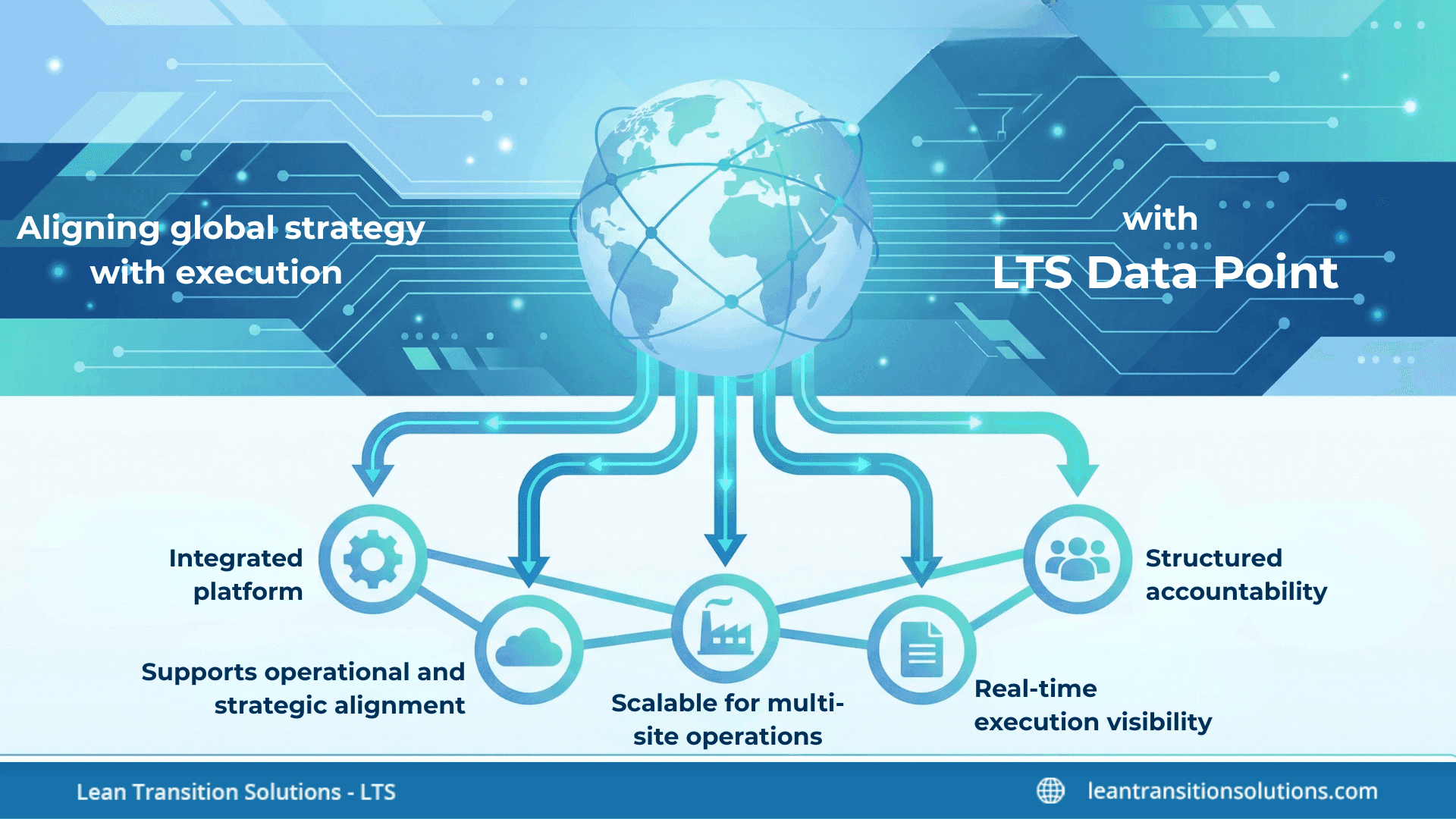
For organisations managing multi-site operations, connecting strategy to execution is often the biggest challenge. Without a centralised system, it’s easy for teams to lose sight of strategic priorities, operational inconsistencies to emerge, and performance insights to remain fragmented. Global performance management ensures that strategy, operations, and accountability are seamlessly integrated, providing clarity and focus across all sites.
Key advantages include:
- Business performance tracking: Consolidated dashboards allow leaders to monitor progress across all locations in real-time, making it easy to identify gaps and measure success against strategic goals.
- Connected teams: By linking all sites and teams, organisations foster collaboration, ensure alignment, and promote shared ownership of outcomes
- Actionable insights: Real-time data and analytics provide the ability to make informed decisions quickly, optimising both operational execution and strategic impact.
Why LTS Data Point stands out:
- Integrated platform: Unlike fragmented spreadsheets or standalone tools, LTS Data Point centralises operational and strategic data in one connected system, reducing manual effort and improving accuracy.
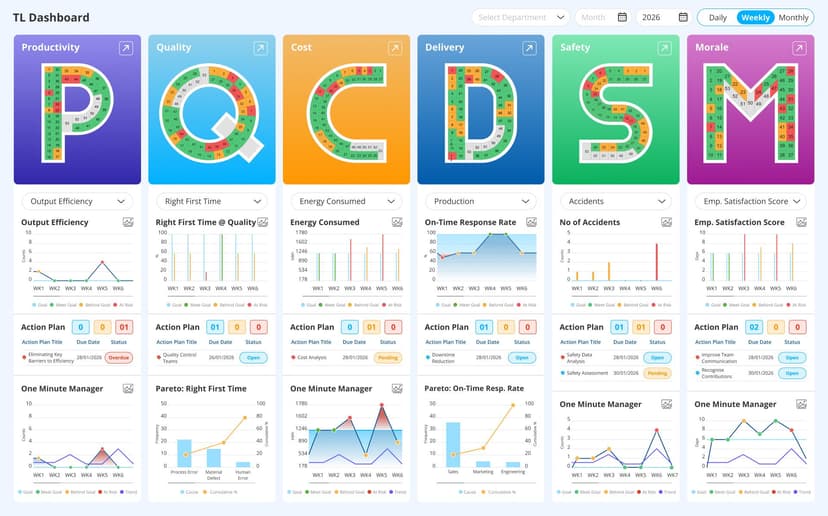
- Global dashboard visibility: LTS Data Point provides a unified global dashboard that consolidates performance data from all locations into a single view, enabling leaders to monitor trends, compare sites, and make faster, informed decisions without switching between systems.
- Scalable for multi-site operations: Whether managing a handful of locations or hundreds, LTS Data Point scales seamlessly without compromising visibility or control.
- Real-time execution visibility: Leaders gain instant insights into performance at every level, enabling proactive decision-making and faster response to deviations.
- Supports operational and strategic alignment: LTS Data Point ensures that every team’s daily activity directly contribute to broader organisational goals, turning strategy into measurable execution.
- Structured accountability: LTS Data Point establishes clear ownership across teams and locations, enabling effective accountability tracking so actions are monitored, responsibilities remain visible, and improvement initiatives move forward consistently.
Global dashboard for unified performance visibility
A key capability of LTS Data Point is its global dashboard, which consolidates performance data from all locations into a single, real-time view. This allows leadership teams to monitor progress, compare site performance, and identify deviations without navigating multiple reports or disconnected systems. By presenting operational and strategic insights in one place, the dashboard strengthens decision-making and ensures that global strategy is supported by accurate, up-to-date execution data. Underneath this global view, site-level teams still work from their own KPI visual management tools, tailored to local priorities, while feeding the same data upward into the consolidated dashboard.
By implementing LTS Data Point for global performance management, organisations can maintain business performance tracking across all sites, keep connected teams aligned, and ensure that global strategy translates into consistent, actionable results. This makes it an ideal choice for industries seeking operational efficiency, agility, and continuous improvement at scale.
Effective global performance management is no longer optional for companies operating across multiple locations. By linking strategy to execution, providing execution visibility, and fostering continuous improvement, it ensures that teams are aligned, processes are efficient, and outcomes are consistent worldwide. Leveraging a centralised solution like LTS Data Point further strengthens this framework, offering real-time insights, seamless collaboration across connected teams, and scalable support for multi-site operations. Ultimately, organisations that adopt structured, digitally enabled global performance management are better positioned to achieve operational excellence, strategic alignment, and long-term growth.
Find out how LTS Data Point can support your global operations and execution goals
FAQs
1. What is the difference between global performance management and local performance management?
Global performance management focuses on aligning operations and strategy across multiple locations, whereas local performance management addresses daily performance within a single team or site. The global approach ensures consistency, visibility, and accountability, across the organisation.
2. How can technology improve global performance management?
Technology, such as performance management software, enables real-time monitoring, centralises data, and keeps connected teams aligned. It reduces manual reporting, enhances workflow optimisation, and allows leaders to make data-driven decisions across all sites.
3. What role does continuous improvement play in global performance management?
Continuous improvement ensures that operational processes evolve over time. By combining execution visibility with structured monitoring, organisations can identify inefficiencies, replicate best practices, and maintain operational consistency across locations.
4. How can organisations ensure all teams stay accountable globally?
Accountability comes from setting clear roles and responsibilities, using centralised platforms for tracking progress, and providing transparent performance visibility. This encourages connected teams to take ownership of results while aligning with organisational goals.
5. Can global performance management support multi-site expansion?
Yes. A structured global performance management framework helps maintain operational scalability and ensures that new locations adhere to the same standards, workflows, and performance expectations as existing sites.
6. How does global performance management help in risk management?
By providing real-time insights into operations, deviations or inefficiencies are quickly identified, allowing proactive interventions. This mitigates operational risks and ensures business continuity across sites.
7. Is global performance management only relevant for large organisations?
No. Even small or mid-sized organisations with multiple locations benefit from aligning strategy with execution. A digital system can scale according to organisational size, helping improve process efficiency and execution visibility.
8. How do connected teams enhance global performance management?
Connected teams share updates, collaborate seamlessly, and access centralised data. This integration ensures that performance metrics are actionable, improvements are shared across locations, and strategic goals are consistently met.

Abel Jiménez, Lean Consultant
Abel is a Lean Consultant with over 30 years of expertise in operational analysis, process improvement, and organisational change across Mexican industries. Currently serving as Director of Insurance Promotions at CESCEMEX, he helps organisations leverage technology and lean practices to improve efficiency and manage change with continuity.