LSS Methodology in Practice: How Lean Six Sigma Becomes a Daily Management System
Last updated on : April 20, 2026
LSS methodology – Lean Six Sigma – is a structured approach that combines two disciplines: Lean, which focuses on waste elimination in manufacturing and improving flow, and Six Sigma, which uses data and statistical thinking to reduce variation and defects. Together, they give organisations a rigorous, practical framework for making processes faster, more consistent, and more reliable. Most organisations deploy it through structured improvement projects. Results are strong while the project is live. Then the team moves on, and the gains quietly erode. LSS methodology only fulfils its potential when it stops being episodic and starts driving how teams operate every single day – and that requires a very different kind of structure.
See how LTS Data Point turns LSS methodology into a live daily management system – not just a project toolkit
Why LSS methodology stalls after the project phase
DMAIC process improvement is the engine of LSS methodology. It moves a problem through five structured phases – Define, Measure, Analyse, Improve, and Control – using data to identify root causes, reduce defects, and embed a better way of working. The Control phase is where improvements are meant to be locked in. In practice, it is where most organisations fall short.
Without a daily management structure to hold the gains in place, the Control phase relies on habit rather than system. Teams drift back to familiar routines, performance data stops being reviewed consistently, and the improvement quietly unravels.
Key reasons Lean Six Sigma gains fading after project closure is so common:
- No structured daily review process to sustain changes once the project team steps back
- KPI dashboards manufacturing teams rely on go unmaintained between formal review cycles
- Frontline teams not engaged in improvement because performance data never reaches them in a usable form
- Leadership attention moves to the next project rather than holding the gains of the last one
- Escalation paths are informal, so problems sit unresolved between tiers
From project tool to lean daily management system
The difference between LSS projects and daily management comes down to rhythm. A project has a start and end date. A lean daily management system has no finish line – it is the operating standard teams follow every day, shift after shift.
Bridge this gap requires a deliberate structural shift – from improvement not sustained after project closes to Lean Six Sigma daily management as a non-negotiable operational discipline. The analytical rigour of LSS methodology must feed directly into how teams manage performance every day, not just when a project is active.
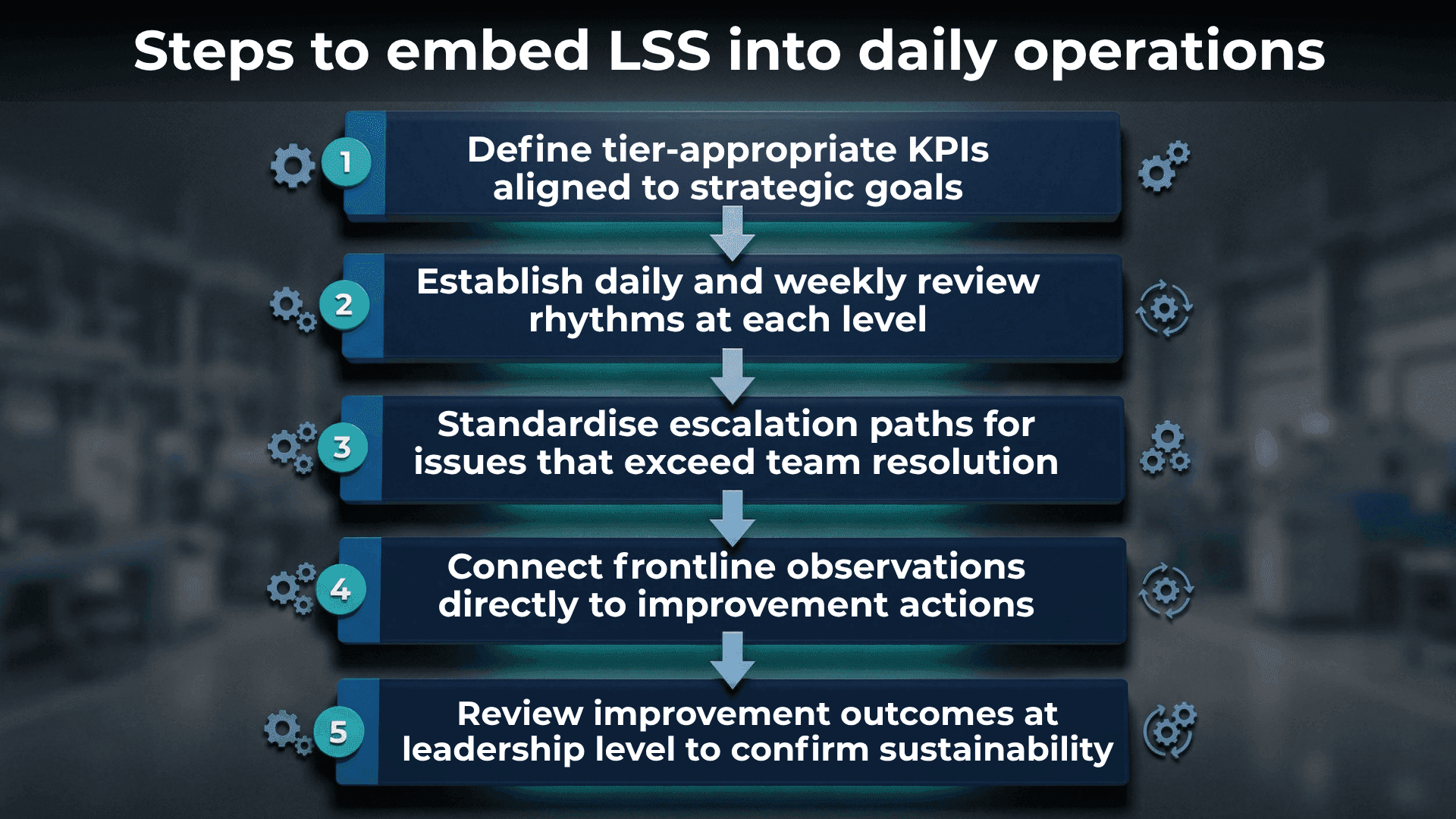
Steps to embed LSS into daily operations
Define tier-appropriate KPIs aligned to strategic goals
- Separate leading and lagging indicators at team, department, and plant level
- Ensure each KPI has a clear owner and a defined review frequency
- Validate that team-level metrics cascade directly from strategic objectives
Establish daily and weekly review rhythms at each level
- Run short, structured daily stand-ups at team level focused on shift performance
- Hold weekly reviews at department level to identify trends and recurring issues
- Maintain consistent timing and format so reviews become habitual, not reactive
Standardise escalation paths for issues that exceed team resolution
- Define clear criteria for when an issue moves from team to department or plant level
- Assign escalation ownership so no problem sits unresolved between tiers
- Log all escalations to track resolution time and identify systemic patterns
Connect frontline observations directly to improvement actions
- Give teams a simple, structured method to raise problems at the point of work
- Link each observation to a responsible owner and a target resolution date
- Review open actions daily to prevent backlogs and maintain team trust in the process
Review improvement outcomes at leadership level to confirm sustainability
- Compare post-improvement performance against baseline data at regular intervals
- Confirm that process changes have been standardised and are being followed
- Feed sustained results back into Hoshin Kanri strategy deployment to close the improvement loop
Visual management and problem-solving that keep LSS working
Disconnected shopfloor performance data is one of the most common reasons LSS methodology gains fade. A well-designed visual management system fixes this – turning live performance data into clear, real-time signals any team member can act on without waiting for a report.
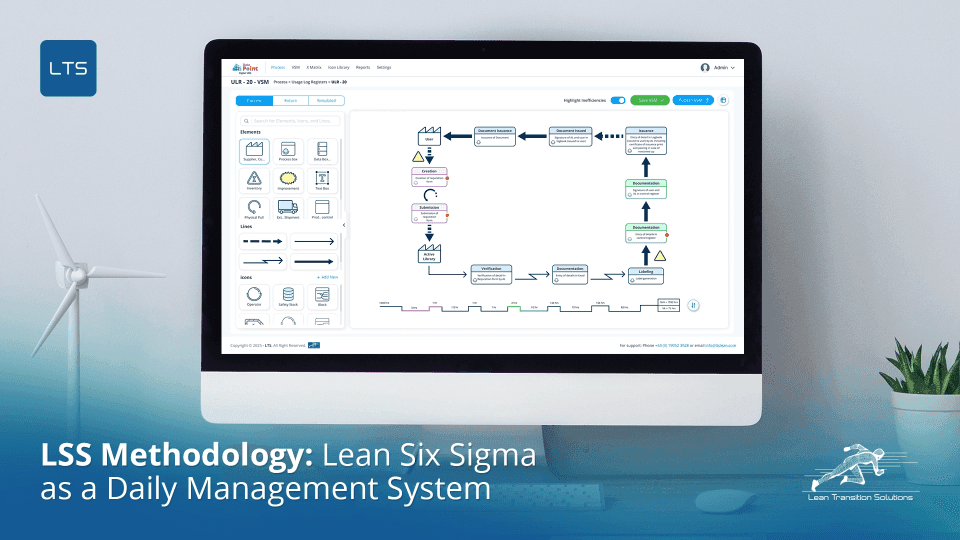
Value stream mapping adds process-level visibility – exposing waste elimination in manufacturing opportunities and keeping improvement priorities tied to daily team actions rather than a completed project document. That same process-level view is what a broader process flow mapping tool captures across the full production sequence, not just the value stream itself.
Effective daily problem-solving tools in lean daily management system:
- PDCA continuous improvement – replaces one-off DMAIC process improvement cycles with repeatable daily habits embedded into team routines
- Fishbone diagrams and 5 Whys – used when a KPI breach needs root cause investigation before an action plan is raised
- Corrective action management – tracks ownership, due dates, and escalation status so no action stalls between reviews
- Pareto analysis – surfaces the highest-impact failure reasons to focus improvement effort where it matters most
How lean daily management supports Lean Six Sigma is straightforward: it provides the daily structure that the Control phase if DMAIC depends on but rarely gets.
Connecting LSS to strategy deployment
Operational performance management at the shopfloor only delivers lasting value when it connects upward to organisational strategy. Without that link, improvement effort gets spent on the most visible problems rather than the most strategically important ones.
Strategy deployment manufacturing frameworks – such as Hoshin Kanri X Matrix – closes this gap by cascading strategic objectives through every tier of the organisation so that shopfloor improvement actions can always be traced back to a business priority.
Benefits of aligning LSS methodology with strategy deployment:
- How to embed LSS methodology into daily operations becomes answerable at every level – each team knows what they are improving and why
- Waste elimination in manufacturing is targeted where it delivers the most strategic value
- Teams align around shared goals rather than competing departmental metrics
- Leadership gains real-time confidence that daily activity is genuinely moving the business forward
The result is a closed loop – LSS methodology identifies the gap, the lean daily management system holds the solution in place, and Hoshin Kanri strategy deployment ensures effort was directed at the right priority from the start.
How LTS Data Point makes LSS methodology operational
LTS Data Point is a performance management system built specifically to make LSS methodology operational – not theoretical. It provides the digital infrastructure that connects shopfloor activity to strategic performance, replacing disconnected spreadsheets and manual reporting with structured, real-time data flows.
The platform supports every layer of a daily management system:
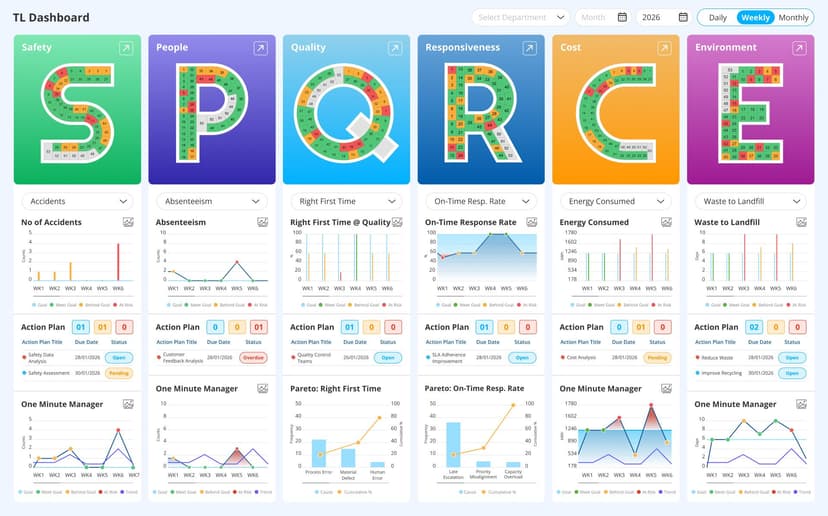
- Digital huddle boards – live RAG-coded manufacturing KPI dashboards teams use directly at their tier, structured around Safety, Quality, Delivery, Cost, and People metrics
- Tiered review meetings – tier-structured digital boards that keep improvement actions owned, visible, and escalated at the right organisational level
- PDCA - a dedicated solution that embeds PDCA continuous improvement into daily operations, moving teams away from one-off DMAIC process improvement cycles toward structured, repeatable daily problem-solving habits
- Quad chart - a visualisation tool that brings KPI trend data, action plan summaries, failure reason logs, and Pareto analysis together in one view, giving teams an instant picture of where performance stands and what needs to happen next
- Value stream mapping Tool – keeps waste elimination in manufacturing connected to live daily priorities, not stored as a static project document
- One-minute manager board - surfaces critical performance intelligence in under 60 seconds for faster, more focused leadership decisions
- Hoshin Kanri X Matrix – cascades Hoshin Kanri strategy deployment goals directly to team-level KPIs, closing the gap between corporate direction and shopfloor execution
- KPI bowling dashboards – track performance against targets across daily, weekly, and monthly intervals with full drill-down from plant to workstation level
- Corrective action management – 4C-structured action plans with ownership, milestone tracking, escalation status, and automated notifications that prevent actions from stalling
The platform drives the daily behaviours that make continuous improvement culture sustainable – not as a management initiative, but as the way the organisation actually operates.
LSS methodology only holds its value when the project phase gives way to a permanent daily operating standard. The difference between LSS projects and daily management is the difference between a result and a habit – and habits require structure. Tiered review meetings, PDCA continuous improvement, value stream mapping, and Hoshin Kanri strategy deployment are what turn a one-time improvement into a lean daily management system that endures. When these disciplines are supported by a connected performance management system like LTS Data Point, Lean Six Sigma daily management stops being an ambition and becomes the way the organisation actually runs – every shift, every tier, every day.
If your improvement gains aren’t holding, there’s a structural reason. Let an LTS Data Point expert help you find it
FAQs
1. How long does it take to embed LSS into daily management?
Timescales vary by organisation size and maturity, but most manufacturers see structured daily management habits forming within three to six months when supported by the right tools and leadership commitment.
2. Do you need certified Lean Six Sigma practitioners to run a daily management system?
Not necessarily. While belt-certified practitioners add value, a daily management system relies more on consistent habits, clear structures, and accessible data than on formal certification across the workforce.
3. What is the difference between Lean and Six Sigma?
Lean focuses on eliminating waste and improving flow. Six Sigma focuses on reducing variation and defects using statistical methods. LSS methodology combines both disciplines into a single, more comprehensive improvement approach.
4. Can LSS methodology be applied outside of manufacturing?
Yes. LSS methodology is widely used in logistics, healthcare, financial services, and shared services – anywhere that processes need to be faster, more consistent, and less wasteful.
5. What are the LSS belt levels?
LSS belts progress from White and Yellow (awareness level) through Green Belt (project-level practitioner) to Black Belt (advanced practitioner) and Master Black Belt (organisational leader and coach).
6. How does LSS methodology relate to ISO standards?
LSS methodology complements ISO standards such as ISO 9001. Where ISO defines what a quality management system must include, LSS provides the analytical tools and improvement disciplines to continuously raise performance within that system.
7. What is the role of leadership in sustaining LSS daily management?
Leadership sustains LSS by modelling improvement behaviours through structured routines such as Gemba walks, participating in tiered reviews, and visibly connecting team actions to organisational goals.