Production Boards for UK Shopfloor Management: Types, Examples and Shopfloor Use Cases by LTS Data Point
Last updated on : April 14, 2026
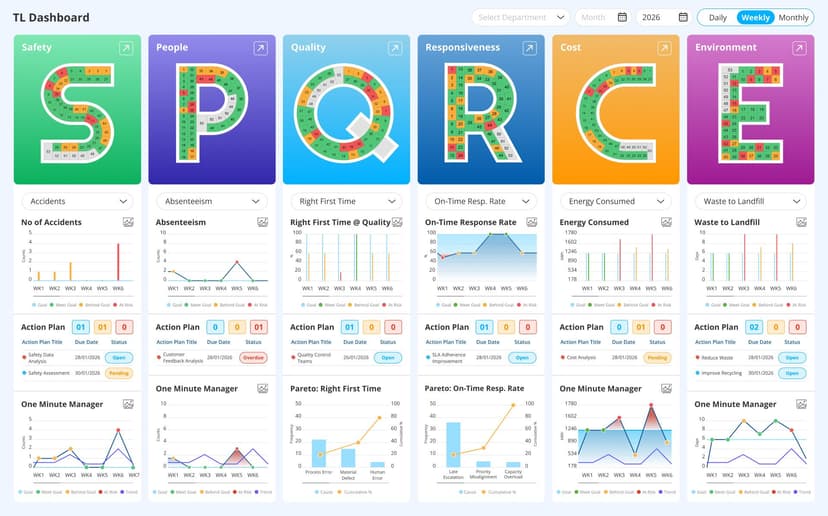
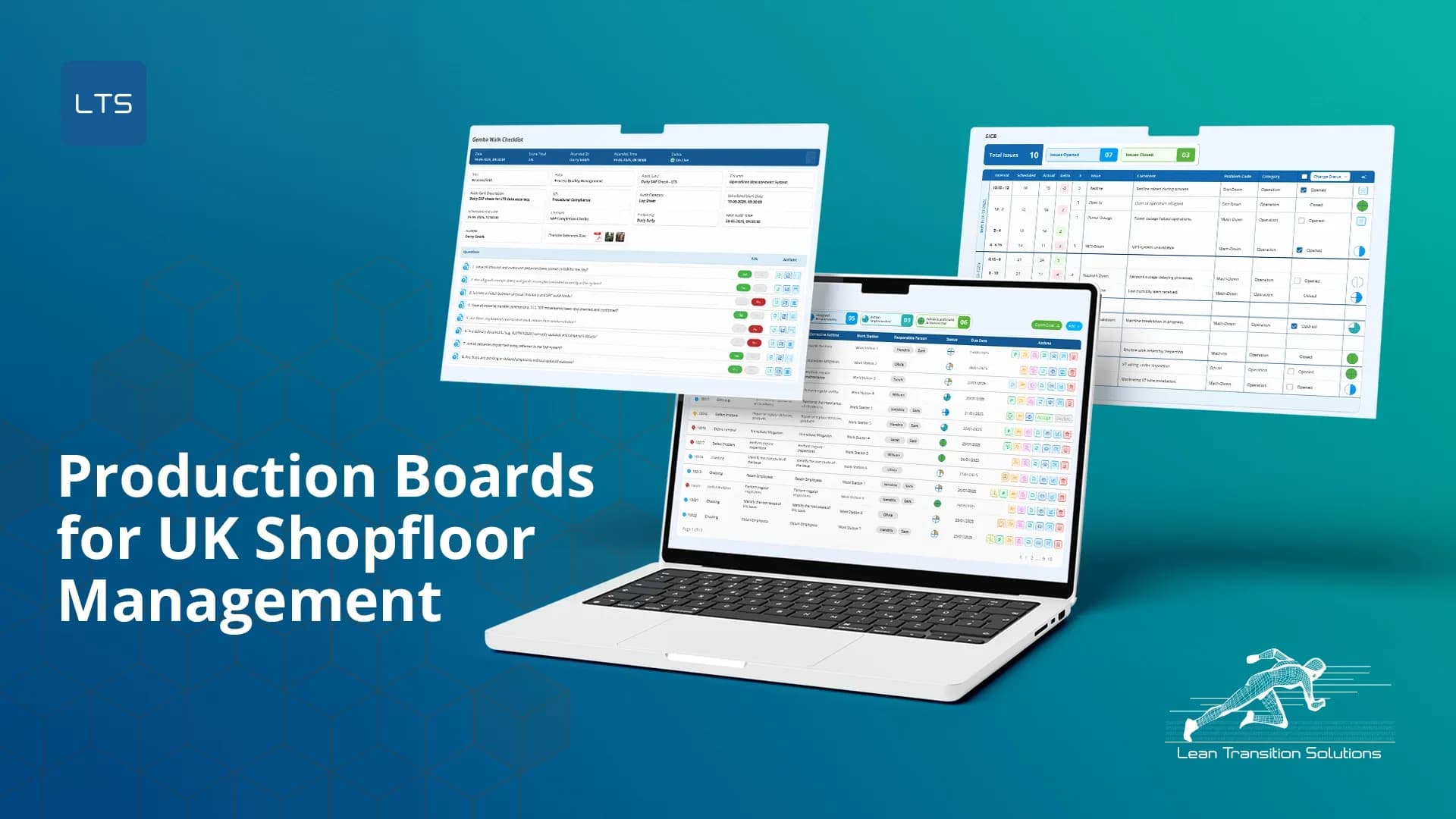
Production boards for UK shopfloor management are tiered visual tools that give executives real-time visibility across lines, departments, and plants. Huddle boards, KPI scorecard boards, Gemba boards, action tracking boards, problem-solving boards, SICB, leadership boards, and overall production summary boards from LTS Data Point enable faster issue resolution, improve operational efficiency, and ensure compliance with UK manufacturing regulations. By integrating these boards into daily routines, UK factories transform data into actionable insights, connecting frontline operations with strategic decision-making.
See how LTS Data Point digitises production boards and gives your teams real-time visibility across every tier of your shopfloor
Tiered production boards: Strategic control across the shopfloor
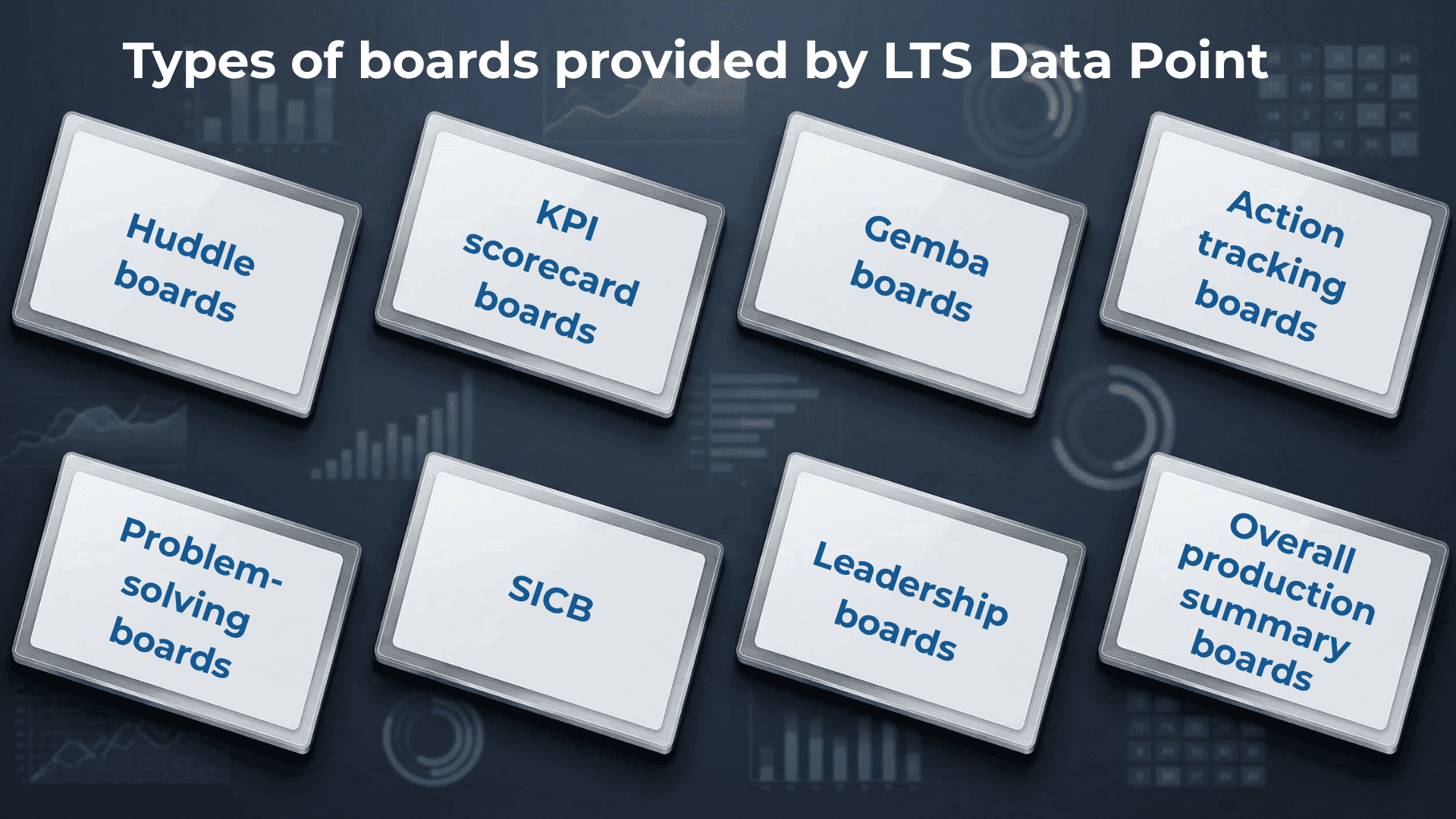
Tiered production boards are structured to provide visibility at multiple operational levels, connecting operator-level execution to executive oversight.
Types of boards provided by LTS Data Point:
- Huddle boards: Facilitate start-of-shift reviews and mid-shift updates, ensuring team alignment and problem escalation.
- KPI scorecard boards: Aggregate performance metrics per line or department for clear KPI tracking.
- Gemba boards: Visualise shopfloor conditions and operational performance at the point of work.
- Action tracking boards: Assign accountability and monitor follow-up on identified issues.
- Problem-solving boards: Highlight deviations, root causes, and corrective actions in real time.
- SICB (Short Interval Control Board): Combine safety, quality, production, and morale metrics for structured, interval-based control.
- Leadership boards: Provide managers and executives with real-time operational snapshots across plants.
- Overall production summary boards: Consolidate KPIs from all tiers for strategic decision-making.
Decision-maker benefits:
- Clear escalation pathways from operators to executives
- Alignment of daily operations with business KPIs
- Audit readiness and compliance with UK manufacturing regulations
Real-world example: A Midlands automotive plant uses SICB and huddle boards to monitor line-level OEE and safety. Operators flag stoppages instantly, while managers track trends across shifts, reducing downtime by 12% within one month.
Metrics and KPI scorecard boards: Line-level operational insights
Modern metrics boards often include digital tools such as an OEE tracker to monitor availability, performance, and quality in real time. This allows supervisors and operations leaders to quickly identify production losses and take corrective action during the shift.
Key metrics displayed:
- Output vs target per hour or shift
- Downtime, stoppages, and root causes
- Quality indicators: defects, rework, rejects
- Safety incidents and alerts
Commercial value for executives:
- Real-time production monitoring to reduce reaction times
- Enhanced throughput and operational efficiency
- Provides shift-level insights for performance reviews and staffing decisions
Example: A London-based FMCG plant uses KPI scorecard boards to track production across multiple lines. Deviations are highlighted immediately, allowing supervisors to intervene mid-shift, improving delivery reliability by 15%.
Huddle boards: Daily alignment and escalation
Huddle boards are central to daily shopfloor operations, promoting team alignment, accountability, and proactive problem-solving.
Functional use:
- Start-of-shift: Display targets and KPIs, highlight risks, assign ownership
- Mid-shift updates: Operators flag deviations in output, quality, or safety
- End-of-shift: Track completed actions and plan for improvement
Decision-maker advantages:
- Encourages proactive management rather than reactive firefighting
- Improves cross-shift communication, ensuring operators align with departmental goals
- Enhances accountability with visible corrective actions
Real-world example: A North East food manufacturer uses huddle boards to monitor throughput and waste in real time. Mid-shift alerts allow immediate corrective measures, preventing product loss and improving operational efficiency.
Gemba, action tracking, and problem-solving boards: Operations control
These boards focus on active shopfloor management, turning static data into actionable insight.
- Gemba boards: Visualise operational realities directly at the point of work, highlighting bottlenecks and deviations from standards.
- Action tracking boards: Track ownership of tasks, follow-up on issues, and record progress, ensuring accountability across shifts.
- Problem-solving boards: Help teams document deviations, assign corrective actions, and carry out structured root cause analysis to ensure that recurring production issues are permanently eliminated rather than repeatedly addressed at surface level.
Benefits for operations leaders:
- Real-time visibility of issues and escalation paths
- Faster corrective actions reduce downtime and rework
- Supports regulatory compliance by documenting interventions
Real-world example: A Midlands pharmaceutical factory uses Gemba boards to monitor batch quality. Deviations trigger immediate problem-solving board updates, reducing compliance risk and ensuring traceable records for audits.
Leadership and overall production summary boards: Strategic oversight
Leadership and overall production summary boards provide executives and plant managers with consolidated operational insights, enabling strategic decisions and resource allocation.
Functionality:
- Aggregate KPIs from metrics, huddle, and problem-solving boards
- Track trends across lines, shifts, and sites
- Highlight deviations requiring managerial or executive intervention
Benefits for operations leaders:
- Aligns operational performance with corporate goals
- Supports data-driven decisions for investment and staffing
- Enhances compliance tracking for audits and regulatory reviews
Real-world example: In a London pharmaceutical plant, leadership boards consolidate batch metrics across multiple lines. This enables managers to proactively allocate quality control resources, reducing audit deviations by 20% annually.
Digitising tier-based production boards with LTS Data Point
Manual boards are effective but limited when scaling operations. Digital production boards from LTS Data Point offer:
Capabilities:
- Real-time dashboards for metrics, huddle, Gemba, action tracking, problem-solving, SICB, leadership, and overall summary boards
- Custom KPI dashboards that allow organisations to configure board layouts, metrics, and visual hierarchies based on plant-specific targets, industry regulations, or corporate scorecard structures
- Automated capture of output, downtime, quality, and safety data
- Traceable, centralised records for audit and compliance
- Integration with operational frameworks: SQDCP, PQCDM, SQDIC, SPQRCE, EQDCPS, and many more custom frameworks
Benefits for operations leaders:
- Reduces errors and reporting delays from manual processes
- Provides a single source of truth for operational performance
- Enables proactive operational control, improving throughput, reducing costs, and increasing compliance
- Ensures that different plants or departments can maintain standardised governance while still tracking local KPIs through custom dashboard configurations
In addition to standard visual boards, organisations can configure custom KPI dashboards to track plant-specific metrics, enabling operations leaders to monitor performance indicators that align directly with their production processes and business goals.
Real-world example: A UK-based FMCG manufacturer digitised its tiered boards using LTS Data Point and implemented custom KPI dashboards for different departments. Production teams tracked throughput and downtime, while quality teams monitored defect trends and audit readiness. This configuration reduced waste by 15%, improved delivery adherence, and ensured that all compliance data remained centrally traceable during inspections.
Commercial outcomes: Connecting production boards to ROI
Implementing tiered production boards from LTS Data Point delivers measurable business outcomes for UK factories.
Some of the key impacts include:
- Reduced downtime: Faster response to line stoppages and quality deviations
- Improved compliance: Audit-ready boards aligned with UK manufacturing regulations
- Operational alignment: Visibility across tiers ensures daily activity aligns with strategic objectives
- Data-driven decisions: Provides clear evidence for resource allocation and investment
Sector examples:
- Automotive: Improved OEE by tracking multiple lines in real time
- Pharmaceuticals: Ensured batch compliance with live KPI monitoring
- FMCG / Food: Reduced waste and optimised throughput
Tiered production boards, including metrics boards, huddle boards, KPI scorecard boards, Gemba boards, action tracking boards, problem-solving boards, SICB, leadership boards, and overall production summary boards, are strategic assets for operations leaders and executives in UK factories. They provide real-time visibility, faster escalation, operational alignment, and measurable ROI. Digitising with LTS Data Point scales these benefits across shifts, lines, and sites, ensuring compliance with UK manufacturing standards and driving efficiency, accountability, and strategic insights.
Get practical guidance on implementing tiered production boards, SICB, and leadership dashboards with LTS Data Point
FAQs
1. How long does it take to implement digital production boards in a factory?
Implementation timelines vary by plant size and system complexity, but most UK manufacturers can deploy digital production boards within a few weeks when using configurable platforms like LTS Data Point.
2. Can production boards be used across multiple manufacturing sites?
Yes. Modern production boards support multi-site visibility, allowing central teams to monitor performance across different factories while each site maintains its own operational dashboards.
3. Do digital production boards replace daily production meetings?
No. They enhance daily meetings by providing real-time data, structured escalation paths, and visual accountability, making discussions faster and more focused on action.
4. Are production boards suitable for highly regulated industries like pharmaceuticals or aerospace?
Yes. Digital boards help maintain traceable records, standardised KPIs, and audit-ready documentation, which is especially important for industries operating under strict UK regulatory frameworks.
5. What types of data sources can feed into digital production boards?
Production boards can pull data from ERP systems, MES platforms, machine sensors, and manual operator inputs, ensuring a comprehensive and accurate operational view.
6. How do production boards support continuous improvement initiatives?
They provide visibility into recurring issues, track corrective actions, and maintain historical performance trends, which helps teams identify root causes and prioritise improvement projects.
7. Can different departments use separate board configurations within the same platform?
Yes. Digital solutions allow departments such as production, quality, and maintenance to configure their own dashboards while still contributing to shared leadership and summary boards.
8. What training is required for shopfloor teams to use digital production boards?
Most platforms are designed with visual interfaces similar to traditional whiteboards, so operators and supervisors typically require only short training sessions to start using them effectively.

Amer Jumah, Senior Lean Consultant
Amer is co-founder of Agile Solutions and a certified Six Sigma Black Belt, Lean Black Belt, and PMP, with over nine years of experience implementing Lean, Six Sigma, and Agile principles across diverse industries. He specialises in process optimisation, waste elimination, and delivering cost savings through organisational change.