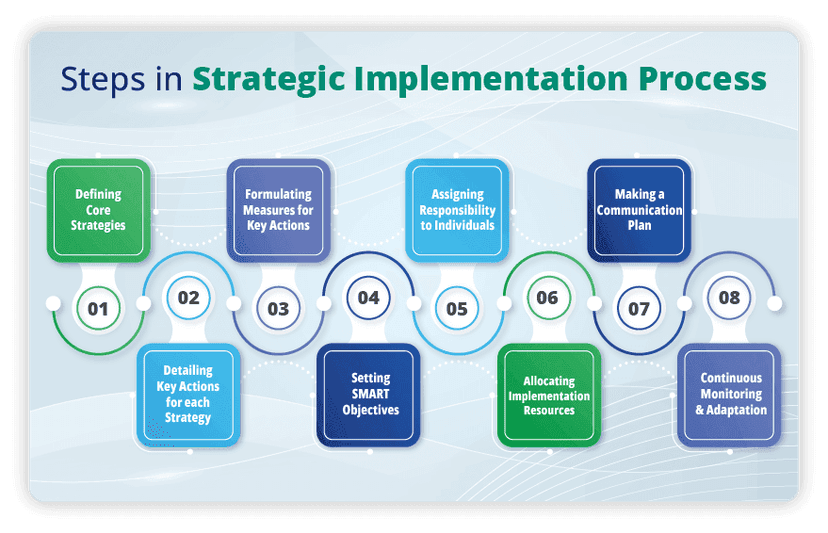
LTS Data Point vs Fabriq: Daily Management and Strategy Deployment Compared for Multi-site Manufacturers
Last updated on : November 20, 2026
Quick verdict: LTS Data Point vs Fabriq
LTS Data Point is the better fit for multi-site manufacturers that need SQCDP daily management and Hoshin Kanri strategy deployment in one connected platform. Teams can adopt the full operational excellence platform or start with single modules, such as digital SQCDP boards.
Fabriq is the better fit for plants that mainly want to digitise frontline routines, such as tier meetings and shopfloor standards.
The biggest differences are strategy deployment linked to daily KPIs, OEE from connected machine data, and ERP and MES integrations.
Connect your daily SQCDP boards to your strategic goals. See how LTS Data Point brings daily management and strategy deployment together.
How do LTS Data Point and Fabriq approach daily management?
LTS Data Point starts from the gap every operations leader face: KPI data that stops short of daily action, ownership and follow-through. From the SQDCP huddle board, Data Point builds through connected operations and strategic alignment to operational excellence tools. Every KPI in Data Point carries an owner, a deadline and a corrective action, from Tier 1 huddles up to Tier 3. LTS Data Point runs across 12+ industries, including pharma, automotive, aerospace and food.
Fabriq starts from the gap between shifts: decisions lost, whiteboards neglected and data that arrives too late to act on. From the shopfloor board, Fabriq builds around the huddle, the tier meeting and the shift handover. Every deviation in Fabriq becomes a ticket and an action plan, tracked in one shared platform. Fabriq targets six industries: aerospace and defence, food and beverage, automotive, luxury goods and cosmetics, pharmaceutical and medical, and logistics.
LTS Data Point vs Fabriq: Capability comparison
Data Point and Fabriq match on daily boards, escalation and structured problem solving and integrations. They differ on strategy deployment, production data, and AI and knowledge tooling.
Where Fabriq is strong
- Similar tickets with a match rate: From one click inside a ticket, Fabriq shows similar open and archived tickets with a match rate, so teams can link related problems.
- Knowledge from resolved problems: Fabriq's Knowledge Management uses AI to turn tickets and field information into structured, shareable documents, with multilingual translation.
- Branching checklists: Fabriq's checklist builder skips irrelevant questions and branches into deeper checks when an answer looks off.
- Audit to closed action: Fabriq links each ticket back to the checklist that caught it, so a team can trace a walk to the CAPA that closed it.
- Ticket templates: Fabriq lets teams build ticket categories such as safety incident, machine shutdown and quality issue, with drop-down fields for equipment, product and priority.
- Hoshin and A3 projects: Fabriq tracks longer-term improvement projects, including A3 and Hoshin, on Gantt or Kanban views next to daily actions.
- KPI tree: Fabriq's dynamic indicators consolidate KPIs in real time, from the shopfloor supervisor to the executive team.
- One template for every site: Fabriq says a central dashboard template pushes to every site in one click, and sites customise within guardrails.
These Fabriq capabilities cluster around shopfloor problem solving such as reusing fixes, catching deviations at source and standardising every plant.
Where LTS Data Point is strong
- Strategy in one X-Matrix: LTS Data Point offers Strategic Monthly Reviews as an add-on, connecting vision, objectives, KPIs and initiatives in one Hoshin Kanri X-Matrix.
- Strategy reaches the huddle: In Data Point, strategy cascades directly into the daily SQDCP huddle.
- Targets checked monthly: Bowler charts in LTS Data Point track monthly targets against actuals, and RCCM dashboards manage root causes and countermeasures.
- Planning in the same system: In Data Point, the Planning add-on covers master production scheduling, resource allocation and operator scheduling.
- Closed loop with the ERP: In the reference ERP setup, LTS Data Point receives work orders and target quantities, then returns actual quantity, downtime, scrap and completion status.
- Machine data to OEE: LTS Data Point takes machine data over OPC UA, MQTT, Modbus and EtherNet/IP, or through Janus edge capture on legacy machines.
- Shift accountability: In Data Point, real-time OEE comes with a Takt Timer for shift accountability and hour-by-hour boards with root cause logging.
- Executive reviews measured: At one customer, executive meetings shortened by 2.5 hours per session, an estimated £151,000 a year in meeting time alone.
LTS Data Point offers global dashboards, multi-site rollups and multi-site benchmarking for performance across all sites. Executive dashboards and multi-language support sit alongside multi-site visibility in Data Point. LTS Data Point hierarchies run from 2 levels, such as area and workstations, to 4 or more, such as regional and global.
LTS Data Point offers digital value stream mapping inside the same platform. Kaizen tracking, improvement project tracking and suggestion systems are part of Data Point. Data Point also offers CAPEX and budget tracking alongside its improvement tools.
LTS Data Point includes Quad charts and KPI trends alongside its SQCDP huddle boards. A One-Minute Manager board gives leaders a quick view of operations, issues and actions in Data Point. Action tracking and escalations run through the same Data Point boards.
LTS Data Point adds enhanced hierarchy, permissions and expanded reporting at the connected operations stage. Data Point captures manual data through structured datasheets, apps and uploads. Data Point adds capability by stage, so a site can start with SQCDP boards and manual KPI entry.
LTS Data Point offers CAPA software for corrective and preventive actions. Data Point also offers a continuous improvement charter and a tracker for evaluating multiple projects. Mind mapping for strategy planning and corporate governance software for board-level control are part of the same Data Point set.
LTS Data Point vs Fabriq: Which should you choose?
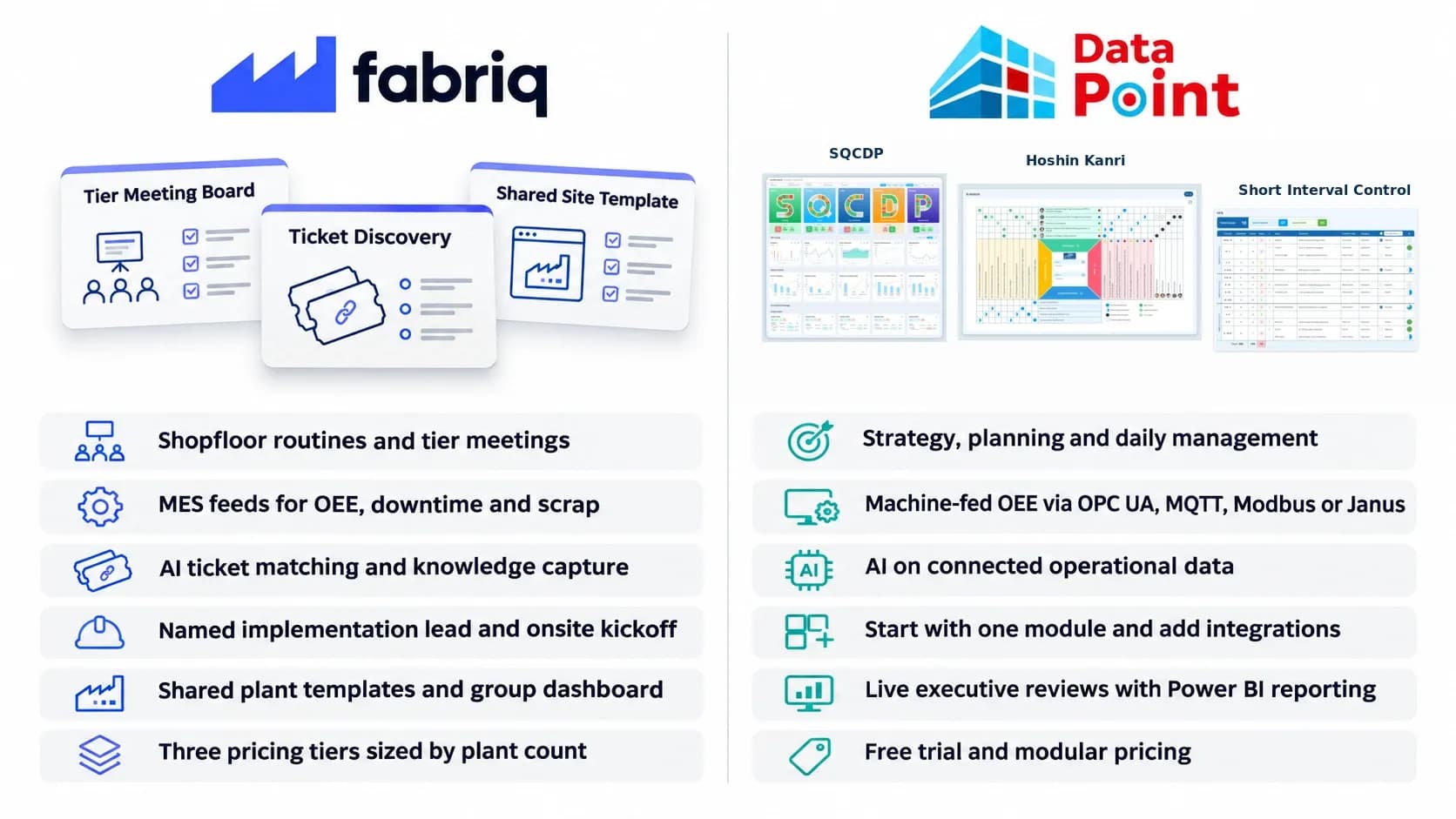
LTS Data Point and Fabriq both scale from one plant to many. Data Point extends into strategy, planning and machine data, while Fabriq extends into AI ticket search and knowledge capture.
LTS Data Point and Fabriq both carry the daily huddle, so the deciding question is whether the board must also carry planning, machines and quality.
Still comparing? Check out these pages too:
- Data Point vs L2L: Which Connected Manufacturing Platform Actually Fits Your Operation?
- Data Point vs iObeya : An Honest Operational Excellence Software Comparison
- Beyond dashboards: How LTS Data Point supercharges Power BI limitations for real-time Lean management
- LTS Data Point vs Tervene: Which Lean Daily Management Platform Fits Your Plant? (2027)
LTS Data Point and Fabriq both run the daily huddle well. Fabriq is strong on knowledge reuse, field routines and one template for every plant. LTS Data Point is strong on the Hoshin Kanri X-Matrix, machine data to OEE and the ERP loop. The right choice depends on what your board must carry beyond the huddle.
Need more than digital huddle boards? Explore how LTS Data Point connects strategy, production planning and shopfloor performance across your sites.
FAQs
1. Does LTS Data Point replace our ERP, MES or Power BI?
No. LTS Data Point works alongside your existing ERP, MES and BI systems without replacing them. LTS Data Point puts that data on SQDCP boards, OEE and Hoshin Kanri, where teams act on it every shift.
2. How secure are LTS Data Point and Fabriq?
LTS Data Point uses TLS 1.3, token authentication, and role-based access and read-only connections, and customers choose UK or US data location. LTS Data Point is GDPR compliant and VAPT tested. Fabriq shows an ISO 27001 logo and a CyberVadis badge. It is always best to enquire the vendor during demo meetings.
3. How much IT involvement does each platform need?
LTS Data Point needs little IT to start, going live in days to two weeks on manual forms and Excel. IT provides source access, IP allowlisting if the firewall needs it and a named data owner per source. Fabriq assigns a dedicated implementation lead to work with your IT team, and connects MES, ERP, CMMS and BI tools through its API.
4. What support and training follow go-live?
LTS Data Point provides training, 24/7 technical support and regular enhancements with best-practice guidance. Fabriq includes onsite kickoff, training and a named implementation lead on its entry tier. Ask each vendor how support hours, implementation lead on its entry tier. Ask each vendor how long queued data is held and how conflicts are resolved.
5. Can we run a pilot before committing?
Yes. LTS Data Point demos and trials are free, and a pilot can start on manual forms and Excel, going live in days to two weeks. Fabriq starts at a single plan on its Standard tier, with most sites live within a few weeks, according to Fabriq. Agree success measures with either vendor before the pilot starts.

Amer Jumah, Senior Lean Consultant
Amer is co-founder of Agile Solutions and a certified Six Sigma Black Belt, Lean Black Belt, and PMP, with over nine years of experience implementing Lean, Six Sigma, and Agile principles across diverse industries. He specialises in process optimisation, waste elimination, and delivering cost savings through organisational change.