Data Point vs L2L: Which Connected Manufacturing Platform Actually Fits Your Operation?
Last updated on : August 31, 2026
Every manufacturer running L2L or LTS Data Point has the same tool in front of supervisors each morning: a digital board showing what happened on the shift before.
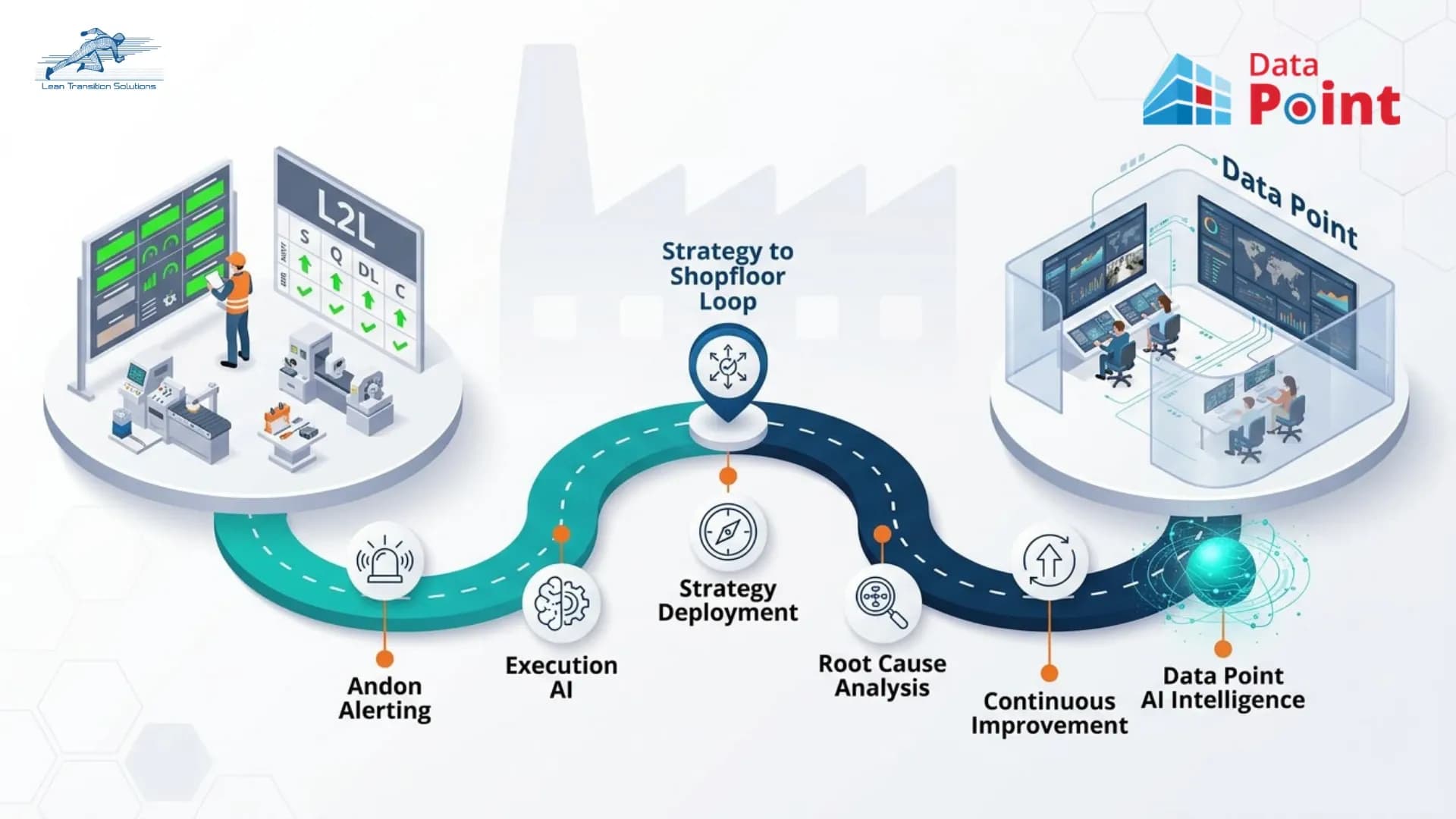
L2L builds that board as the entry point into a wider execution system. Data Point builds it as one stop inside a longer loop that starts at strategy and ends at a verified fix. The board looks the same. What it connects to doesn't.
See how Data Point connects strategy to the shopfloor in one system
What each platform is actually built to do
The board on the shift-review screen might look similar. The system behind it isn't.
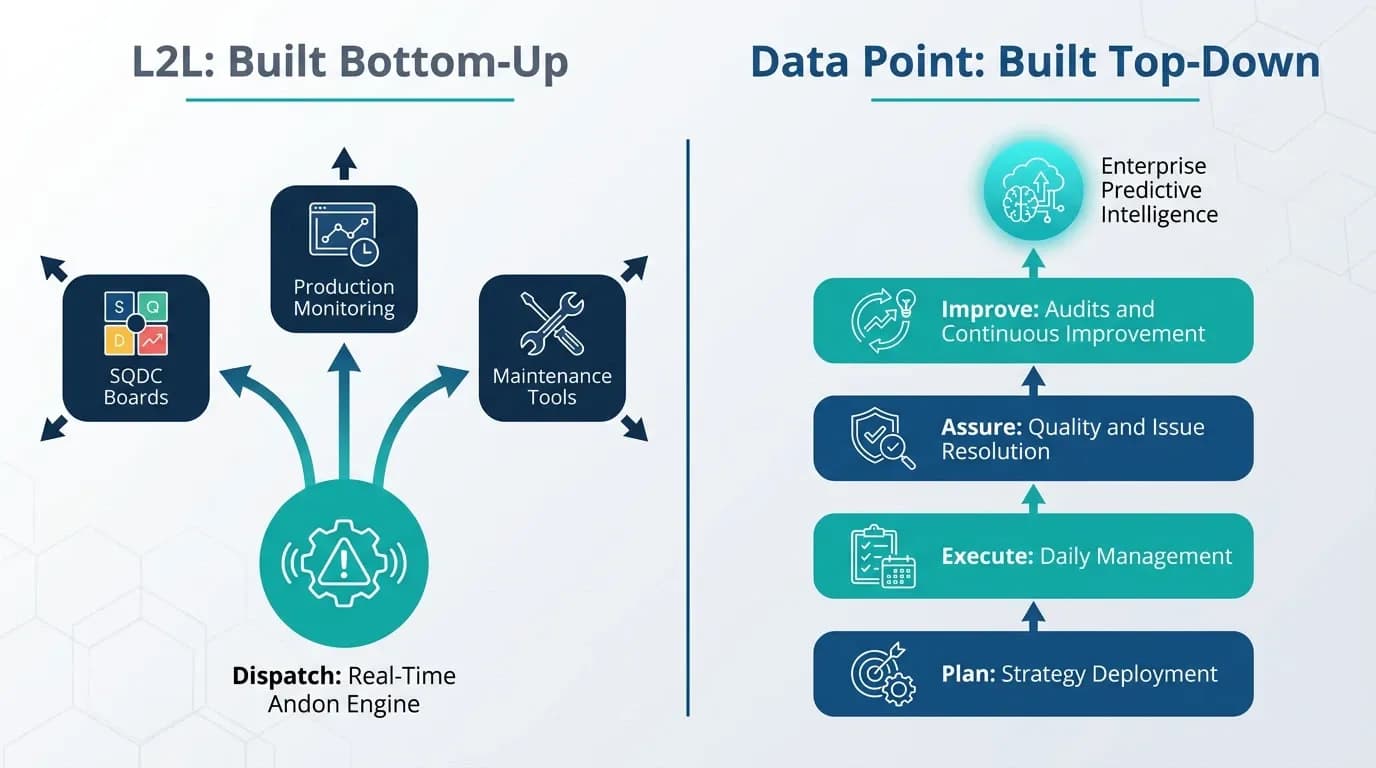
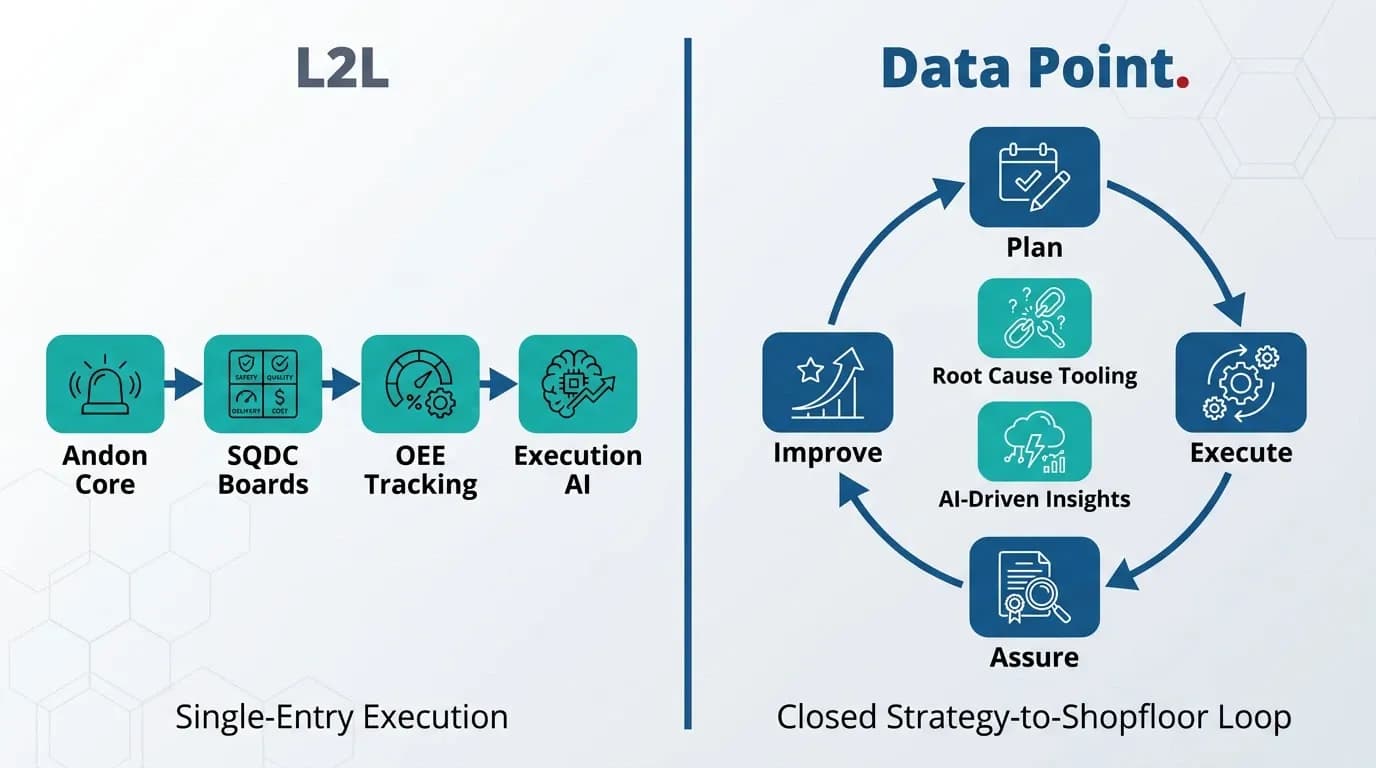
Data Point runs on four connected phases. Plan covers strategy deployment through Hoshin Kanri X-Matrix. Execute covers daily management and live shopfloor data capture.
Assure covers quality management and issue resolution. Improve covers audits and continuous improvement cycles. Every phase feeds the one above it, up to enterprise-wide predictive intelligence.
L2L starts from a different point of entry. Its foundation is Dispatch, a real-time Andon engine. Built to catch a single abnormality on the floor. A machine running hot. An unexpected vibration. A stalled line. Routed straight to whoever can fix it. Its digital SQDC boards, production monitoring, and maintenance-adjacent tools all grew outward from that one mechanism.
The difference isn't breadth versus narrowness. Both platforms have grown wide. The difference is what each one was built outward from. Data Point was designed top-down, with strategy deployment as one of its four founding phases. L2L was designed bottom-up, from a single floor-level alert to a broader platform around it.
Neither approach is automatically better. A team that lives by fast issue resolution will recognise the logic in L2L's design. A team trying to connect a strategic target to tomorrow's shift will recognise the logic in how Data Point is designed.
Where L2L holds its own
- TeamBoard: Digital SQDC boards that auto-populate from live Dispatch and production data, replacing manually updated shift boards with something that reflects the floor in real time.
- Dispatch: The Andon engine at the core of the platform, auto-alerting on machine parameters like heat and vibration and routing issues straight to whoever can fix them, without waiting for a supervisor to notice.
- Execution AI: Launched in 2026, a prescriptive AI layer with pre-built Solvers that diagnose root causes and recommend next-best actions, rather than leaving that judgement call to whoever’s on shift.
- SwipeGuide: Mobile-first digital work instructions and frontline training, acquired in 2024 and used by hundreds of thousands of factory workers globally.
- OEE and production monitoring: Live tracking of efficiency, downtime, and output, used by enterprise manufacturers to catch performance drops before they become bigger problems.
Each one solves a specific, recognisable shopfloor problem: catching issues in real time, acting on them with AI, training the people who'll fix them, and tracking whether performance actually improved.
What Data Point does differently
A closed loop only counts if a strategic target on a screen actually turns into something done on the floor, tracked to close.
Strategic monthly reviews in Data Point connect vision, objectives, KPIs, and initiatives through Hoshin Kanri X-Matrix, built into the same module, not bolted on separately. Every issue that surfaces below that runs through the same structure: Action Plans follow a 4C workflow with full traceability from assignment to close and an audit trail behind every step.
That structure reaches the floor through the same connected tools: Digital TCards for task management and escalation, 5S Audits through the Saisho 5S app, and Gemba Walks for shopfloor engagement. None of these sits outside the loop. Each one feeds the same KPI and escalation structure that starts at the strategy layer.
That's the difference between a strategy target left running until someone checks on it, versus one that's tracked, escalated, and closed automatically the moment it's missed.
Capability comparison
Data Point vs L2L: Choosing between them
Both platforms are real. Both have genuine strengths, verified and shipped. The right choice isn't about which one is "better" in the abstract – it's about which question your evaluation actually starts with.
- L2L fits a team whose primary need is execution-layer issue resolution. Its Andon engine is the platform’s core, not a bolt-on, and everything else – TeamBoard's SQDC visibility, live OEE and downtime tracking, and frontline training extended through the SwipeGuide acquisition – grew outward from that same mechanism. Its prescriptive AI layer, Execution AI, diagnoses root causes and recommends next-best actions in production.
- Data Point fits a team that needs the strategy-to-shopfloor loop held together in one architecture, not assembled from separate tools. Hoshin Kanri deployment sits inside the same structure as daily management, quality, and continuous improvement – one of four founding phases, not something added after the fact. Root-cause tooling (RCCM, Fishbone, Pareto) runs inside that same loop, with AI-driven insights extending it further.
L2L's Andon maturity and AI layer are the stronger fit for a team whose evaluation starts on the shopfloor. The connected strategy-to-execution loop in Data Point is the stronger fit for a team whose evaluation starts in the boardroom and needs to reach the floor without losing the thread.
That second starting point is the more common one behind the phrase "connected operational intelligence platform" specifically – it describes a closed loop, not just an execution engine. For a team evaluating on those terms, Data Point answers the question directly.
Two platforms, two starting points. L2L answers the shopfloor first. Data Point answers the boardroom first and carries that thread down to the floor, with planning, daily management, quality, and improvement running as one connected system. That makes Data Point the more complete platform overall.
Still confused on which platform is right for your operational tasks? Also see:
- Data Point vs iObeya : An Honest Operational Excellence Software Comparison
- MES vs Data Point: What's the Real Difference for Manufacturers?
- Which Manufacturing KPI Tool Is Best for 2026? Full Comparison Inside
- Beyond dashboards: How LTS Data Point supercharges Power BI limitations for real-time Lean management
Get a straight answer on which platform fits your operational tasks
FAQs
1. Is L2L a legitimate alternative to Data Point, or just a smaller competitor?
L2L is a genuine, credible platform in its own right, not a stripped-down alternative. Its Andon engine has years of deployment behind it, and its recent Execution AI launch shows active platform investment.
2. Can a mid-size manufacturer use Data Point, or is it built for large enterprises only?
Data Point is modular. A single plant can start with daily management or a specific add-on and scale from there – there's no minimum site count required to begin.
3. Does switching from L2L to Data Point mean starting from scratch?
No. Data Point is designed to connect to existing ERP, MES, CRM, and BI systems rather than replace them outright, so a switch doesn't require rebuilding your entire operational stack.
4. What happens to historical performance data if a manufacturer moves from one platform to the other?
Migration approach depends on the vendor, but integration in Data Point is designed to pull in structured data from existing sources (including manual Excel capture) rather than requiring a clean start, so historical KPI history isn't necessarily lost in a switch.
5. How customisable is each platform to a specific manufacturer’s KPI structure?
Both platforms support configuration to a company's own metrics. L2L structures its boards around SQDC categories as configured per site. Data Point covers a wider named set – Safety, Quality, Delivery, Cost, People, Lean, Maintenance, and Environment – with every KPI linked to an owner, deadline, and corrective action.
6. Does either platform require a dedicated data science or IT team to run?
Neither is built for data scientists specifically. Both are designed for operations teams to configure and use directly, with technical support available from each vendor during setup.

Amer Jumah, Senior Lean Consultant
Amer is co-founder of Agile Solutions and a certified Six Sigma Black Belt, Lean Black Belt, and PMP, with over nine years of experience implementing Lean, Six Sigma, and Agile principles across diverse industries. He specialises in process optimisation, waste elimination, and delivering cost savings through organisational change.