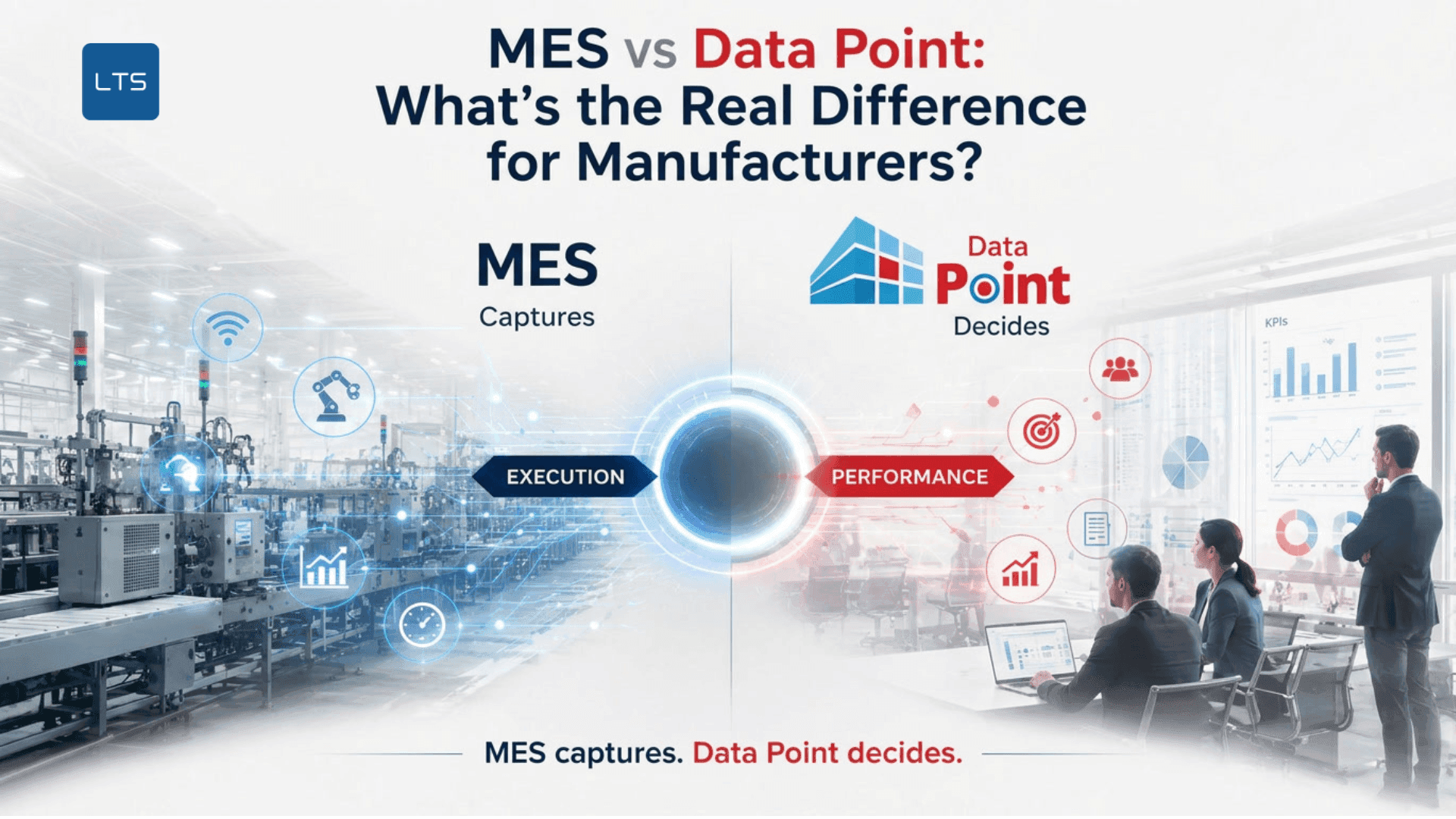
MES vs Data Point: What's the Real Difference for Manufacturers?
Last updated on : July 10, 2026
A Manufacturing Execution System (MES) is shop-floor software that dispatches work orders, captures machine and operator data, and enforces process and quality compliance in real time. Data Point is a connected operational intelligence platform that sits above MES, turning captured data into daily accountability, KPI management, and continuous improvement.
What Is MES, and What Is It Actually Built to Do?
A Manufacturing Execution System exists to control what happens on the shop floor, second by second. It dispatches work orders. It captures machine and operator data: OEE, downtime, yield. It enforces process control and traceability. It monitors quality and compliance as production happens, not after the fact.
In UK automotive plants and US discrete manufacturing lines alike, MES is the backbone of real-time execution. It tells a supervisor exactly what a machine is doing right now. It's built for control, not for context.
MES was never designed to manage performance across a team, a shift, or a site. It was designed to manage the process. Smart manufacturing strategies increasingly separate these two jobs deliberately, rather than asking one system to do both.
Why “MES vs Data Point” Is the Wrong Question to Start With
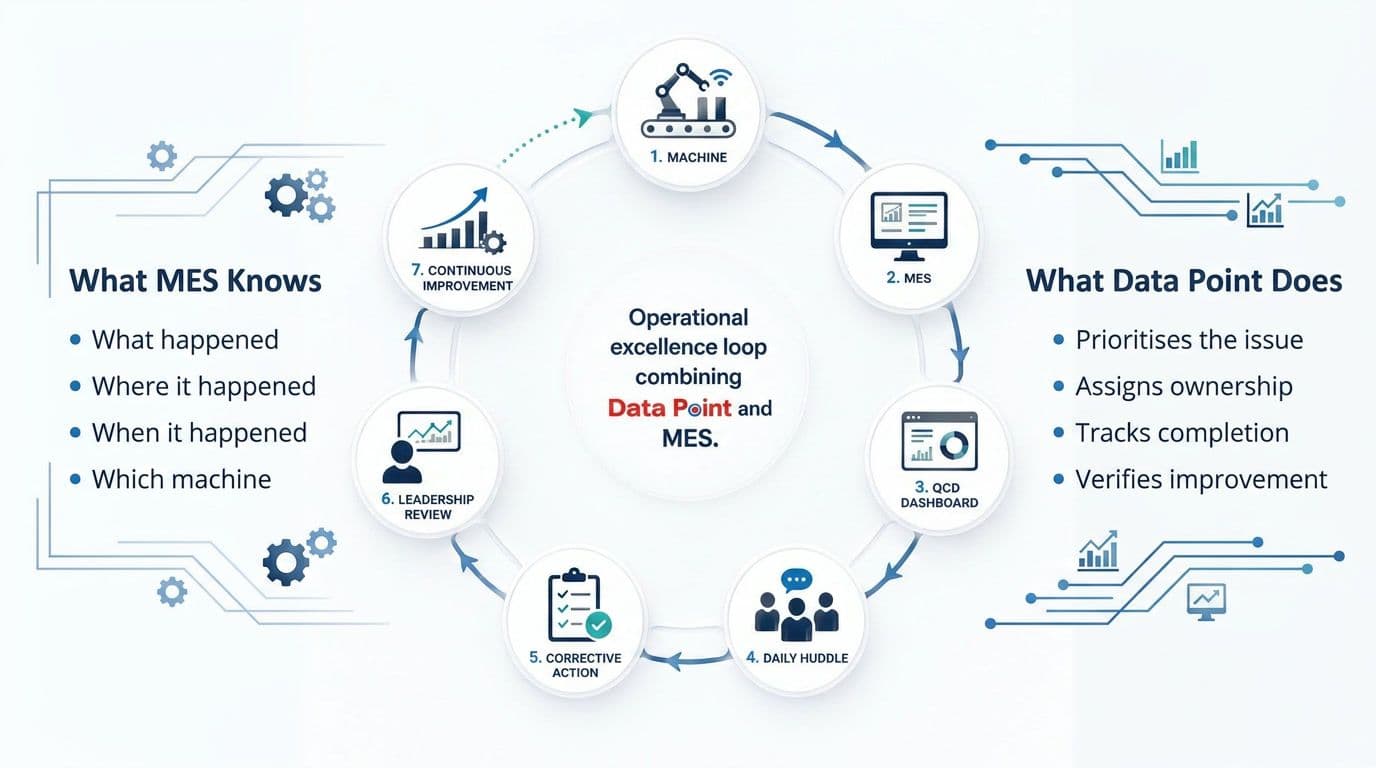
Here's what most manufacturers get wrong when they start comparing MES vs Data Point: they assume it's a straight swap, one system replacing another.
It rarely is.
MES and Data Point solve different problems. MES answers “what is happening on the line right now?” Data Point answers “what should we do about it, and who owns the action?” Confusing the two is where the redundancy fear comes from: teams look at their MES dashboard, see numbers, and assume any new platform must be duplicating what they already have.
It isn't. A Manufacturing Execution System dispatches and tracks work, captures machine data, and enforces compliance. Data Point operates above that layer, focused entirely on how performance is managed, reviewed, and improved once the data exists.
Still asking “why do we need this if we already have an MES?” Let's talk it through.
MES Limitations: Where Capturing Data Stops and Acting on It Begins
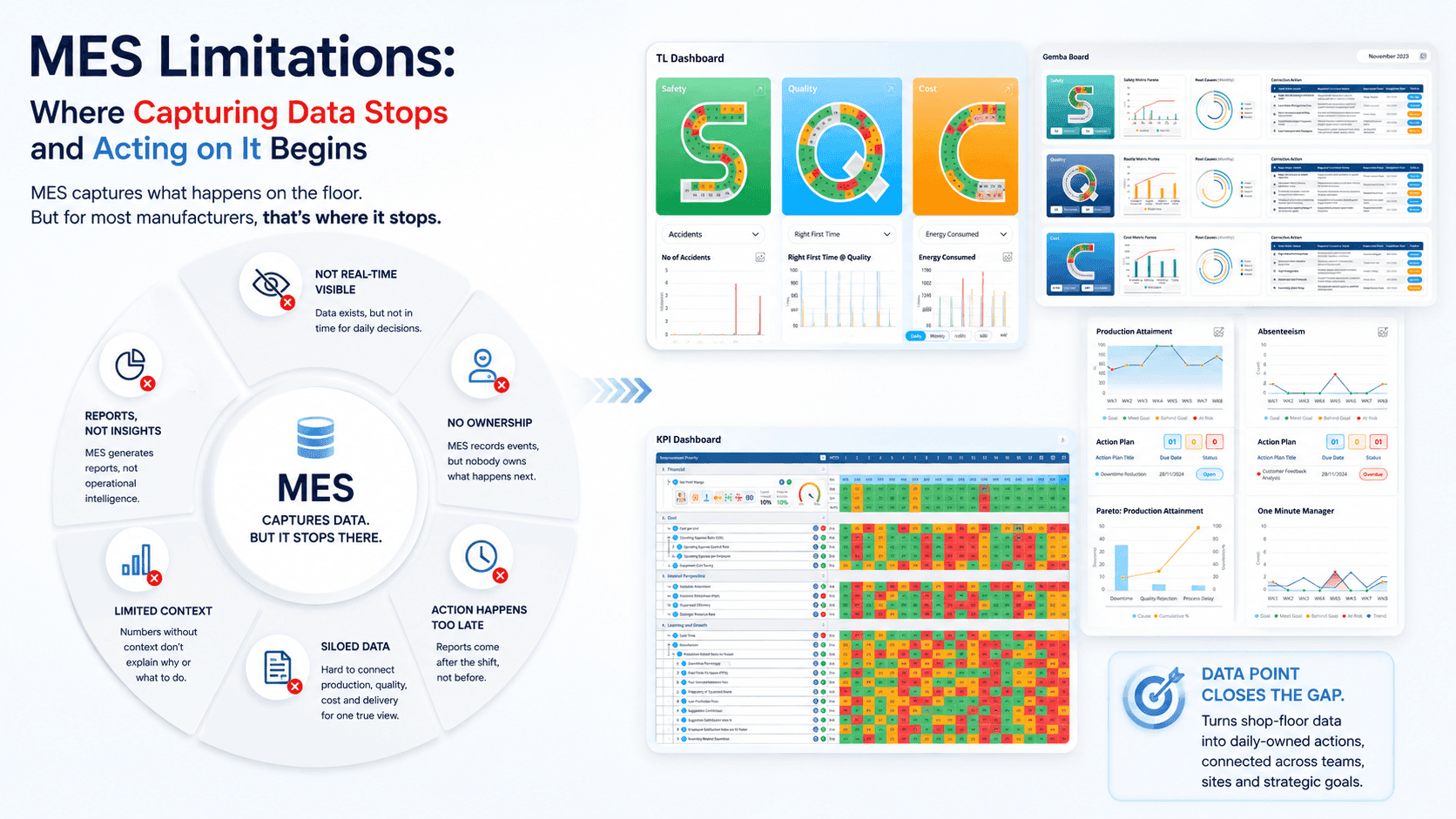
Picture a plant manager on a Monday morning. The MES has been running all weekend. Downtime is logged. Yield numbers are sitting in a database somewhere. OEE has a number attached to it.
None of that is visible in the huddle at 7am.
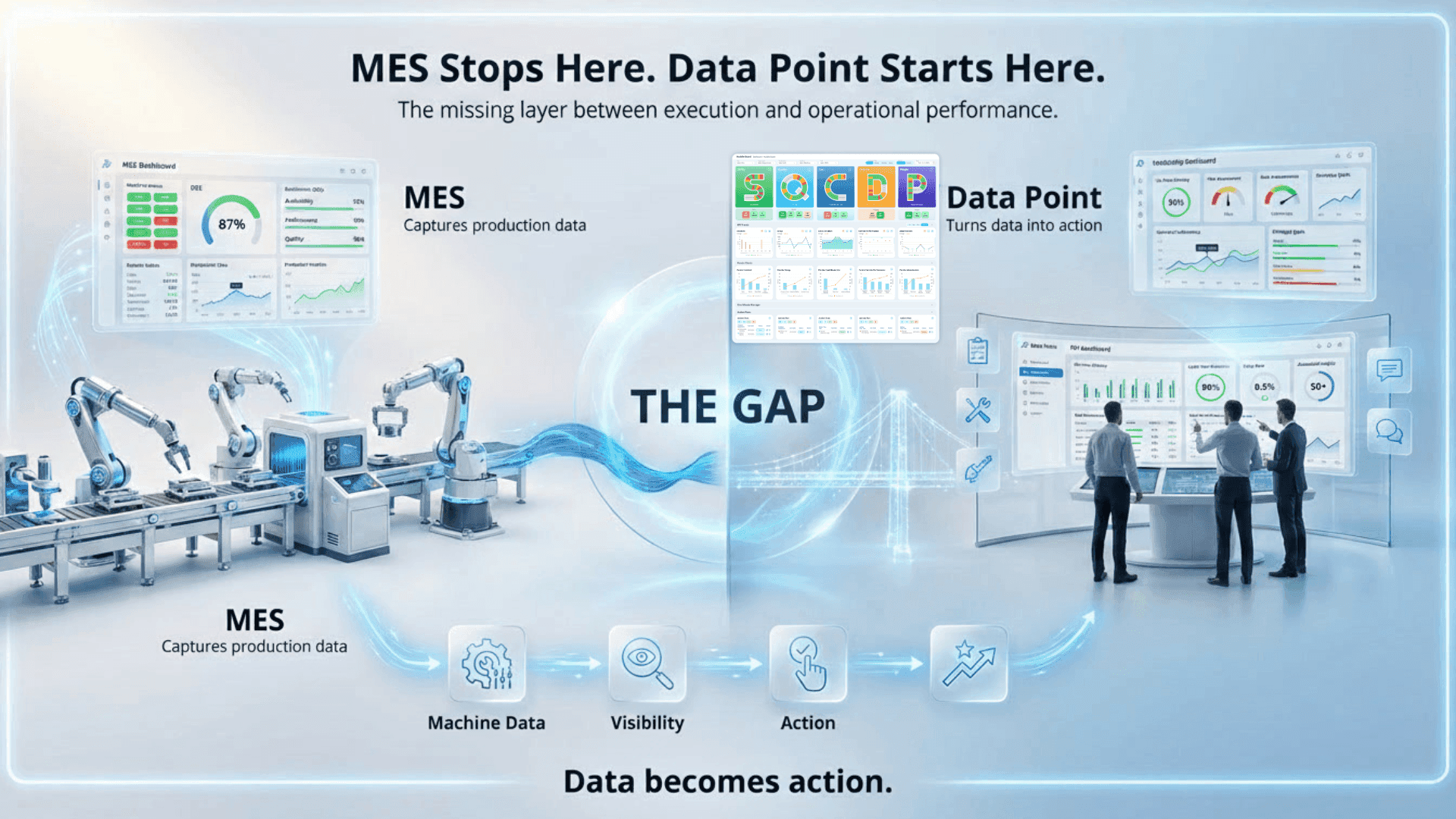
The data exists. Nobody owns turning it into action. Engineering can pull a report. The floor supervisor can't see it in a format that drives a decision before the shift starts. That's not a data problem. It's a follow-through problem, and it's the single biggest reason manufacturers start searching for something beyond their MES.
How Most Manufacturers Are Managing This Gap Today, and Why It's Not Working
Most teams patch this gap manually. Someone exports the MES data into a spreadsheet before the huddle. Someone else builds a separate KPI dashboard nobody quite trusts. A third person chases down yesterday's numbers by phone.
Why manual boards can't keep up with real-time production metrics is a familiar story on most shop floors: the board gets updated once a shift, sometimes once a day, and by the time it's current, the moment to act on it has already passed. See why manual boards can't keep up for the full pattern.
Standalone manufacturing KPI dashboards rarely fix this either, because they visualise the data without connecting it to an owner, a deadline, or a corrective action. Visibility without accountability just moves the same problem onto a screen.
MES vs Data Point: Side-by-Side Comparison
Once you separate what each system is actually for, the comparison gets simple:
MES shows what's happening. Data Point makes sure something is done about it. That single line, more than any feature list, is the real difference between MES and Data Point.
This is also where a manufacturing balanced scorecard earns its place. It's the mechanism Data Point uses to translate MES-level data into a structure leadership can actually review: safety, quality, delivery, cost, and people, all in one-tiered view.
See what changes when your MES data finally gets acted on daily.
MES Integration: Do You Need to Replace Your MES, or Connect to It?
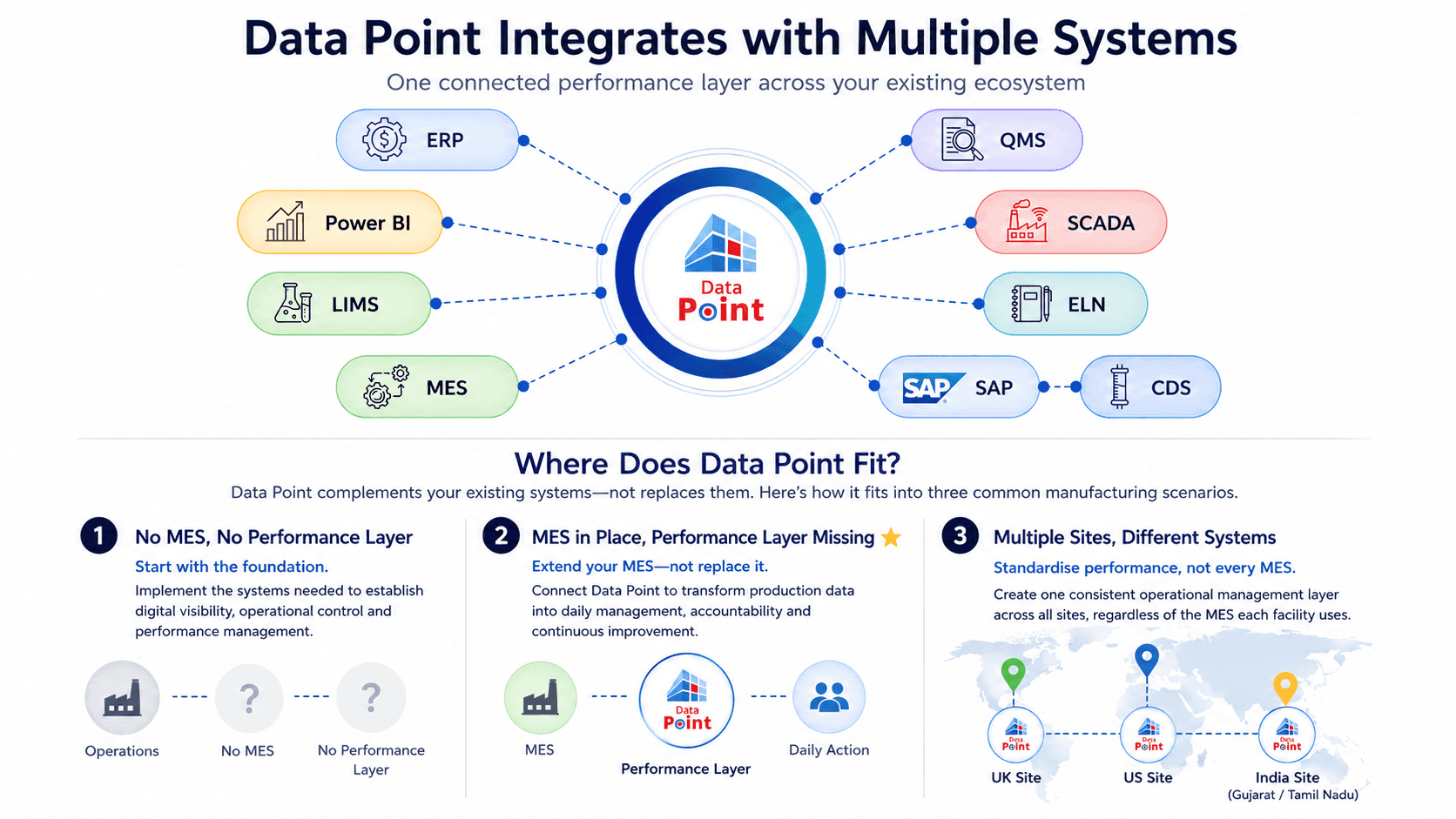
This is the question that actually matters, and it's rarely the one being asked. MES integration, not MES replacement, is what most manufacturers need.
Data Point doesn't rip out your MES. It connects to it, alongside your ERP, CRM, and BI tools, and pulls that machine and production data upward into a performance layer your teams already use daily.
Data Point isn't an MES alternative, it's an MES companion
If MES and ERP integration is something you've already tackled, adding a connected performance layer on top is a smaller step than most IT teams expect, not a second system to babysit.
That single point matters more than any feature comparison: the redundancy fear that stops most manufacturers from even looking at Data Point disappears once integration, not replacement, is on the table.
A Simple Framework for Deciding What You Actually Need
Here's a practical way to work out where you sit:
- No MES and no performance layer: you likely need both, starting with whichever solves your most urgent compliance or traceability risk.
- An MES but no performance layer: the most common gap, and the one this article has been describing. You don't need to touch your MES. You need to connect a system that turns its output into daily action.
- Multiple sites, each with its own MES or none at all: standardising the performance layer matters more than standardising the MES itself, whether those sites sit in the UK, the US, or manufacturing hubs like Gujarat and Tamil Nadu in India.
Future-proof your shop floor without ripping out your MES.
What Changes on the Shop Floor When MES and Data Point Work Together
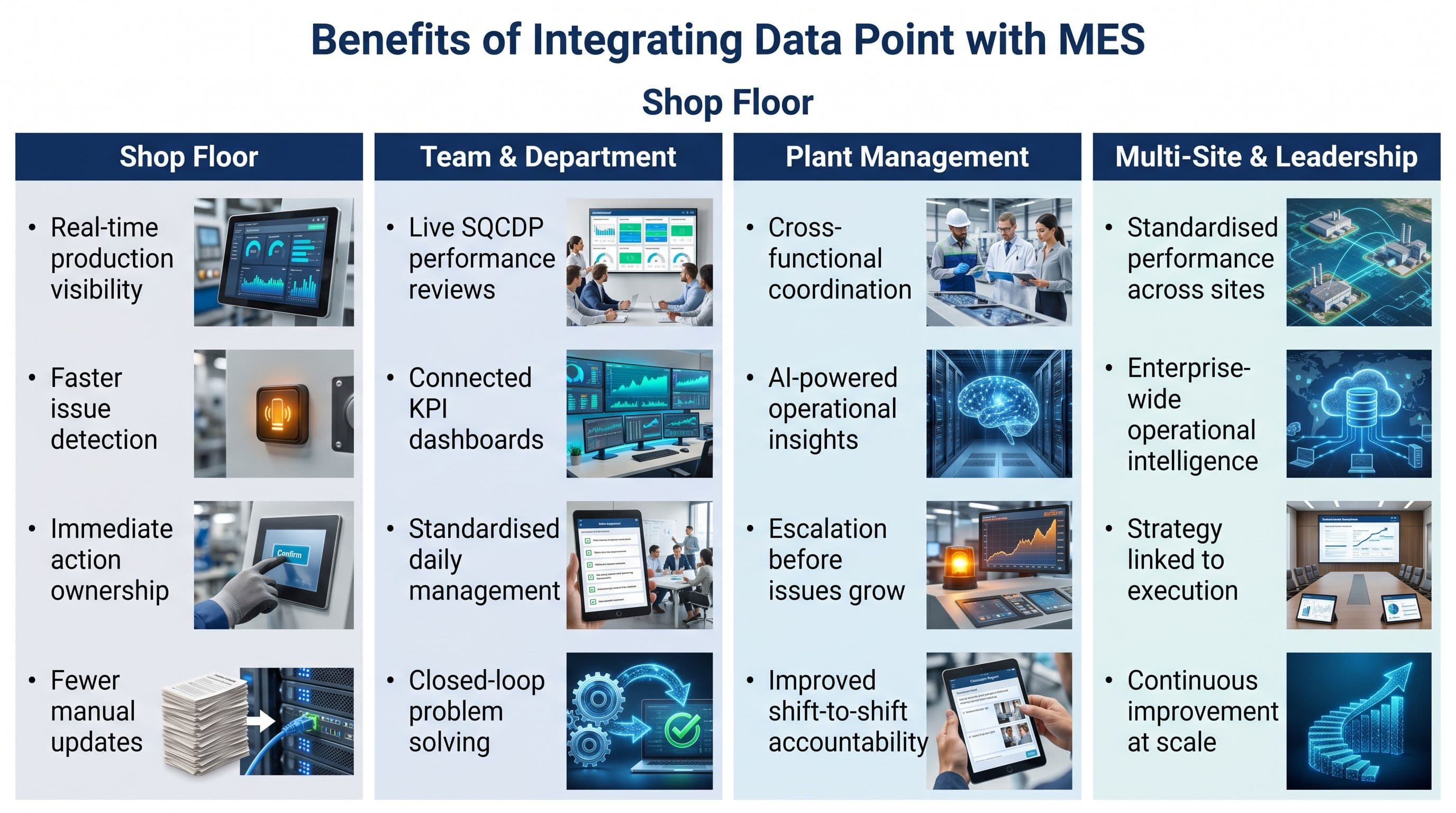
Think of a factory as a body. The MES is the nervous system, collecting real-time sensory data: what's happening right now, on which line, on which machine. Data Point is the brain: analysing that data, learning from it, and deciding where to improve next.
That's why global manufacturers across pharmaceuticals, automotive components, and electronics run both together, rather than choosing one. MES feeds machine and production data upward. Data Point connects that information to people, actions, and strategic outcomes, the layer MES was never built to cover.
Why shopfloor data isn't delivering usually comes down to exactly this gap: the data is accurate, but it never reaches the person who can act on it, in a form they can act on it in. Read why shopfloor data isn't delivering for the full breakdown.
MES vs MOM vs Data Point: Where Does Manufacturing Operations Management Fit?
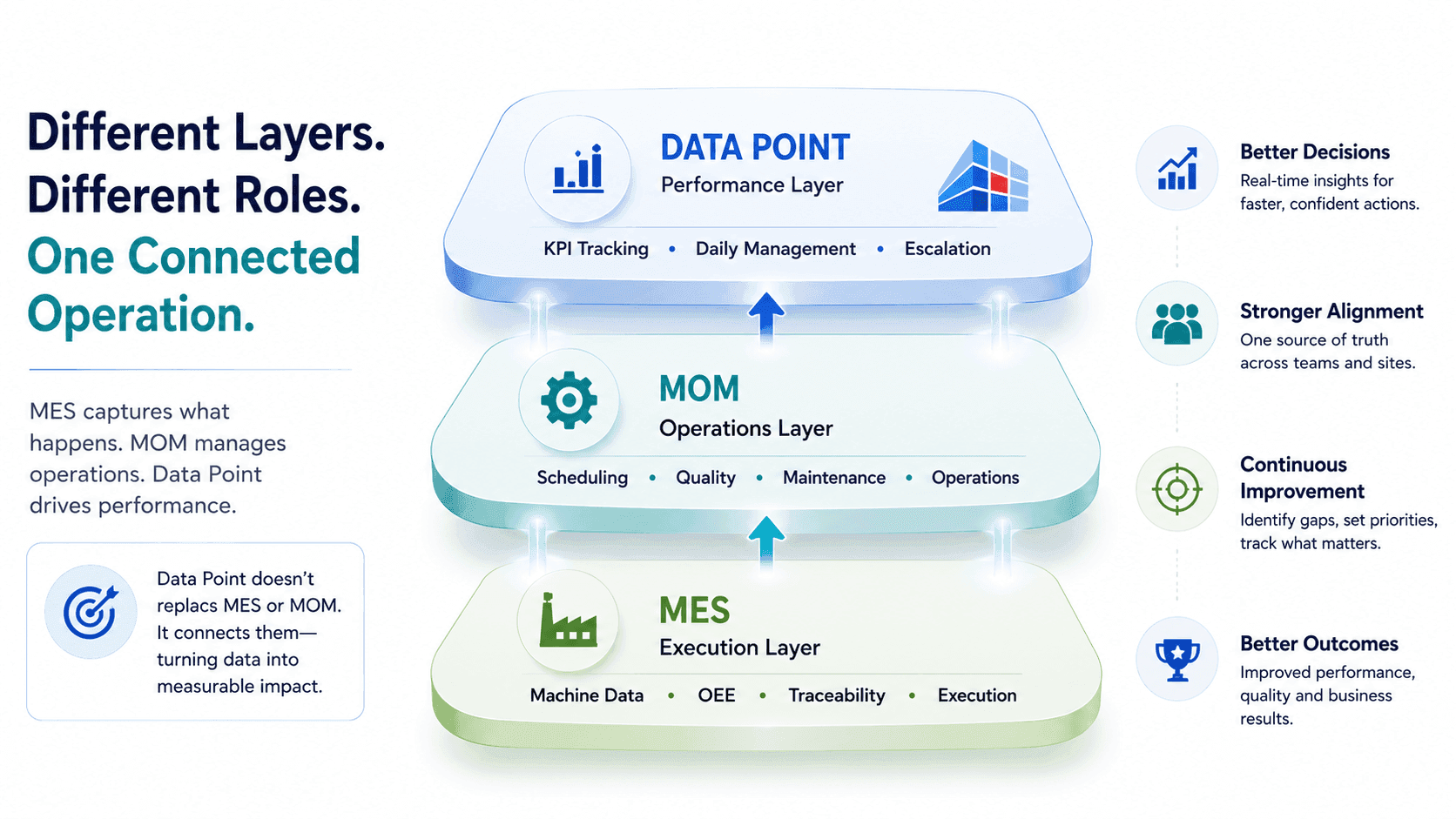
Manufacturing Operations Management, or MOM, sits between the two, and it's often where the “MES vs Data Point” question gets muddled further. MOM is broader than MES: it can include scheduling, quality, and maintenance modules across a wider operational footprint.
Data Point isn't a MOM replacement either. It doesn't try to run production scheduling or quality workflows. It focuses on the performance rhythm above all of them: KPI tracking, tiered reviews, and escalation, whether the data underneath comes from an MES, a MOM suite, or a mix of both. An OEE tracker alone won't tell you if the real gap sits in production control or in performance follow-through.
If you're already comparing manufacturing KPI tools broadly rather than just MES options, that's worth doing properly before committing to either layer.
Data Point Solutions: Connecting What MES Captures to What Your Teams Actually Do
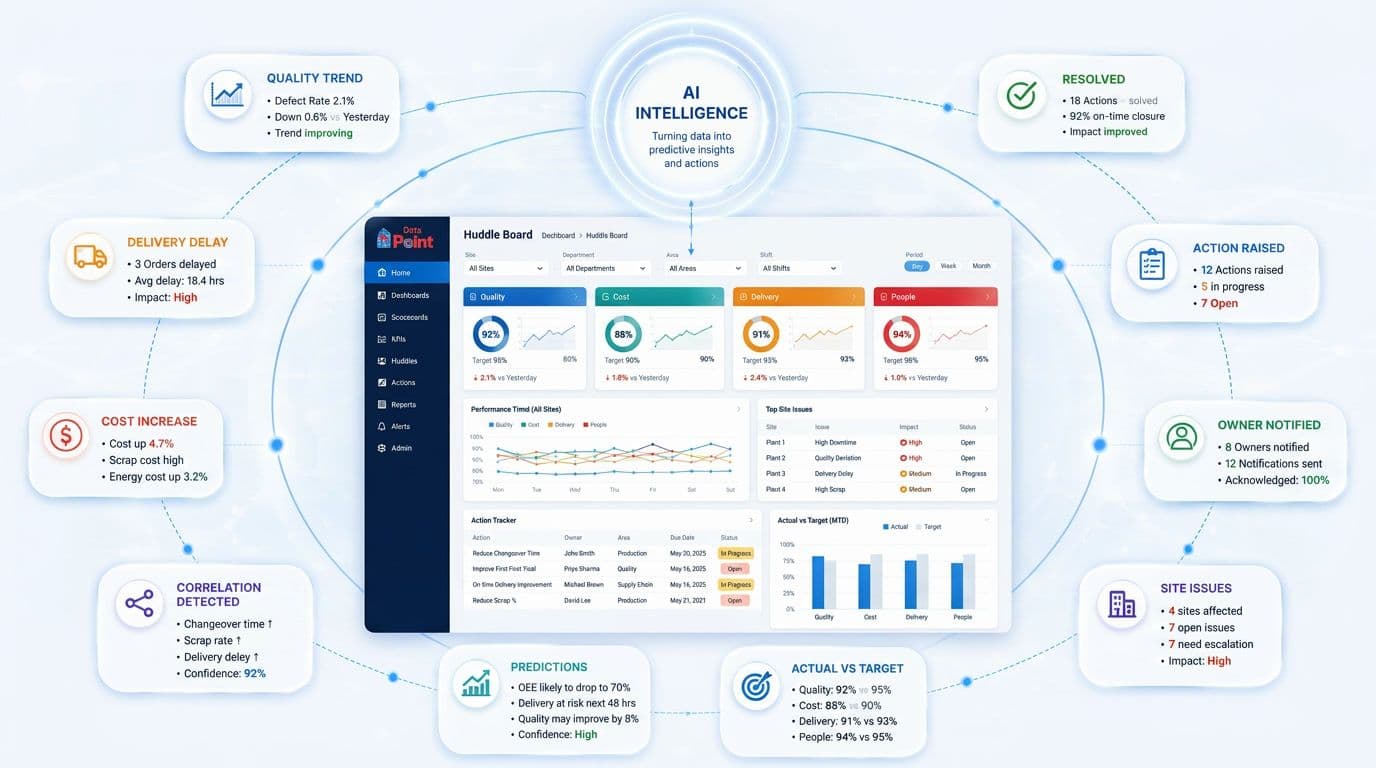
None of this works as a slogan. It works because Data Point is built as a connected system, not a single dashboard bolted onto an MES feed.
At the daily management level
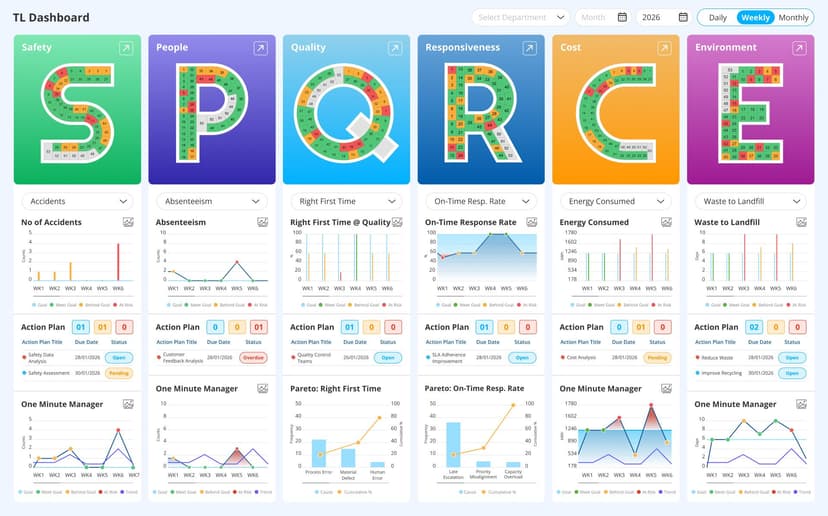
Tiered SQCDP and PQVC dashboards turn MES and shop-floor data into structured huddles, with escalation paths (4C, PDCA, Fishbone, Pareto) built in when something needs to go further than the floor. SQDCP vs PQVC metrics aren't interchangeable, and choosing the right framework for your operation matters as much as the platform underneath it.
At the strategy level
X-Matrix and Bowler dashboards connect that same shop-floor data to site and enterprise-level goals, so a downtime spike on one line is visible in the same governance view as a strategic KPI miss three sites away.
Data Point Vs Power BI
This is also where the comparison with generic BI tools breaks down. Data Point vs Power BI isn't really a fair fight, because Power BI visualises data someone else has to structure first. Data Point is built with the lean and operational structure already inside it: KPIs tied to owners, deadlines, and corrective actions from day one.
The AI layer
sits on top of all of it. Data Point AI Intelligence isn't a generic chatbot bolted onto a dashboard. It understands the full lean and operational context already inside the platform: which KPIs are escalating, which actions are overdue, and where a pattern across shifts or sites is starting to repeat. That's the difference between an alert and a decision someone can actually act on.
MES vs Data Point was never really about picking a winner. It's about knowing which job each system is built for and connecting them so neither one is carrying weight it wasn't designed to hold.
FAQs
1. Is Data Point a replacement for my MES?
No. Data Point connects to your existing MES rather than replacing it. MES continues controlling shop-floor execution; Data Point manages the performance layer above it.
2. What's the difference between MES and MOM?
MOM (Manufacturing Operations Management) is broader than MES, often covering scheduling, quality, and maintenance across a wider footprint. MES focuses specifically on real-time execution and process control. Data Point sits above both, regardless of which one, or combination, a plant runs.
3. Can Data Point integrate with any MES?
Yes. Data Point is built to connect to ERP, MES, CRM, and BI systems, pulling shop-floor and machine data upward into a single performance view rather than requiring a specific MES vendor.
4. How long does it take to connect Data Point to an existing MES?
Most manufacturers see a live, tiered dashboard within weeks of connecting Data Point to their existing systems, not the twelve-month timeline typical of a full MES rollout, since no shop-floor software is being replaced.
5. Does Data Point work without an MES in place?
Yes. Data Point can run on manual data entry, spreadsheets, or partial digital capture while an MES is planned or phased in, then absorb MES data automatically once it's live.
6. What's the ROI of adding Data Point on top of an existing MES?
The return typically comes from faster escalation and fewer repeat issues rather than from the MES data itself: turning a downtime pattern into a corrective action within a shift, instead of finding it in a monthly report, is where the real cost saving sits.
7. Is Data Point only for large, multi-site manufacturers?
No. Single-site manufacturers use it to structure daily huddles and KPI ownership; multi-site and enterprise manufacturers use the same platform to standardise that view across sites and regions.
8. How does Data Point's AI layer differ from standard MES analytics?
MES analytics report what happened on the line. Data Point AI Intelligence understands the full lean and operational context already inside the platform, flagging which escalations are overdue and where a pattern is repeating across shifts or sites, not just what the last reading was.
9. What does it cost to add Data Point to an existing MES setup?
Pricing depends on functionality, the number of KPIs and users, and data capture complexity, from single-site starter packs through to multi-site enterprise deployments. A demo is the fastest way to get a figure specific to your setup rather than a generic number.
10. Do manufacturers really run MES and a performance platform together, rather than choosing one?
Yes. It's the norm among global manufacturers across pharmaceuticals, automotive components, and electronics, precisely because MES and a connected performance platform solve different problems rather than competing for the same one.

Abel Jiménez, Lean Consultant
Abel is a Lean Consultant with over 30 years of expertise in operational analysis, process improvement, and organisational change across Mexican industries. Currently serving as Director of Insurance Promotions at CESCEMEX, he helps organisations leverage technology and lean practices to improve efficiency and manage change with continuity.