Jidoka in Manufacturing: How Real-Time Shopfloor Data Turns a Lean Principle into a Daily Defect-Stopping System

Last updated on : September 25, 2026
Modern factories run highly automated lines. Abnormalities still slip through, unnoticed until defects move downstream. Jidoka stops that: production halts the moment a defect, equipment fault or process abnormality appears. Toyota calls it "automation with a human touch": machines stop automatically, or operators stop the line themselves. The defect is contained, the abnormality exposed, quality built into the processes itself. Not caught at final inspection but stopped at the source.
But stopping the line only proves something is wrong. It does not reveal the cause, assign ownership or prevent recurrence. Machine performance often goes unmonitored on the shopfloor, letting failures and out-of-spec parts surface without warning. Real-time monitoring, automated alerts, root cause records and escalation workflows close that gap: not replacing Jidoka is human judgement, but extending it into a live, data-driven discipline.
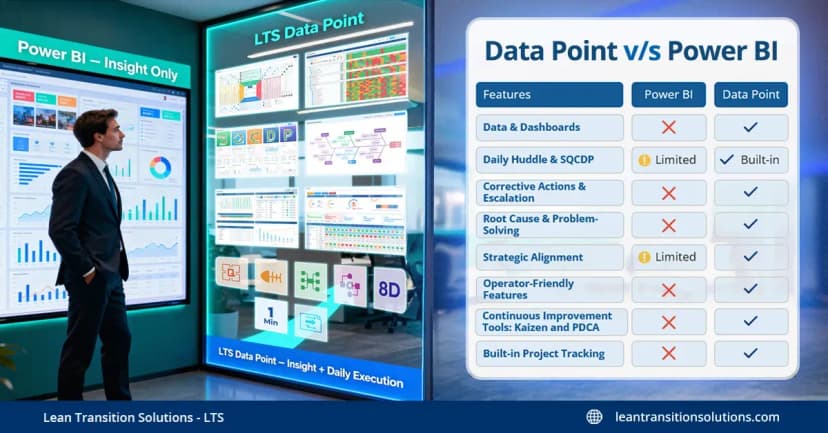
See how LTS Data Point connects real-time visibility, automated escalation and accountable corrective action to support a more responsive approach to Jidoka.
What Jidoka means in lean manufacturing
Jidoka is one of two pillars holding up the entire Toyota Production System. Not a technique bolted onto it, but one of the two things it stands on. Alongside Just-in-Time, it forms the foundation Toyota built everything else around.
- Two pillars: Jidoka and Just-in-Time.
- Born on the factory floor, not in a boardroom: Sakichi Toyoda’s automatic loom, built to stop the second a thread broke.
- “Automation with a human touch”: machines stop themselves, or operators pull the cord.
- Detect. Stop. Signal. Respond. Four steps, one sequence.
Stopping isn't lost production. It's how quality gets built in rather than caught later. Toyota hands operators the authority to call it: poor quality, equipment trouble, a delay, any of it triggers the stop and lights up the Andon signal. The job isn't to work around the problem quietly. It's to expose it. And the machines that can catch their own faults free people from watching them constantly. Stopping the line, done right, doesn't cost productivity. It protects it.
Not a safety net for when things go wrong, but the mechanism that stops them going wrong further. That's Jidoka.
Jidoka vs Poka-Yoke, Andon and Kaizen
Four terms, one process, not four separate systems. Jidoka governs the whole thing: detect the abnormality, stop or contain it, make it visible, stop defective output moving on. Poka-Yoke, Andon and Kaizen all sit inside that, each doing a different job.
- Poka-Yoke error-proofs a specific step. A shape that won’t allow the wrong part to fit. A sensor that catches it before it does.
- Poka-Yoke isn’t always passive, either. Some versions shut the machine down outright. Others just warn. Either way, it can trigger a Jidoka response. It isn’t the whole response.
- Andon signals the problem. A light, a sound, a stop cord that tells the right person where to go.
- A signal on its own isn’t Jidoka. If the light’s flashing and the line keeps running defective parts, the principle hasn’t been met.
- Kaizen closes the loop. Not the stop itself, but what happens after: fix the standard, fix the process, stop it happening again.
Not competing tools, but one continuous sequence. Kaizen is even the bedrock underneath Jidoka: teams improve the work first, decide what "abnormal" looks like, then build that detection in. Jidoka exposes the problem. Kaizen changes the process that let it happen.
Here's what the sequence looks like on the floor, one component placed backwards in a fixture:
Four names, one sequence. Not four systems working apart, but one system working in order.
Implementing Jidoka on the shopfloor
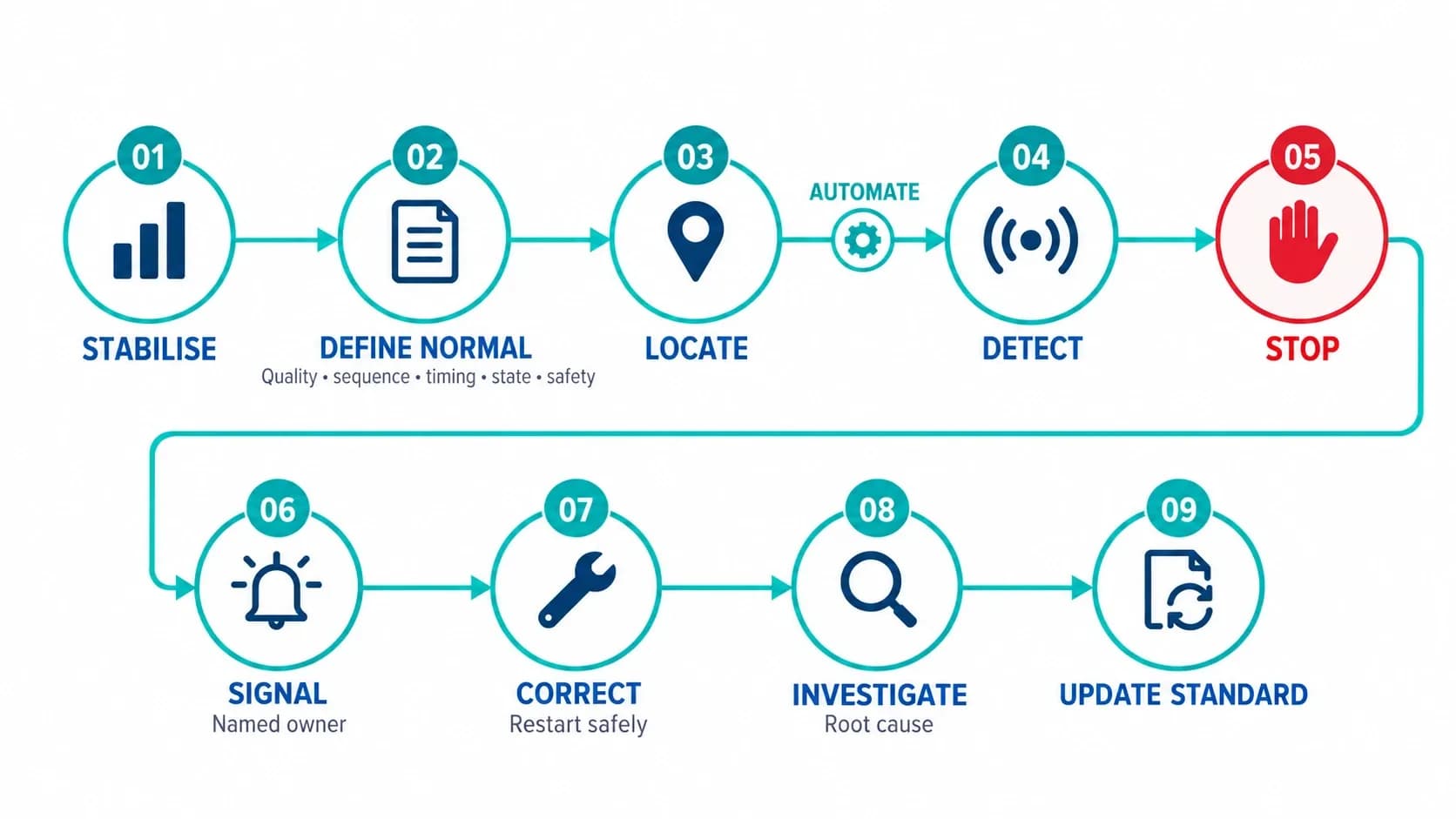
Automate too early and you've automated a broken process. Toyota's rule: stabilise the work first, strip out the waste, define abnormal before you ever build detection into a machine.
- Define normal before you chase abnormal. Quality, sequence, timing, machine state, materials, safety. No clear line, no consistent stop.
- Match detection to the failure mode. Sensors, limit switches, gauges, vision checks, whatever the operation actually needs.
- Every signal needs an owner. Who responds, how fast, what restarts production. A light with no response is just a light.
- Correct the fault, then chase the cause. Fix the line to restart it. Fix the root to stop it happening again.
Where it breaks: automating too soon, thresholds nobody's defined, alerts nobody's built a response for, stops nobody investigates, operators punished for calling it out instead of thanked for it.
Nine steps, one sequence: stabilise, define, locate, detect, stop, signal, correct, investigate, update the standard.
Not whether the stop mechanism exists, but whether the organisation learns from what triggered it. That's embedded Jidoka.
Why stopping the line isn't enough
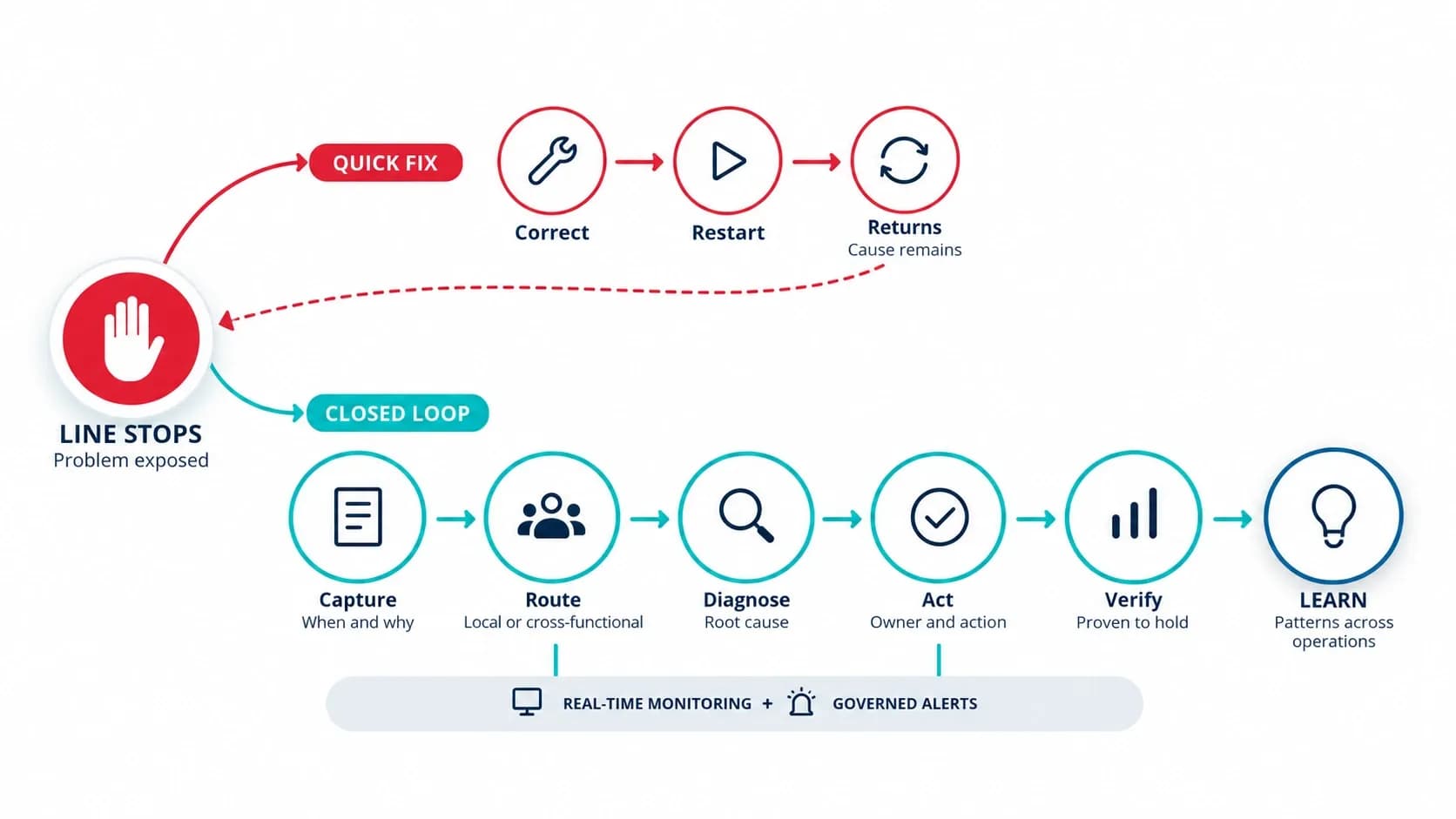
The stop exposes the problem. It doesn't solve it. Work halting the moment something goes wrong makes the cause visible, but visibility isn't the same as elimination. Correct the immediate fault, restart the line, and the root cause can still be sitting there waiting to resurface.
Every detected deviation land as work for the management system, not just the shopfloor. Someone has to sort it, route it, escalate it. Diagnose it. Confirm it's actually closed. A quick fix isn't a countermeasure: it suppresses the symptom, not the cause. The loop only closes once the response has been checked and proven to hold. That's why the same fault can keep resurfacing even where Jidoka is, on paper, fully implemented.
Not every abnormality needs the same response, either. Some get resolved on the spot by the nearest team leader. Others, the recurring ones, the cross-functional ones, need structured review and more than one function in the room. Generic escalation misses both ends of that range.
Real-time monitoring fills in what the stop alone can't: when a threshold was breached, and why. NIST is blunt about this: manufacturers need sensing, data infrastructure and analytics to know both, and that knowledge is what support decisions that cut downtime without sacrificing quality. The alternative, offline diagnosis, is expensive in equipment and in time. Manufacturers want machinery that can assess its own condition while it's still running, not after.
An alert isn't the finish line, either. Alarm-management standards exist precisely because generating a signal is only one part of the job. Alerts have to be defined, designed, installed, maintained, kept meaningful across their lifecycle, or they stop being actionable and start being noise.
Here's the gap, plainly: a line can follow Jidoka correctly at the exact point something goes wrong, and the organisation can still have no wider view of it happening again elsewhere. Stop events, causes, owners, corrective actions, scattered across separate systems or local logs. Individual incidents get resolved. The pattern behind them doesn't get seen.
Real-time monitoring, automated alerts, root cause records, action tracking: not decoration on top of Jidoka, but what turns it from a sequence of isolated stops into one connected operating discipline.
Bringing Jidoka to life with LTS Data Point
Stopping the line exposes the problem. Data Point handles what comes after.
- One environment, not five systems. ERP, MES, QMS, Excel, Power BI, connected. No more manually reconciling what should already match.
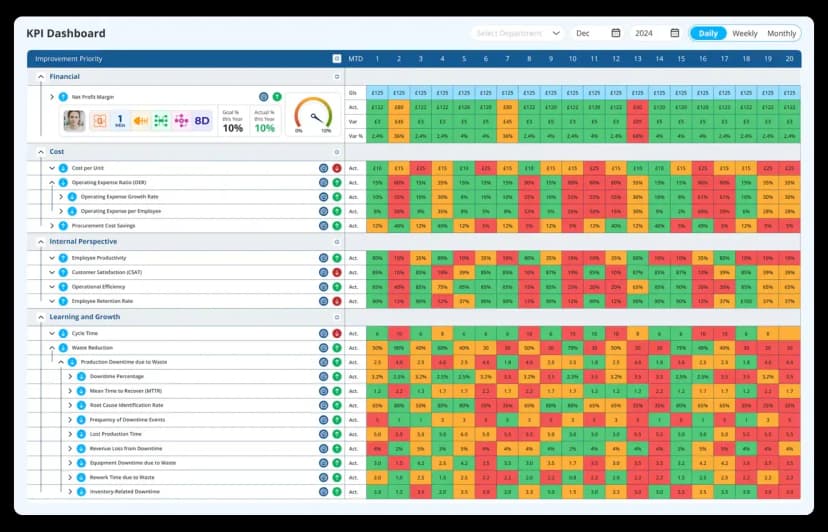
- Trend charts, Pareto analysis, live dashboards. Turnaround time, throughput, bottlenecks, visible before the report gets written, not after.
- Real-time OEE, Takt Timer, hour-by-hour Short Interval Control Boards. The monitoring layer that catches what a single stop cord can’t.
- Breach a threshold, and it routes itself to the right owner. Not a verbal handover. Not someone remembering to flag it.
- Notifications, escalation workflows, role-based dashboards. The problem gets a name and an owner, not an email thread.
- Root cause runs through the 4C workflow. Traceable, timestamped, audited.
- Fishbone, A3, 5 Whys, RCCM, 8D. Structured tools built in, not left to notebooks and memory.
- Every action assigned, tracked, closed. Complex issues followed from containment through to prevention, each stage owned.
Not detecting the defect, not stopping the machine. Data Point doesn't replace Jidoka. It's what carries the problem from the moment the line stops to the moment it's actually solved.
Jidoka was never about stopping machines. It was about refusing to let a defect move forward unnoticed. Toyota built that into a loom. Manufacturers now build it into data: real-time monitoring, automated routing, root cause held through the 4C's. Not a replacement for the stop cord, but everything that has to happen after someone pulls it.
Speak with an LTS Data Point expert about turning shop-floor abnormalities into visible, owned and traceable improvement actions.
FAQs
1. Can Jidoka be used outside automative manufacturing?
Yes. Although Jidoka developed within the Toyota Production System, its principle applies wherever a process can detect an abnormality, contain it and trigger a response. It can support pharmaceuticals, food production, electronics, logistics and administrative workflows.
2. How does Jidoka work in batch and continuous production environments?
Instead of stopping an assembly line, teams may pause a batch, isolate affected material or hold a process at a defined control point. The response depends on the operation, but the objective remains preventing abnormal output from moving forward.
3. Is Jidoka suitable for low-volume, high-mix manufacturing?
Yes. Teams can define acceptable conditions for each product, configuration or process route. Digital instructions, configurable thresholds and appropriate detection methods can help accommodate variation without applying one fixed standard to every job.
4. What metrics can manufacturers use to measure Jidoka effectiveness?
Useful measures include abnormality response time, defects contained at source, repeat incidents, time to close corrective actions, false-alert frequency and defects discovered downstream. The measures should show whether problems are detected early and prevented from recurring.
5. How can manufacturers prevent false alarms from weakening Jidoka adoption?
They should set meaningful thresholds, validate detection methods and review alerts that repeatedly prove irrelevant. If teams receive too many low-value warnings, they may begin ignoring or overriding the system, weakening the response to genuine abnormalities.
6. Is a Jidoka stop the same as an emergency safety stop?
No. An emergency stop protects people and equipment from immediate danger. A Jidoka stop responds to a defined production abnormality, such as a quality defect, missing component, equipment fault or process delay. Separate safety requirements must still be followed.
7. How does Jidoka support regulated manufacturing environments?
Jidoka can help contain abnormal output close to its source and create a structured response. When supported by controlled records, named owners and traceable corrective actions, it can strengthen investigation and audit readiness. It does not replace industry-specific compliance requirements.
8. What leadership behaviours are needed to sustain Jidoka?
Leaders must treat exposed abnormalities as opportunities to improve the process rather than reasons to blame operators. They must also respond promptly, protect employees' authority to raise problems and ensure recurring issues receive proper investigation.
9. Can Jidoka principles be applied to administrative and service processes?
Yes. A workflow can pause or escalate when information is missing, and approval fails or work exceeds a defined threshold. The same logic applies: recognise the abnormal condition, prevent it from continuing unnoticed and involve the right person in resolving it.

Abel Jiménez, Lean Consultant
Abel is a Lean Consultant with over 30 years of expertise in operational analysis, process improvement, and organisational change across Mexican industries. Currently serving as Director of Insurance Promotions at CESCEMEX, he helps organisations leverage technology and lean practices to improve efficiency and manage change with continuity.