Nutraceutical Manufacturing Software: From Compliance Tracking to Performance Execution
Last updated on : April 24, 2026
Passing your next FDA inspection is not the same as running a high-performing plant – yet most conversations on nutraceutical manufacturing software end in compliance. For dietary supplement manufacturers who operate under FDA 21 CFR Part 111 and increasingly demanding retail standards, compliance is the actual foundation.
But what happens after you prove you followed the rules?
Supplement manufacturing performance management begins precisely where compliance software ends, and the gap between the two? It begins where most plants silently lose time, yield, and margin.
See how LTS Data Point gives nutraceutical manufacturing teams real-time KPI visibility across every shift, line, and plant
The compliance burden is real – but it is not a performance strategy
GMP compliance tracking under FDA 21 CFR Part 111 is non-negotiable. The regulation covers certain areas – incoming ingredient identity testing, master manufacturing records, batch production documentation, quality control sign-off, and record retention requirements. Third-party certifications – NSF, USP verification, SQF – add further layers for manufacturers supplying retail and e-commerce channels.
This framework generates significant administrative overhead, which is very important. But it answers just one question:
Can we prove we followed the rules?
It does not say anything about whether each shift hit its output target, whether a batch deviation was caught before it was rejected, or whether your operation is genuinely improving.
Where generic ERP falls short as nutraceutical manufacturing software
The dietary supplement manufacturing software market is full of horizontal ERP platforms built for discrete, uniform component assembly – not for formulation-based production. Manufacturers who still stick onto these platforms end up running into dead ends.
Natural ingredients vary in potency from lot to lot. For example, a botanical extract may test at different assay levels across various batches. This calls in for dynamic quantity recalculations to meet the desired label claim.
Why is this an issue with generic ERP?
Simple. Just as the name suggests, generic ERP generalises all units of an ingredient – treating them the same. This raises a major issue – a fundamental mismatch for supplement production.
This challenge may seem unique to you, but in reality, it isn’t. Pharmaceutical industries also face these issues, which they tackle using the right pharmaceutical manufacturing software. All you need is the right tool.
The gaps compound across other dimensions including:
- Overage management – integrating stability data with formulations to account for shelf-life degradation is not a native ERP function
- Allergen and changeover tracking – validated cleaning verification tied to production sequencing requires dedicated process logic
- Multi-dosage-form production – capsules, tablets, gummies, and powders each carry different yield expectations and in-process quality checkpoints
- FDA-specific batch record workflows – identity testing at receiving, in-process checks, and release sign-off have no natural home in a horizontal platform
The result is the bolt-on problem.
ERP ends up managing inventory and finance. While other important factors such as quality, formulation, and compliance get scattered across spreadsheets, paper records, and other disconnected tools.
Spreadsheet-based compliance in supplement plants is still the norm, which is indeed, a growing operational and regulatory risk.
This brings us to one definite conclusion – generic ERP is not suitable for nutraceutical manufacturing. The fix isn't replacing the ERP - it's integrating a Balanced Scorecard with your existing MES and ERP systems, so scheduling and inventory data flows directly into the daily KPI and compliance tracking that ERP alone can't handle.
What nutraceutical manufacturing software must actually do
The distinction – compliance tracking vs performance execution – is one of the most important concepts for nutraceutical plant operations leaders to note.
Both are necessary. But not interchangeable.
A compliance system defines what needs to happen and records whether it did. Performance execution software ensures it happens correctly, every shift, every batch and gives teams that visibility to act before a quality issue becomes a non-conformance.
How a nutraceutical manufacturing software closes the actual plan-to-actual gap
The plan-to-actual gap widens when production schedule says something should happen but something else is happening on the floor. Every plant has one. The trick is in what you do about it.
High-performing plants manage it actively; others discover it too late.
An effective lean daily management system provides the structure you need – tiered meetings, visual boards, and escalation routines – that turns real-time data into consistent daily action. The foundation for this is of course, a tiered meeting cadence:
- Tier 1 (shopfloor, every shift): A focused 10–15-minute review of the previous shift – safety, quality, output vs plan, and open actions
- Tier 2 (department level, daily): Supervisors address issues escalated from Tier 1 that need cross-functional resolution
- Tier 3 (plant leadership, weekly): Performance trends connect to plant-level objectives and longer-cycle improvement priorities
These meetings are structured around a daily performance review covering Safety, Quality, Cost, Delivery, and People – tracked visually against targets at every tier using an SQDCP board.
Depending on the operational focus, nutraceutical plants often tailor this framework to capture dimensions that matter more in regulated batch environments:
- SQDCM adds Morale dimension – tracking workforce engagement, team satisfaction, and retention indicators that directly affect shift consistency and execution quality
- SQDIP adds Inventory and Productivity dimensions – relevant for monitoring raw material stock levels, ingredient hold status, and overall production throughput against targets
- SQDIC adds Inventory and Cost dimensions – useful where ingredient cost control and batch traceability need to be tracked alongside safety and quality in daily reviews
The operational KPIs nutraceutical manufacturing software should surface daily
OEE, FPY, OTIF, changeover time, shift-to-shift variance, and CAPA closure time are some of the most relevant nutraceutical manufacturing KPIs that drive daily operational decisions in supplement plants. They cover everything from equipment efficiency and batch quality to delivery reliability and compliance responsiveness.
If you need more insight on how you can tackle your issues with the best nutraceutical manufacturing software, check out our recent case study: How Did a Nutraceutical Manufacturer Improve Batch Quality with Digital KPI Tracking
How LTS Data Point delivers performance execution for nutraceutical manufacturers
I now know what I was doing wrong. But I still have questions. For instance, which is the best nutraceutical manufacturing software out there, that caters to my industry’s needs?
If this is the question you’ve landed on right now, then you’re on the right track.
Your organisation’s needs are unique as it depends on factors such as what immediate issues you’re facing, or at what stage the industry is right now. Adopting the exact software your competitor use, doesn’t seem like a wise choice in this case.
The next question then would naturally be:
What does this particular nutraceutical software has to offer my company?
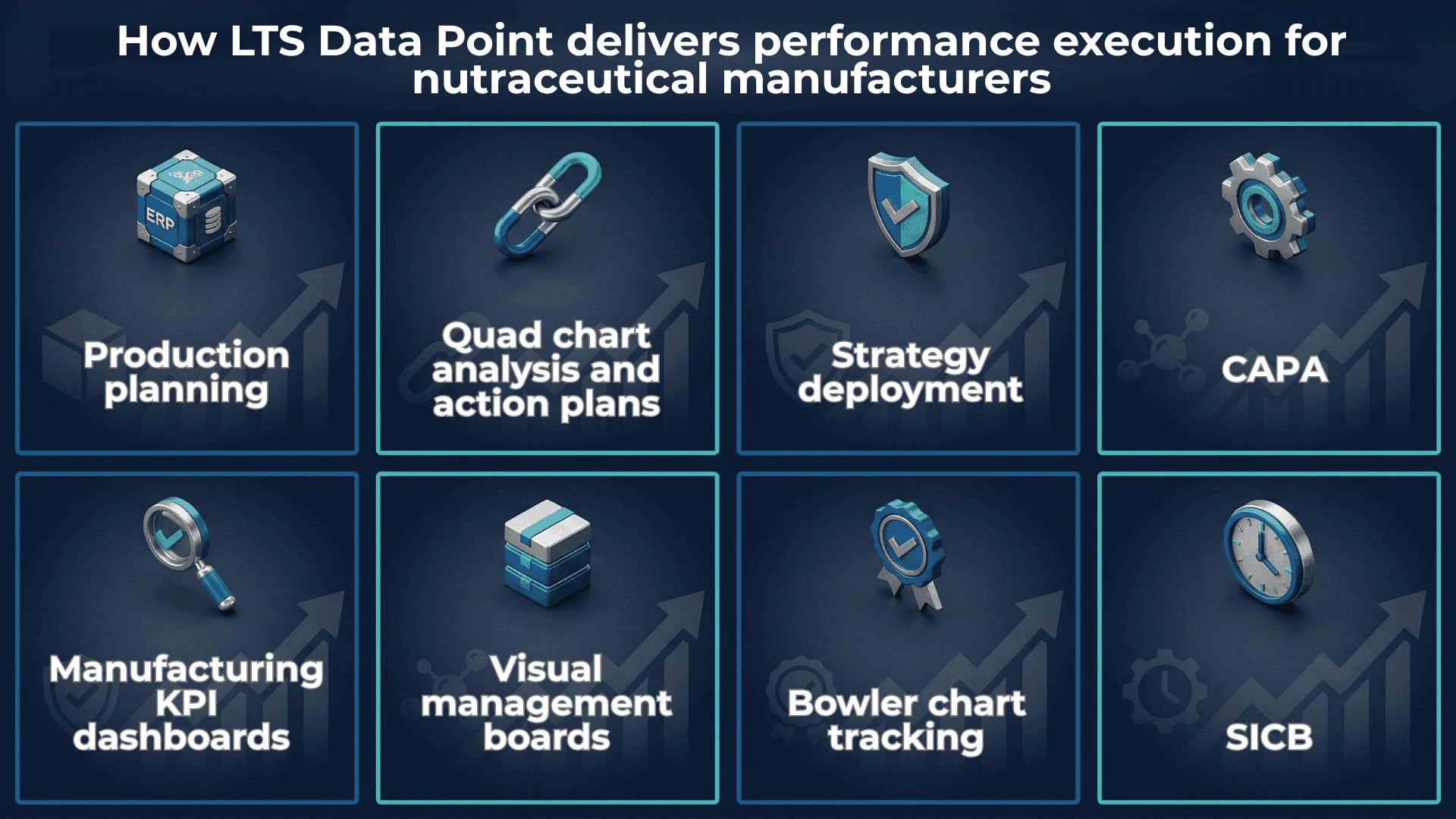
This a question LTS Data Point can easily answer with confidence. LTS Data Point nutraceutical manufacturing software capabilities that align to nutraceutical plant operations include:
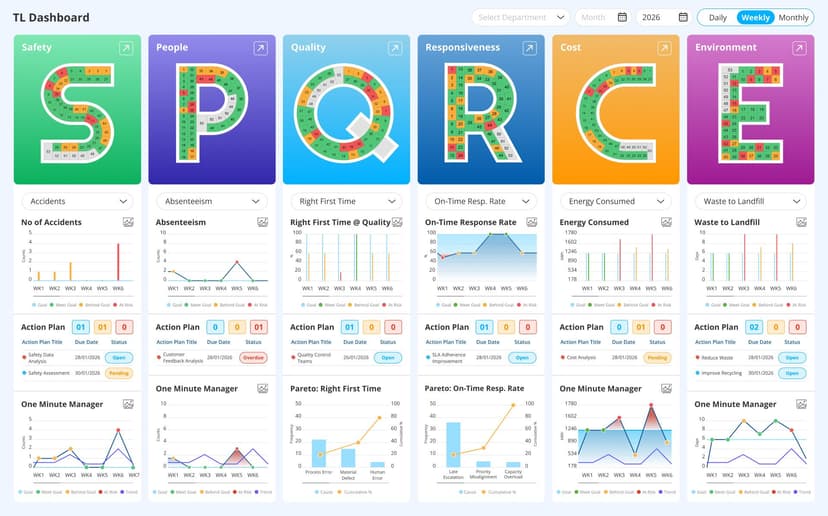
- Manufacturing KPI dashboards - configurable across safety, quality, delivery, cost, and people; visible at shift, line, and plant level simultaneously
- Visual management boards – including SQDCM, SQDIP, and SQDIC frameworks, each adaptable to specific KPI priorities of a nutraceutical plant
- Bowler chart tracking – displaying goal vs actual vs variance across KPI categories on weekly, monthly, and year-to-date views for structured performance review
- CAPA - structured corrective and preventive action workflows that close the loop between quality deviations before they compound
- Short Interval Control Board (SICB) - real-time production monitoring at intervals shorter than a shift, enabling teams to catch and correct batch deviations before they compound
- Quad chart analysis and action plans – combining trend analysis, failure reason tracking, Pareto charts, and corrective action ownership in one structured view
- Production planning – connecting scheduled production orders to live execution data, making plan-to-actual gaps visible in real time across lines and shifts
- Strategy deployment – connecting daily operational KPIs to plant and business-level objectives through visual alignment
LTS Data Point fills the execution gap between compliance documentation and real operational control – ensuring every shift runs to plan, every deviation surfaces immediately, and every team has the information it needs to act. For manufacturers where reactive management in regulated manufacturing is still the norm, that distinction changes what daily operations look like.
Nutraceutical manufacturing software must do more than generate audit-ready records.
In a sector where compliance demands are rising, ingredient costs are high, and retail customers are unforgiving, the gap between tracking compliance and executing performance is where profitability is won or lost.
Manufacturers who close that gap with the right software, structured daily management, and real-time visibility will not just pass the next inspection – they will outperform it.
Your next FDA inspection won't wait — see how LTS Data Point closes the gap between compliance records and real shop floor
FAQs
1. What is the difference between nutraceutical manufacturing software and pharmaceutical manufacturing software?
Nutraceutical manufacturing software focuses on formulation variability, dietary supplement-specific compliance frameworks such as FDA 21 CFR Part 111, and multi-dosage-form production. Pharmaceutical software is built around stricter drug regulatory requirements, clinical validation, and GMP frameworks such as 21 CFR Part 211. The operational and compliance demands differ significantly between the two sectors.
2. How does shift-to-shift performance variance affect batch quality in supplement manufacturing?
When different shifts produce inconsistent results against the same process, it signals gaps in standard work, operator training, or supervision. In supplement manufacturing, this variance directly affects batch composition, yield, and compliance documentation – making it one of the most important metrics to track and reduce at shift level.
3. How many tiers should a daily management system have in a nutraceutical plant?
Most nutraceutical plants operate effectively with three tiers – shopfloor, department, and plant leadership. The number of tiers should reflect the organisational structure and escalation needs of the plant rather than a fixed standard.
4. Can small and mid-sized nutraceutical manufacturers benefit from performance execution software?
Yes. The operational challenges of formulation variability, allergen changeovers, and compliance documentation apply regardless of plant size. Smaller manufacturers often have fewer resources to absorb the cost of yield losses, rework, or inspection failures – making structured KPI visibility proportionality more valuable.
5. How long does it typically take to implement a daily management system in a nutraceutical plant?
Implementation timelines vary depending on plant size, existing data infrastructure, and team readiness. A phased approach – starting with Tier 1 daily reviews and digital visual boards before scaling to full tiered management – typically delivers visible results within the first few weeks.
6. What is the role of Gemba walks in nutraceutical manufacturing performance management?
Gemba walks in a nutraceutical context serve the dual purpose of operational performance verification and compliance observation. Leaders physically reviewing the production floor can confirm that SOPs are being followed, deviations are being captured correctly, and daily management routines are running as designed.